Monday, August 31, 2009

Where in the world did Secretary Clinton vacation?

Photo from US ConGen Bermuda August 20, 2009

Yes, Secretary Clinton went on a holiday and the press had a field day trying to guess if she went to New Mexico, Vegas, or Los Angeles. They tried their guessing game with the Spokesman:

QUESTION: Well, is Secretary Clinton on holiday? She’s not going to New Mexico just - (Laughter.) MR. KELLY: I think I can assure you she’s not going to New Mexico, no. QUESTION: Okay. QUESTION: What exactly was the itinerary that was approved? MR. KELLY: Matt, we don’t go into the details of that. You’ll have to ask the -- QUESTION: Ask the North Koreans? MR. KELLY: Yeah. (Laughter.) QUESTION: Thank you. Were there other stops – were there other stops? MR. KELLY: There were other stops on their -- QUESTION: Two other stops? MR. KELLY: -- proposed itinerary. QUESTION: Yes. Would one of them be a place that’s -- MR. KELLY: There were other stops. QUESTION: -- one of them be a place that North Koreans might not generally be comfortable with going to? QUESTION: Disney World? QUESTION: A little bit north. Are they going to Vegas? MR. KELLY: I’ll repeat, Matt, we don’t go into the details of -- QUESTION: Are they going to Las Vegas? MR. KELLY: You’ll have to ask the North Korean mission, Matt, if they’re going to Las Vegas. QUESTION: What about Los Angeles? MR. KELLY: I believe you’ll have to ask the North Korean mission, Matt.

I don't know if the North Koreans were able to track Bermuda on their map. Above photo showed the Secretary of State and President Clinton with some US ConGen Bermuda's staff a few days ago. The Clintons were with (right-left) Consul General Grace Shelton, Deputy Principal Officer Frank Fulgham and Consul Margaret Pride in Hamilton.

$75 million to run a single PRT is not excessive?

Map from OIG/MERO Report
The State Department’s Office of the Inspector General (OIG) has just released two Iraq-related reports the last few days. One on the Embassy’s transition planning as the Department take on increased roles and responsibilities following the withdrawal of all US forces from Iraq by December 31, 2011 (we’ll get to that in a separate post); the other report is a review of the effectiveness of Regional Embassy Offices (REOs) in Iraq.

Quick background:

"In the summer of 2004, upon the disestablishment of the Coalition Provisional Authority, the Department established Regional Embassy Offices (REO) in the cit­ies of Basra and Hillah in southern Iraq, and Kirkuk and Mosul in northern Iraq.1 In February 2009, REO Kirkuk closed. Most of its functions were transferred to the Regional Reconstruction Team (RRT) located in downtown Erbil. In May 2009, REO Basra was closed and replaced by the Provincial Reconstruction Team (PRT) in Basra. When the OIG audit began in December 2008, three REOs were operating, but as of the date of this report, only REO Hillah is active."
Now - the good news:

"REOs, as diplomatic extensions of Embassy Baghdad, were important in pro­jecting an active USG presence in Iraq’s outlying provinces. REOs effectively served as bases for conducting engagements with Iraqis, reported firsthand on political and economic developments in the provinces, and acted as vital nearby staging areas for personal protection operations.”

The not so good news? These bases for engagement come at a pretty stiff price tag:

"[…] Operating and supporting a forward-deployed USG civilian presence is a challenging and expensive proposition. Due to the unstable security environ­ment in Iraq, REOs depended on private contractors to provide life support and personal protective services. At the time of this audit, there were a total of 265 USG staff members at REO Basra, RRT Erbil, and REO Hillah, and a total of 1,027 life support and personal security contractors — a ratio of nearly four life support and personal security contractors to each USG staff member."

$75 million to run a 37-member PRT. From the OIG report:

REO Hillah was established in June 2004 on the site of the former regional headquarters of the Coalition Provisional Authority for south central Iraq. The south central area is known as the Shia heartland, with the city of An Najaf serving as the capital. Babil Province, south of Baghdad, has a mixed Sunni and Shia population, and is an important transport and fuel network, which creates sectarian volatility. REO Hillah mainly served as a base for five PRTs operating in Babil, Karbala, Najaf, Wasit, and Qadisiyah. However, by early 2008, four of the PRTs in Hillah were trans­ferred to their respective provinces, and REO Hillah supported only PRT Babil.

OIG visited REO Hillah in February 2009, and an interim report was issued in April 2009 recommending: (1) stopping or curtailing all capital improvement proj­ects; (2) relocating PRT Babil and other USG employees to a nearby U.S. Army base; (3) curtailing or transferring REO Hillah security and support staff to other locations in Iraq; and (4) decommissioning and returning the Hillah hotel property to the Government of Iraq. Embassy Baghdad objected to OIG’s recommendation to accelerate the closing of REO Hillah stating that speeding closure and relocation would undermine an existing process moving forward at a measured pace. The Embassy emphasized the need to consider the negative impact on all of the organizations and personnel supported by the REO.

Embassy Baghdad had calculated $55 million in annual security costs at REO Hillah to support approximately 300 personal security specialists and a perimeter guard force. The annual support costs for about 350 KBR employees and locally hired Iraqis was estimated at $20 million. REO Hillah is currently supporting one 37-member PRT, and OIG determined that $75 million in annual operating costs was excessive and an expensive way to support a single PRT. OIG observed that cost savings of $6.5 million a month meant that closure of the REO by May 2009 could result in savings of more than $32 million in FY 2009. In addition to the operating costs, REO Hillah had 10 capital improvement projects underway, including three not yet begun and valued at $1.4 million, four projects that were 15 percent completed leaving $235,000 unobligated, and three projects 25 to 73 percent completed with $643,000 unobligated, adding up to potentially nearly $2.3 million in unexpended funds. OIG has learned that the Embassy has stopped all capital improvement projects at REO Hillah. The Embassy’s contracting officer’s representative, with management support, rejected requests by the site contractor to continue with several proposals, including work on a firing range, procurement of communications systems for fire trucks, and purchase of handheld radios. However, as of July 2, 2009, Embassy Baghdad had not taken any further action toward closing REO Hillah. Therefore, OIG reiterates its recommendation to accelerate the relocation of PRT Babil and the closure of REO Hillah.

The Embassy is understandably concerned about the "negative impact on all of the organizations and personnel supported by the REO." But please let's think about this for a moment. If REO Hillah is supporting a 37-member PRT, that's over $2 million dollars to support each PRT member in that location. The move would be inconvenient for sure, but how much of a negative impact is there going to be if the PRT operation moves to the nearby U.S. Army base as suggested by the OIG? I would have felt much better if Embassy Baghdad quantified that in their response to the report; otherwise, I can't help but agree that $75 million is just a tad much as operation cost for a 37-member PRT.

On a related note -- AFP recently reported that in May this year, the administration projected a 3.998 trillion dollar budget for 2009 with a deficit of 1.841 trillion dollars, reflecting swollen spending amid the worst economic crisis on record. The estimated budget deficit for the current fiscal 2009 ending September 30 will reportedly be trimmed to 1.58 trillion dollars, around 262 billion dollars lower than forecasted. Yay?!

Related Items:

Sunday, August 30, 2009

Insider Quote: Specialist and Generalist

A Wide Receiver catching a ball.Image via Wikipedia

When it comes to distinguishing between the Foreign Service career paths, many officers still give me a blank stare when I mention I'm a specialist and not a generalist. I get the impression that once someone is in a-100 class (generalist's orientation) they never hear about the specialist path. […] I understand American's coming from other agencies serving a tour as an FSO not picking up on it. Everything in the department of state is new to them. I'm talking about regular FSOs that have already worked for several tours. I explain to them the differences in pay, job responsibilities, usually no language training, etc. Invariably, I get asked by post to fill in for officers even though I've never received any generalist training in that regard. I've been a backup for management officers but that usually the norm for an IT person, since we work under that section and learn about it anyway. But my current post has brought up other back-fill positions that I really have no right to do at the expense of my own responsibilities. I'm all about working as a team, but that's like putting a running back into a wide receiver position. You better plan on seeing a few balls get dropped.

Specialist and Generalist From FS Blog: 240to120.com

ConGen Mumbai: Everybody Needs Love

All You Need Is LoveImage via Wikipedia

Sigh! As if life is not hard enough down in the trenches …

A good thing that Judge Paul Friedman of the US District Court of the District of Columbia dismissed this case.

One plaintiff, proceeding in forma pauperis, filed a pro se complaint seeking to compel the issuance of a visa for his fiancée and requesting one million dollars in damages for the allegedly wrongful initial denial of the visa, and for “unreasonable harassment” and denial of civil rights in the process. Compl. at 2. The Court appointed pro bono counsel for the plaintiff and stayed the case to allow the parties time to resolve the matter. The plaintiff’s fiancé has since been issued a visa, and the plaintiff has voluntarily dismissed the U.S. Citizen and Immigration Service as a defendant. See Joint Status Report, July 30, 2009, ¶¶ 2, 4; Order, Aug. 11, 2009 (dismissing the U.S. Citizen and Immigration Service as a defendant).

The plaintiff, however, asks the Court to admonish or sanction the remaining defendant, the U.S. Consul General in Mumbai, India, for its conduct in what plaintiff alleges was delay in the process of obtaining the visa. See Joint Status Report ¶ 5(a). The defendant contends that this Court has no jurisdiction over this matter, there was no wrong-doing by the defendant, the case has become moot with the issuance of a visa for the plaintiff’s fiancée and that therefore, the sole remaining party should be dismissed. See id. ¶ 5(b). The plaintiff has not identified either a cause of action upon which may be based a claim for sanctions, admonition, or damages against the U.S. Consul General for Mumbai, or a basis for this Court’s jurisdiction over such an action. The Court is aware of no such jurisdiction or cause of action. Accordingly, the complaint will be dismissed for lack of subject matter jurisdiction.

But that’s not all. Included in the papers is the Court’s expression of appreciation to Karen Grisez, Esq., and to the firm of Fried, Frank, Harris, Shriver & Jacobson, for its able pro bono publico representation of the plaintiff, who was proceeding in forma pauperis.

In forma pauperis . Someone who is without the funds to pursue the normal costs of a lawsuit or criminal defense.

I know what you’re thinking. How did Romeo get around the I-134 requirement? I mean, if you can’t afford the normal cost of a lawsuit, how can you afford to live with your US-bound fiancée in America? The Affidavit of Support need to show that the sponsor's income is 100 percent of federal poverty guidelines as required under Section 212(a)(4) of the INA. Um, okay, I get it -- somebody else signed the I-134? But if the fiancee becomes a public charge later, would USCIS then turn around and deport her back to her ... hmmn? no? Did I say I'm glad the good judge dismissed this case? But darn, a million US dollars! That would have been as good as a lottery ...

Saturday, August 29, 2009

TED@State: Paul Collier on Rebuilding a Broken Nation

Long conflict can wreck a country, leaving behind poverty and chaos. But what's the right way to help war-torn countries rebuild? At TED@State, Paul Collier explains the problems with current post-conflict aid plans, and suggests 3 ideas for a better approach.

Paul Collier studies the political and economic problems of the very poorest countries: 50 societies, many in sub-Saharan Africa, that are stagnating or in decline, and taking a billion people down with them. His book The Bottom Billion identifies the four traps that keep such countries mired in poverty, and outlines ways to help them escape, with a mix of direct aid and external support for internal change.

From 1998 to 2003, Collier was the director of the World Bank’s Development Research Group; he now directs the Centre for the Study of African Economies at Oxford, where he continues to advise policymakers.

Interactive script here.

From ted.com

Friday, August 28, 2009

Lessons Learned Resources

Lessons Learned. SureImage by Mike Licht, NotionsCapital.com via Flickr

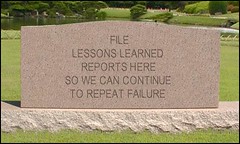
I have put together a compilation of lessons learned resources with some relevance to the State Department and the Foreign Service here. The web page is live in googlepages and will be updated as needed; a new link is added from Diplopundit's Online Resources for easy access (see right side-bar). Any suggestion for additional materials would be deeply appreciated. I also found this Mike Licht image of a lessons learned tombstone. He writes in his blog that "A “Lessons Learned” report is a ceremonial corporate mea culpa that will be swiftly embalmed, buried, entombed in archives, and unread by the next set of leaders, who will embark on similar misguided projects of their own." I hope that is not the case here.

Hard Lessons: The Iraq Reconstruction Experience | Released by SIGIR in January 2009

Hard Lessons concludes with 13 lessons drawn from 6 difficult years of Iraq reconstruction. Virtually all the leadership interviewed for this report agreed that the US approach to contingency relief and reconstruction operation needs reform.

Oral Histories: Iraq Provincial Reconstruction Teams | 2008-2009

The Iraq PRT program has highlighted the challenges that the U.S. government faces in conducting operations in conflicted environments. The Iraq PRT Project collected insights and lessons learned from government, military, and non-governmental officials. Interviews were conducted by the Association for Diplomatic Studies and Training under a contract with the Institute of Peace.

Includes interviews with 72 Government Officials from 2008-2009. There are also several interviews of military officers and NGO personnel.

Provincial Reconstruction Teams in Iraq | Special Report, March 2007

This report examines the U.S. experience with PRTs in Iraq, notes shortcomings, and suggests ways they could be more effective. The report is based on statements by panelists at a public forum held at the Institute on February 14, 2007, and on interviews conducted by the author with government agencies and commercial contract firms that participate in the PRT program. Report is by Robert M. Perito, senior program officer at the United States Institute of Peace.

Oral Histories: The Sudan Experience Project | 2006-2007

Sudan's North-South Comprehensive Peace Agreement (CPA) is a unique example of an effort by the international community to negotiate and to implement a peace agreement. The Sudan Experience Project Oral History Library contains the transcripts of nearly 100 interviews with those who negotiated and who are implementing the CPA. These first person accounts and the lessons learned from their experience are a substantial contribution to our understanding of the challenges of negotiating and implementing complex peace agreements. Includes interviews with 33 Negotiators and 57 Implementers taken from 2006-2007.

Oral Histories: Afghanistan Provincial Reconstruction Teams | 2005 In November 2005, there were 22 PRTs in Afghanistan: nine were directed by the U.S. and countries belonging to the NATO-led International Security Assistance Force directed the other 13. The Afghanistan Experience Project collected lessons learned by Provincial Reconstruction Teams by interviewing 52 government officials, military officers, and representatives of international and non-governmental organizations who had served in Afghanistan. Interviews were conducted by the Association for Diplomatic Studies and Training under a contract with the Institute of Peace.

Includes interviews with 52 Government Officials in 2004-2005. There are also several interviews of military officers (12) and IO/NGO personnel (4).

The U.S. Experience with Provincial Reconstruction Teams in Afghanistan: Lessons Identified | Special Report, October 2005 This report is the product of the United States Institute of Peace's Afghanistan Experience Project. It is based on extensive interviews conducted with American and foreign officials, soldiers, and representatives of nongovernmental organizations that worked directly with Provincial Reconstruction Teams in Afghanistan. It also reflects interviews conducted with a broad range of contacts during the author's visit to Afghanistan in June 2005. The report discusses lessons identified by those who served in Afghanistan. It is intended as a training aid for developing programs that prepare American personnel for service in peace and stability operations. Robert M. Perito, Coordinator of the Afghanistan Experience Project at the U.S. Institute of Peace, prepared this report.

The 9/11 Commission Report | Public report released on July 22, 2004

The National Commission on Terrorist Attacks Upon the United States (also known as the 9-11 Commission), an independent, bipartisan commission created by congressional legislation and the signature of President George W. Bush in late 2002, is chartered to prepare a full and complete account of the circumstances surrounding the September 11, 2001 terrorist attacks, including preparedness for and the immediate response to the attacks. The Commission is also mandated to provide recommendations designed to guard against future attacks.

Joseph T. Cox: Second Tour

The night before Thanksgiving

my son told me he’s going back to Iraq,

again. The first cost him his two best friends

and his CO’s legs. He doesn’t talk about it much.

This time he has go to Fort Riley

for two or three months first.

I told him that after that shit hole,

Iraq might even look good.

His grandfather went to Germany,

got shot twice, came back an angry,

sullen man, still picking shrapnel out of his legs

as he fought the middle-aged battle of the bulge.

I had my time in Vietnam, never shot,

but came back different, or so my

first wife told me before she left.

Every soldier’s war is unique, every minute,

every step, every square foot, even for those

in the same country at the very same time.

My only wish is that my son will find peace,

but I honestly don’t know how to tell him that,

and when I try, it sounds like just one more lie.

Reprinted from War, Literature & the Arts | Volume 20:1&2 | 296

A frequent contributor to WLA, Joseph T. Cox is headmaster of the Haverford School and author of the poetry collection Garden’s Close.

You have no rank, whatsoever ...

Yeah, right.

I was reading Tom Wolfe’s The Right Stuff, first published in 1979 (and more recently published by Picador in 2008) about the test pilots and astronauts at the dawn of the space age. Wolfe wrote that his "book grew out of some ordinary curiosity" about what "makes a man willing to sit up on top of an enormous Roman candle… and wait for someone to light the fuse."

Image of old U. S.Image via Wikipedia

The book is an engrossing read; frankly, reading Chuck Yeager flying the NF-104 is more exciting than watching any teenage-driven demographic movies that populate the cinema these days. The book is also about the wives and the unwritten rules and standards they lived by as they supported their husbands' careers. This was out of the 40’s and 50’s, where wives generally stayed home, and where trailing husbands as a specie, were still unheard of except in the celestial wormholes of Jupiter. I came to page 218 of the book and I had to pause to laugh out loud:

A commander designated to give the wives an orientation lecture says: “First, would you ladies please rearrange yourselves by rank, with the highest ranking wives sitting in the first row and so on the back to the rear: It takes about fifteen minutes for the women to sort themselves out and change their seats, since very few of them know one another. Once the process has been completed, the commander fixes a stern glare upon them and says: “Ladies, I want you to know that I have just witnessed the most ridiculous performance I have ever seen in my entire military career. Allow me to inform you that no matter who your husbands are, you have no rank whatsoever. You are all equals, and you should kindly remember to conduct yourselves as such in all dealings with one another.” That was not the end of the story, however. The wives stared back at their instructor with looks of utter bemusement and, as if with a single mind, said to themselves: “Who is this idiot and what planet has he been stationed on?” For the inexpressible provisions of the Military Wife’s Compact were well known to all. A military officer’s wife rose in rank with her husband and immediately took on all the honors and perquisites pertaining thereto, and only a fool or the sort of simple-minded jerk who was assigned to give orientation lectures to wives could fail to comprehend this.

Despite the absence of a similar Diplomatic Wife’s Compact, the Foreign Service is not altogether different from this. It’s not cultural, mind you. It’s just part of organizational life and the need for the neat ordering of the hierarchy. The next time you are tempted to give an orientation to incoming diplomatic spouses whether here or at post, remember this. And please, for the love of god and gin -- don’t tell them “you have no rank, whatsoever.” They will know the truth soon enough.

Snapshot: US Mission Nigeria

US Embassy Abuja via Facebook

Despite a robust package of incentives, staffing Lagos and Abuja was hard, with many officers in stretch assignments, working out-of-cone, on excursion tours, or on directed first assignments. These staffing woes, an operating budget that was lagging behind program funding, and aging facilities in Lagos reduced the efficiency of diplomatic operations. Both the consulate office building and many U.S. Government-owned residences in Lagos had suffered physical neglect, based partly on the view that operations in Lagos would get smaller when the Embassy moved to Abuja in 2000. This shrinkage is unlikely to happen. Inspection of Embassy Abuja and Consulate General Lagos, Nigeria (ISP-I-08-25A) Excerpted from Office of Inspector General Semiannual Report to the Congress, April 1, 2008 to September 30, 2008 | PDF

Thursday, August 27, 2009

Quote: Non-Portable Rights, Once More

EthiopiaImage by robynejay via Flickr

“When you go to another country, you don’t take your rights with you. As romantic and adventurous as it sounds to spontaneously pack up and travel the globe, when you don’t do your homework, reality can be harsh.”

Rory Linnane From Captured in Ethiopia: An American nightmare The Daily Cardinal - August 26, 2009 (A UW-Madison sophomore recounts her experience being detained and deported from her host country of Ethiopia).

Insider Quote: Running of the Goats ... in Kabul

afghanistanImage by Army.mil via Flickr

"A buddy of my mine was leaving post, and we thought we would give him a fond farewell by procuring four goats and chasing them down the sidewalk in an reenactment of Pomplona's running of the bulls. These four goats were decorated in traditional Afghan jingle truck fashion. Before we could set up the alley for the run, the Mission's security officers (I mean all of them...it was a slow day security-wise) shut us down and forced us to remove the goats from the compound. We told security that we thought the goats were ok because the Gurkas were laughing when we brought them through gate. Furthermore, we took all the necessary security precautions by putting them through the metal detectors. Regardless, security did not want them on the compound...plus our boss was somewhat pissed, and while hiding his chuckle told us to remove the goats. I am sure these are words he thought he would never utter. Once the goats were gone we drank until they reappeared...to us, at least."

Nick in Kabul Running of the … goats From FS Blog: Nick and Liz Go Global

US Suspends Visa Services in Honduras

US Embassy Honduras (Photo from Website)

This is all over the wires now. Ian Kelly, the State Department Spokesman has released a statement on the temporary suspension of non-immigrant visa services in Honduras. The statement dated August 25, 2009 is reprinted below:

WASHINGTON, DC - The OAS Foreign Ministers mission is in Honduras seeking support for the San Jose Accord, which would restore the democratic and constitutional order and resolve the political crisis in Honduras. In support of this mission and as a consequence of the de facto regime’s reluctance to sign the San Jose Accord, the U.S. Department of State is conducting a full review of our visa policy in Honduras. As part of that review, we are suspending non-emergency, non-immigrant visa services in the consular section of our embassy in Honduras, effective August 26. We firmly believe a negotiated solution is the appropriate way forward and the San Jose Accord is the best solution.

Whether what occurred in Honduras was a coup or not is no longer the question. It was. The question that still needs to be resolved is whether this was a military coup or not. A Senior State Department Official on background briefing says: "We have said from the very beginning, what we do know is that the legitimate government, the legitimate president, was taken out of office in a way that was not prescribed, in a way that was unexpected and forced. And we call that a coup, a coup to the head of the government. There are specific – we have laws – there’s a – I forget the exact section of the law that deals with our – the way we can handle assistance and the way we can handle our relationship with a country if there is a military coup, if the person in charge of, leading, and then taking over the government after the coup are the military. And we are examining to determine whether or not that’s the case here."

I'm not sure there is a win part in this scenario for the USG. As one writer puts it, "the dirty little secret known to all Latin American nations is that only Washington possesses the exercisable clout necessary to force outcome on its terms." It has already been been accused of not doing enough, and if it does more, it will be promptly be accused of doing too much. Can't blame them, given the United States history in the hemisphere. How about we let them sort out their affairs on this one?

See some Honduras links below: Go here, if you want to read the Honduran Constitution (in Spanish via Georgetown's Political Database of the Americas). You can also check The world law guide. See Codigo Procesal Penal 2002 (Decreto 9-99-E).

During the background briefing the Senior U.S. official also told reporters that the visa decision was "a signal of how seriously we are watching the situation" and said Washington was considering other steps though it was premature to disclose these. I'm not sure how long this "watching" is going to take. I understand that the Honduran election is not going to take place until late November. So this suspension can last several days, a week, to several weeks, months. Months? The official did say "The United States will not think that this thing will go on forever." Okay -- in the meantime no visas except for emergency ones. In case you're worried that folks there won't have anything to do -- don't. The visa officers in Tegucigalpa will not be sitting around doing nothing. They will most probably be tasked to put live training into their schedule, take online training, go on R&R, get sent on TDY in WHA posts that are still working through their visa peak demands, do a "Chuck It in the Bin" day for days on (that is, clean up their files from top to bottom), write reports, revise SOPs, read the FAM, etc. etc. And for the moment I hope, they will actually have time for coffee breaks, enjoy their drink and not chug it down in a roomful of expectant applicants.

Wednesday, August 26, 2009

Insider Quote: Returning to the Real World

NYC - Battery Park City: Nelson A. Rockefeller...Image by wallyg via Flickr

"At my mandatory “PTSD” course taken right when I got back last month, they described the process that one will experience upon returning to the “real world.” Regardless of who you are, what you do, or where you come from, coming down off of a 13 month adrenaline rush – that is the constant high level stress (both work and environmental stress) – is not an easy feat. They were correct. Irritability, lack of energy, odd emotional responses, hyper alertness, lack of sleep, too much sleep, trouble reconnecting with old relationships, fatigue, restlessness, appetite shifts, stress bursts, irrational responses to loud noises, irrational responses period – are all “normal”. Okay. Good to know I am “normal.” I did ask “how long should it last?” – the response was “if it lasts longer than six months, we encourage you to seek professional help.”

by Erin The next chapter From FS Blog: Overseas View

What do you do with fraudulent naturalizations?

Michael Matza of Philliy.com (August 24) writes about how Citizenship exemption can be abused. Quick excerpt below, read the whole thing here:

Tunisian-born Sofian Khlifi, 34, is a knowledgeable man, college-educated, fluent in Arabic, French, Italian, and English - the type who, presumably, could pass the simple, brief test for U.S. citizenship.

In 2002, five years after arriving in Philadelphia, Khlifi began the process of naturalization. But the consultant he hired to help him apply, Broomall businessman Habeeb Malik, had a curious idea for greasing the skids. He took Khlifi to an osteopath in Media who, after 15 minutes, concluded he had "mental retardation, anxiety disorder, and depression. With a diagnosed learning disability, Khlifi could have become a citizen without having to take the test.

How many immigrants used the shortcut has not yet been determined. However, a federal jury already has found Malik, Ira Weiner, and another Philadelphia-area physician, Thongchai Vorasingha, guilty of naturalization fraud for participating in evaluations of at least a dozen applicants falsely labeled mentally disabled. In court documents, investigators said Weiner had told them he saw up to 150 immigrant clients in three years.

The three, set to be sentenced in October, "exposed a vulnerability" in immigration law, said Andrew McLees, who supervises investigations for Immigration and Customs Enforcement in Philadelphia. "They cheated to get naturalization, which is the golden ticket."

For this golden ticket, all the applicants needed to do was pass the civics and English portion of the test.

For the civics test, an applicant will be asked up to 10 questions from the list of 100 civics questions and answers. Applicants must answer correctly at least six of the 10 questions to pass the civics test. On the English test, there are three components: speaking, reading, and writing. USCIS says: “An applicant’s ability to speak English is determined by the USCIS Officer from the applicant’s answers to questions normally asked during the eligibility interview on the Application for Naturalization, Form N-400. Modifications were made to the reading and writing tests. The sentences included on the new reading and writing tests will not be made publicly available. USCIS released reading and writing vocabulary lists containing all the words found in the new English reading and writing tests. Applicants can use the vocabulary lists to study. Applicants must read 1 out of 3 items correctly to pass the reading test. Applicants must write 1 out of 3 items correctly to pass the writing test.”

Yep, the test is so tough that some applicants pay off somebody to say that they're not right on the head, so they need not have to take the test. Jeez! I mean, the USCIS naturalization test page is here. The July 21 press release from the U.S. Immigration and Customs Enforcement (ICE) screams:

3 convicted in naturalization scheme | ICE and USCIS work together to stop fraud (reprinted in full below):

PHILADELPHIA - Two doctors and a business man were convicted today for their role in a naturalization fraud conspiracy after an investigation by U.S. Immigration and Customs Enforcement (ICE).

Dr. Habeeb Malik, 60, of Broomall, Penn., Dr. Ira Weiner, 59, of Narberth, Penn., and Dr. Thongchai Vorasingha, 73, of Wallingford, Penn., were convicted July 20 by a federal court jury on charges they conspired to make false statements in applications to become U. S. citizens and committed fraud in connection with the applications. Malik was also convicted of filing false tax returns that failed to report hundreds of thousands of dollars in taxable income.

According to court records, Malik owned The Foundation of Human Services in Broomall which purported to assist foreign individuals in becoming naturalized U. S. citizens. As part of the scheme, Malik would refer clients to Weiner and Vorasingha who would "examine" the clients and then complete a U.S. Citizenship and Immigration Service (USCIS) waiver form N-648.

The N-648 waiver is a Medical Certification for Disability Exceptions. The form is intended for applicants for U.S. citizenship who seek an exception to the English and civics testing requirements for naturalization "because of physical or developmental disability or mental impairment."

The waiver forms falsely stated that the applicants suffered from various permanent maladies that impaired their ability to learn English when in fact the doctors knew that the applicants did not suffer from any of these ailments and were not eligible for the waiver. Malik charged his clients approximately $2,000 for this service and paid Weiner and Vorasingha approximately $120 for the "examinations."

"This conviction is the direct result of close coordination between ICE and USCIS," said John P. Kelleghan, special agent in charge of ICE's Office of Investigations in Philadelphia. "What we have been able to do together is expose a conspiracy to defraud the government and put a stop to individuals seeking to exploit our nation's immigration system. This case should put others on notice that ICE and USCIS will continue to work together to combat fraud and restore integrity to our nation's immigration system."

The conviction is the result of an investigation by ICE special agents assigned to the Document and Benefit Fraud Task Force and was conducted in coordination with USCIS.

Weiner and Vorasingha face up to three years in prison. They will be sentenced on October 21 and October 22 respectively. Malik faces up to four years in prison and will be sentenced on October 20. The case is being prosecuted by Assistant U. S. Attorneys Michael Bresnick and Richard Zack.

The funny thing is – there’s no mention on what they're going to do with the naturalized applicants (who I presumed are now, American citizens with punched golden tickets) who availed of these folks’ friendly services. Really - if ICE and USCIS want “to restore integrity to our nation's immigration system,” they can start with these individuals, yes? I see that the revocations of naturalization under INA 340(d) are judicial proceedings. But man, isn't that why the taxpayers have U. S. Attorneys working for them.

7 FAM 1230 APPENDIX D REVISED INA 340 (CT:CON-286; 03-18-2009) says that a. The revised INA 340(a) (8 U.S.C. 1451(a)) reflects that naturalization may be revoked on the ground that the certificate of naturalization was illegally procured or was procured by concealment of a material fact or by willful misrepresentation.”

I'm not a lawyer -- but if an applicant paid these guys $2,150 to get off having to take the naturalization test, and there’s supporting papers that says the exception was due to “physical or developmental disability or mental impairment" when the applicant is actually of able mind and body -- tell me again that such action is not willful and not a misrepresentation.

In a Jeopardy round this would be -- What is the “rule of law”? That’s also Question 12 in the civics booklet, Learn About the United States: Quick Civics Lessons for the New Naturalization Test.

Related Items:

US Embassy Jakarta's FotObama Contest Winners

US Embassy Jakarta via Facebook
US Embassy Jakarta has picked the photo above as winner of its recent FotObama Competition. This was one of my top four picks because I like the Indonesian landmark and hat tweaked into 44's photo with the Capitol Building in the background. Contestant - Dewa Made Cakrabuana Aristokra See all the winners here. I understand that the winner and the runner-ups will get the following prizes: iPod Shuffle, vouchers from Blitz Megaplex and Starbucks, Coca-Cola merchandise, and exclusive U.S. Embassy & Obama gear and memorabilia. The US Embassy Jakarta's Facebook page will also use the best fan picture as its Facebook profile picture. Congratulations all!

Tuesday, August 25, 2009

Quickie: Hillary Clinton, In a New Role of Her Own Making

Hillary Rodham Clinton campaigning, 2007Image via Wikipedia

David Rothkopf, a visiting scholar at the Carnegie Endowment for International Peace and the author of "Superclass: The Global Power Elite and the World They Are Making" and "Running the World: The Inside Story of the NSC and the Architects of American Power," over the weekend asked the following question:

It's 3 a.m. Do You Know Where Hillary Clinton Is?

Rothkopf writes that “She's not answering those crisis calls at the White House. But she's quietly revolutionizing American foreign policy.” Excerpts below:

[…] what is Clinton actually doing? Only overseeing what may be the most profound changes in U.S. foreign policy in two decades -- a transformation that may render the presidencies of Bill Clinton and George W. Bush mere side notes in a long transition to a meaningful post-Cold War worldview.

The secretary has quietly begun rethinking the very nature of diplomacy and translating that vision into a revitalized State Department, one that approaches U.S. allies and rivals in ways that challenge long-held traditions. And despite the pessimists who invoked the "team of rivals" cliche to predict that President Obama and Clinton would not get along, Hillary has defined a role for herself in the Obamaverse: often bad cop to his good cop, spine stiffener when it comes to tough adversaries and nurturer of new strategies. Recognizing that the 3 a.m. phone calls are going to the White House, she is instead tackling the tough questions that, since the end of the Cold War, have kept America's leaders awake all night.

“It is still early, and a president's foreign policy legacy is often defined less by big principles than by how one reacts to the unexpected, whether missiles in Cuba or terrorism in New York. Promising ideas fail because of limited attention or reluctant bureaucracies, and some rhetoric eventually rings hollow, as the self-congratulatory "smart power" already does to me. Nevertheless, there is evidence that, seven months into the job, Obama's unlikely secretary of state is supporting and augmenting his agenda effectively. Not as Obama's "other wife," not as Bill Clinton's wife, not even as a celebrity or as a former presidential candidate -- but in a new role of her own making.”

Read whole thing here.

Things to Pack When You’re Bound for Baghdad

Side view of a B-2 Spirit.Image via Wikipedia

Below is an excerpt from a personal essay by Major Jason Armagost, a graduate of the United States Air Force Academy and the University of Colorado. This was published in 2006 in the War, Literature & the Arts |An International Journal of the Humanities. Full text here. WLA was founded in 1989 and is published by the Department of English and Fine Arts at the United States Air Force Academy. The journal is indexed in the American Humanities Index, Literary Criticism Register, The MLA American Periodical Verse, and the Annual Bibliography of English Language and Literature. WLA is published using government funds; the material published is in "public domain." The Journal’s current and back issues can be accessed here.

Literature is history with the truth left in. —Ralph Peters

Missouri—19 March 2003 | The clock is punched for war in Mesopotamia. Six hours until midnight, the day before the sudden flourish of air combat. I am suited, armed, and briefed for a 20,000 mile flight. The middle 208 seconds of the journey will be over Baghdad. Tomorrow’s strikes will compose the first salvos of “shock and awe.”

Our war-birds are carbon-fiber and titanium Stealth Bombers. They idle, topped with fuel, pre-flight crews tending aircraft systems on the rain-damp tarmac of Whiteman Air Force Base. In the course of the next two days, I will stiffen my backbone against exhaustion and battle with Air Force-issued amphetamines, a half-case of canned espresso drinks, and 40,000 pounds of steel and high-explosive. And books.

The Northrop Grumman B-2A “Spirit” is a flying wing—a 60-year old concept writ lethal in composites and computers. In profile, it is racy—a falcon stooping on distant prey. From the front—a menacing winged whale; from overhead—a wedge-shaped Euclidean study in parallel form. The plane carries aloft a crew of two pilots with the necessary life-support systems—oxygen, heating, air-conditioning, and cockpit pressurization. The pilots sit next to each other in twin ejection seats.

The running joke is that the seats don’t work because you’d rather be dead than face an accident board having crashed a $2,140,000,000.00 national asset.

Satiny charcoal in composition with a smooth, blended body, the B-2 is simultaneously rounded and angular. The skin is exotic and TOP-SECRET. Wing span is 172’, two-and-a-half times the length of 69’ nose-to-tail. It is rare— only 21 were built—but not endangered. It threads the 3-D envelopes of missile defense networks. Stealth has the same effect on defenses as speed, rendering reactions ineffective because they are too little, too late, if at all. This plane will bring us home.

The payload consists of 16 weapons mounted on two, eight-position, rotating launchers in each of the three aircraft of our flight. My primary weapons are 13 one-ton penetrator bombs for hardened targets and runways. The three remaining launcher stations carry the 4617 pound GBU-37 “Bunker Buster.” These two-and-a half ton monstrosities are targeted against deeply buried, steel-reinforced, concrete command centers in a planned effort to “decapitate” Iraq’s leadership.

In the lingo of combat aviators, these bombs will “prosecute” targets. Rarely—unless talking about Saddam or his sons—is killing mentioned. We are distanced. We make “inputs” into a network of flying computers. I manage the ghost in the machine. Our enemies label us the “Great Satan”—moral descendants of the Paladins of Charlemagne, Protector of the One Church. I don’t know if those we aim to liberate call us anything at all. We are armed to strike from the air, over the land, between the two rivers.

I have brought a bag of books and journals to pass the hours of tedium. I am bound for desert places.

[…]

I have supplemented the standard equipment with my own essentials stashed throughout the seven pockets of my flight suit:

3 tubes of Chap Stick, medicated

Toothbrush, floss, and travel toothpaste

1 oz. tin of Bag Balm—cow-udder salve for dry hands

Nail clippers

Aspirin, Acetaminophen, Ibuprofen, Vitamin C, Multi-vitamin,

Immodium, Iodine, Band-Aids, Saline Nasal Spray, Eye-drops

Baby wipes in a plastic sandwich bag

Sunglasses

Swiss Army knife

Duct tape

In a stained and ratty helmet bag I have a small library of books and personal journals:

Heartsblood: Hunting, Spirituality, and Wildness in America

—David Petersen

The Shape of the Journey: New and Collected Poems, and Just Before

Dark: Collected Nonfiction—Jim Harrison

Winter Morning Walks—Ted Kooser

Nine Horses: Poems—Billy Collins

A Timbered Choir: The Sabbath Poems 1979-1997—Wendell Berry

West with the Night—Beryl Markham

Fire Road, and Aftermath: An Anthology of Post-Vietnam Fiction

—Donald Anderson

The Things They Carried—Tim O’Brien

Winter: Notes from Montana—Rick Bass

Burning the Days: Recollection and Dusk and Other Stories

—James Salter

Blood Meridian: Or the Evening Redness in the West

—Cormac McCarthy

The Vintage Book of Contemporary American Short Stories

—Edited by Tobias Wolff

A Voice Crying in the Wilderness—Edward Abbey

The Art of Living and Other Stories—John Gardner

Hunting the Osage Bow—Dean Torges

The Norton Book of Classical Literature—Edited by Bernard Knox

Don Quixote—Cervantes, Starkie translation

Gilgamesh—Translated by Herbert Mason

Thoughts of a Philosophical Fighter Pilot—Jim Stockdale

Wind, Sand, and Stars—Antoine de Saint-Exupéry

The Longest Silence: A Life in Fishing, and Keep the Change

—Thomas McGuane

The Nick Adams Stories—Hemingway

Gray’s Sporting Journal—Aug 2001 & Nov/Dec 2002

The Iliad and The Odyssey—Homer. Robert Fagles translations

Beowulf—Seamus Heaney translation

Four leather-bound journals in various states of wear. At the bottom of the bag, amongst the books:

Stainless-steel Colt 1911A1, .45 ACP with custom night-sights and four loaded magazines—in a nylon chest holster

Four pairs of wool socks, black silk long-johns, three brown undershirts, two pairs of flannel boxer shorts

Blue, fitted-wool, logo baseball cap “YALE—Lux et Veritas

Black & white photo of my wife, son, and daughter

These things, these books, are a measure of security. A redoubt in war. They bring me comfort in their many ways. The books have all been read. That is the point. In the middle of the Atlantic I won’t be interested in the cheap plot-twists of the latest bestseller. I’m in need of art—recklessness, patience, wisdom, passion, and largess. I rifle through the titles, grab five, and return to the seat. We are over Ohio. Me, my books, and the colonel.

[…]

Walking into the local market in my uniform, I avert my eyes from those I suspect will acknowledge me for service to the country. “Thank you for what you do” is difficult to hear. I am confounded by their innocence. I smile and nod—no words.

I am embarrassed because troops are dying and I am here, buying fresh asparagus, wine, and apples. These people are kind and gracious, but I can’t tell them what I have done because I don’t know what’s buried in the bunkers of an ex-tyrant’s palace. I know I left over 36 tons of high-explosive and weapons-grade steel in Iraq. Buildings destroyed, bunkers mangled beyond recognition, airfields once bombed to submission—now in use by our own forces. It is conceivable that I killed no one. It is, however, very unlikely.

I turn back to the words. Words I would like the people in local markets to read and own. Own and live. I read and write and read. Hemingway wrote, “There are worse things than war and all of them come with defeat.” I believe that—but just because one thing is worse than another, it doesn’t make the lesser good. Just less bad.

Once more to Heraclitus, 2600 years ago:

War, as father

of all things, and king,

names few to serve as gods,

and of the rest makes

these men slaves, those free.

Even the free then, are subjects to war, and dying for freedom is easy, at least for the dead.

This is no boast. Killing’s something apart.

I sit on an overturned canoe amongst budding wild rose bushes on the bank of a mountain lake that is named on no map. My son and daughter are fishing for trout and throwing pinecones at mallards. My wife is seven months pregnant. She sleeps on a couch in our small cabin with our youngest daughter. They are warmed by the late-morning sun piercing a picture window. I look up from Victor Davis Hanson’s Ripples of Battle. My daughter beckons me to untangle a snag in her fishing line. I grab my fly rod and stride down the thorny bank to help her. The last paragraph I read before placing the opened book on the boat says:

So battle is a great leveler of human aspiration when it most surely should not be. Stray bullets kill brave men and miss cowards. They tear open great doctors-to-be and yet merely nick soldiers who have a criminal past, pulverizing flesh when there is nothing to be gained and passing harmlessly by when the fate of whole nations is at stake. And that confusion, inexplicability, and deadliness have a tendency to rob us of the talented, inflate the mediocre, and ruin r improve the survivors—but always at least making young men who survive not forget what they have been through.

* * *

A well-read man, one who can also write well, and above all a thoughtful warrior, able to look inward. I don't think we want mindless robots fighting our wars. As I read this essay, I kept thinking of that story from Imperial Life in the Emerald City by Rajiv Chandrasekaran where an Iraqi American interpreter offered to loan a senior CPA staffer a copy of Hanna Natatu’s The Old Social Classes and the Revolutionary Movements of Iraq, a seminal work of regional history, the staffer declined. The CPA staffer told the interpreter that everything he needed was in a small book on his desk. The book turned out to be a tourist guide to Iraq written in the 1970’s (Green Zone, Scene VI). Jason Armagost, now Lt Col Jason R. Armagost, USAF is the Commander of the 13Th Bomb Squadron. He has served as an officer, fighter pilot, and bomber pilot in the active branch of the U.S. Air Force since May of 1992. In 1999, he was competitively selected to fly the USAF's premier B-2 Stealth Bomber. Lt Col Armagost flew the lead aircraft over Baghdad in the opening salvos of Operation Iraqi Freedom in March 2003.

He holds a Master of Arts degree in counseling psychology from the University of Colorado and a Bachelor of Science degree in English from the United States Air Force Academy. This piece is one of the 13 essays included in the University of Iowa collection When War Becomes Personal: Soldiers' Accounts From the Civil War to Iraq (edited by Donald Anderson).

Related Item:

Colorado Springs Independent: First Strike | August 24, 2009

Monday, August 24, 2009

Snapshot: State Dept's Family Member Employment - Part 2

Where are the jobs located?
According to the latest FLO data, 25% of adult family members of USG employees overseas are working inside US missions worldwide (embassies and consulates). The actual number is 2,477 out of the total family member population of 9,817. Below is the the percentage of family members working inside US missions, ranked by geographic bureau Family Members at Post Working Inside US Missions (by geographic bureau):

#1. South Central Asian Affairs - 44% (see SCA countries here)

#2. African Affairs - 39% (see AF countries here)

#3. Near Eastern Affairs – 27% (see NEA countries here)

#4. Western Hemisphere Affairs – 25% (see WHA countries here)

#5. East Asian Pacific Affairs – 24% (see EAP countries here)

#6. European and Eurasian Affairs – 18% (see EUR countries here)

June 2009 State department/Family Liaison Office

Below is the overall ranking by geographic bureau with the percentage of family members working inside US missions as well as those working in the local economy and the self-employed. You will note that except for the switch between EAP (#4) and WHA (#5), the ranking below is identical to the working inside the mission ranking above.

Family Members Working at Post (overall by geographic bureau)

#1. South Central Asian Affairs - 64% (see SCA countries here)

#2. African Affairs - 56% (see AF countries here)

#3. Near Eastern Affairs – 44% (see NEA countries here)

#4. East Asian Pacific Affairs – 37% (see EAP countries here)

#5. Western Hemisphere Affairs – 36% (see WHA countries here)

#6. European and Eurasian Affairs – 32% (see EUR countries here)

The interesting thing is that the South Central Asian (SCA) bureau (covering Afghanistan*, Bangladesh, Bhutan, India, Kyrgyzstan, Kazakhstan, Maldives, Nepal, Pakistan*, Sri Lanka, Tajikistan, Turkmenistan, and Uzbekistan) has the lowest number of family members present at posts (430 individuals) but has the highest rate of employment. (As an aside here -- I should note that Afghanistan and Pakistan are fully unaccompanied assignments as of February 2009 and adult EFMS are only authorized on a case by case basis by “M;” apparently EFMs must secure employment at missions (I’m presuming prior to authorization). In Afghanistan, both the Ambassador’s wife and the Deputy Ambassador’s wife are reportedly working inside the US mission in Kabul.)

On SCA, although not all family members get to accompany their employee-spouses to posts, almost half of those that get to go, are able to work within the mission (44%) or in the local economy (20%).

The most numbers of family members (3,249) according to current data are located in European and Eurasian posts -- at some 30 countries from Albania to the Ukraine. But the EUR bureau has the lowest percentage of employment both inside US missions (18%) and outside (local economy employment is at 14%). Part of this may have to do with language barriers, preference for hiring EU nationals in EU countries, bilateral work agreement restrictions, etc. I can't say for sure. What is clear is if you are heading to a European post, you can expect two things: 1) high standard of living in a good number of posts (also often expensive); and 2) over 2/3 of overall family members will be unemployed during the tour.

I guess in real terms that means -- family members will have time to hang around and have coffee, except that having coffee will be too expensive a past time for many.

Related Item: See Part 1: Snapshot: State Department's Family Member Employment