Sunday, February 28, 2010

Diplopundit’s Blog Index | February 2010


Hillary in Qatar:  From right to left: US Ambassador to Qatar Joseph Lebaron, Ambassador Ali Al-Hajri, Qatar Ambassador to the United States, U.S. Secretary of State Hillary Rodham Clinton, and Ambassador Mohammed bin Khater Al-Khater Director of the Department of Protocol in Doha, Qatar February 14, 2010. [State Department Photo / Public Domain] 


Saturday, February 27, 2010

Learning from the 1960 Chilean Tsunami

The USGS says that the February 27 Chile earthquake occurred at the boundary between the Nazca and South American tectonic plates. Also this: "The two plates are converging at a rate of 80 mm per year. The earthquake occurred as thrust-faulting on the interface between the two plates, with the Nazca plate moving down and landward below the South American plate."

The February 27 shock reportedly originated about 230 km north of the source region of the magnitude 9.5 earthquake of May, 1960 – the largest earthquake worldwide in the last 200 years or more.

The 1960 Chilean Tsunami occurred in the aftermath of that 9.5 earthquake in Chile and spawned a tsunami that engulfed the Pacific Ocean.

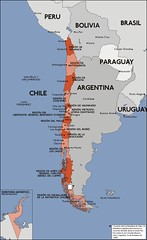
The 1960 Chilean tsunami radiated outward from
a subduction zone along the coast of Chile.
Its waves reached Hawaii in 15 hours and Japan and the Philippines in 22 hours
Map from USGS

  
From Chile the tsunami radiated outward, killing 61 people in Hawaii and 122 in Japan.  The 1960 Chile earthquake ruptured a fault zone along which a slab of sea floor is descending, or “subducting,” beneath the adjacent South American Continent. Such “subduction zones” are formed where two of the tectonic plates that make up the Earth’s outer shell meet. Earthquakes occur when the fault ruptures, suddenly releasing built-up energy. During the 1960 Chile earthquake, the western margin of the South American Plate lurched as much as 60 feet relative to the subducting Nazca Plate, in an area 600 miles long and more than 100 miles wide.

A Tsunami Advisory is currently in effect ( #12 issued 02/27/2010 at 9:58AM PST) which includes the coastal areas of California, Oregon, Washington, British Columbia and Alaska from the California-Mexico border to Attu, Alaska.

CHILE / PERU / ECUADOR / COLOMBIA / ANTARCTICA / PANAMA /
 COSTA RICA / NICARAGUA / PITCAIRN / HONDURAS / EL SALVADOR /
 GUATEMALA / FR. POLYNESIA / MEXICO / COOK ISLANDS / KIRIBATI /
 KERMADEC IS / NIUE / NEW ZEALAND / TONGA / AMERICAN SAMOA /
 SAMOA / JARVIS IS. / WALLIS-FUTUNA / TOKELAU / FIJI /
 AUSTRALIA / HAWAII / PALMYRA IS. / TUVALU / VANUATU /
 HOWLAND-BAKER / NEW CALEDONIA / JOHNSTON IS. / SOLOMON IS. /
 NAURU / MARSHALL IS. / MIDWAY IS. / KOSRAE / PAPUA NEW GUINEA /
 POHNPEI / WAKE IS. / CHUUK / RUSSIA / MARCUS IS. / INDONESIA /
 N. MARIANAS / GUAM / YAP / BELAU / JAPAN / PHILIPPINES /
 CHINESE TAIPEI

The USGS publication, Surviving a Tsunami—Lessons from Chile, Hawaii, and Japan also include eyewitness accounts on surviving the tsunami:

Actions that saved lives, and actions that cost lives, as recounted by eyewitnesses to the tsunami from the largest earthquake ever measured—the magnitude 9.5 earthquake in Chile on May 22, 1960. In interviews several decades later, people in Chile, Hawaii, and Japan recall the tsunami

Their accounts contain lessons on tsunami survival:


US Embassy Santiago: Feb 27 Chile Earthquake Update


The US Embassy in Santiago has released a statement on the earthquake in Chile this morning (as of 11:30 a.m., February 27, EST):

On Saturday, February 27, 2010 at 3:34 a.m. local time, an earthquake with a magnitude of 8.8 on the Richter Scale was recorded off the central Chilean coast.  The epicenter was approximately 70 miles northeast of the city of Concepcion, about 200 miles south of Santiago. 

Strong tremors were felt throughout Chile, including Santiago.  For more technical information on the earthquake, please see the United States Geological Survey website: http://earthquake.usgs.gov/earthquakes/eqinthenews/2010/us2010tfan/

Chile is a one of the most seismically active countries in the world – earthquakes here are not uncommon.  Building construction standards reflect that, but damage is being reported – ranging from light to moderate in Santiago to more severe structural damage closer to the epicenter.

The U.S. Embassy in Santiago is working actively to ascertain the whereabouts of U.S. citizens, both official and unofficial -- through our warden network -- and local Embassy staff.  No Embassy casualties have been reported at this time.  American citizens in the United States seeking information on whereabouts of U.S citizens in Chile may call the U.S. State Department in Washington, D.C. at 1-888-407-4747.  American citizens in Chile may call 56-2-330-3476.

We have reached out to the Government of Chile and stand ready to provide assistance as requested. 

We extend our heartfelt condolences and prayers to the people and residents of Chile who are confronted with this disaster. 

For the latest U.S. State Department information see:  http://www.state.gov/headlines/137379.htm

To use the Chile Earthquake Person Finder function directly, see:
http://chilepersonfinder.appspot.com/


You might want to check the USGS: World Earthquake Information by Country/Region.  Knowing what to do to prepare for an earthquake, what to do during an earthquake and what to do after an earthquake is critical. Please read the Emergency Preparedness for Earthquake from the US Embassy in Chile.


The Embassy is on Facebook, Twitter, Flickr and YouTube (click the preceding links to check them out).  Its Facebook and Twitter pages seem to have current updates (with Facebook 5 minutes ago, and Twitter 3 hours ago).  To view some photos of the earthquake, check out Cryptome


Video of the Week: Hans Rosling on Asia's rise -- how and when


Hans Rosling was a young guest student in India when he first realized that Asia had all the capacities to reclaim its place as the world's dominant economic force. At TEDIndia, he graphs global economic growth since 1858 and predicts the exact date that India and China will outstrip the US.


from ted.com

2014?  2048?


Related Posts:

Friday, February 26, 2010

US ConGen Matamoros Closes Reynosa Consular Agency due to Gun Battles

The US Consulate General in Matamoros has issued a Warden Message on February 24, 2010:


This Warden Message is being issued to advise U.S. citizens of recent gun battles in Reynosa, Mexico, and cities surrounding Reynosa in the last week.  Several gunfights are believed to have involved narcotics trafficking organizations. The U.S. Consulate General in Matamoros has restricted the travel of American officials to Reynosa until further notice.  The Consulate General also has temporarily closed the Reynosa Consular Agency until further notice.  The Consulate General in Matamoros advises U.S. citizens to take the above information into consideration when making any decisions concerning traveling to or within Reynosa.  The Consulate General also advises U.S. citizens to stay current with media coverage of local events.

Read the whole thing here. 

The Consulate General in Monterrey has also issued a Warden Message urging Americans to avoid travel not only to Reynosa but also to Nuevo Laredo.

Due to several gun battles in Reynosa and Nuevo Laredo, Tamaulipas, in recent days, the U.S. Consulate General in Monterrey urges all U.S. citizens to avoid travel to those cities.

There were reports of ongoing gun battles in Nuevo Laredo starting at International Bridge #2 on the evening of February 19, and later moving into other parts of the City of Nuevo Laredo.  Throughout February 22 through 23, there have been gunfights or rumors of gunfights in various parts of the City of Nuevo Laredo.  There have also been confirmed gunfights in the city of Reynosa.  Gunfights in Nuevo Laredo are believed to have involved the Mexican Army and narcotics trafficking organizations. 

Read the whole thing here.

Read the updated State Department Travel Alert on Mexico Security here.


Related Items:
22 Feb 2010 | Travel Alert: Mexico


SFRC Clears 10 State Department Nominees

Also clears nominees for ADB, IBRD, USTDA and IMF


The Senate Foreign Relations Committee cleared the nomination of the following State Department nominees as well as nominees for related agencies on February 24.  Reported by Mr. Kerry without printed report.

Donald E. Booth, of Virginia, a Career Member of the Senior Foreign Service, Class of Minister-Counselor, to be Ambassador Extraordinary and Plenipotentiary of the United States of America to the Federal Democratic Republic of Ethiopia.

Scott H. DeLisi,of Minnesota, a Career Member of the Senior Foreign Service, Class of Minister-Counselor, to be Ambassador Extraordinary and Plenipotentiary of the United States of America to the Federal Democratic Republic of Nepal.

Beatrice Wilkinson Welters, of Virginia, to be Ambassador Extraordinary and Plenipotentiary of the United States of America to the Republic of Trinidad and Tobago.

David Adelman, of Georgia, to be Ambassador Extraordinary and Plenipotentiary of the United States of America to the Republic of Singapore.

Harry K. Thomas, Jr.,of New York, a Career Member of the Senior Foreign Service, Class of Minister-Counselor, to be Ambassador Extraordinary and Plenipotentiary of the United States of America to the Republic of the Philippines.

Allan J. Katz, of Florida, to be Ambassador Extraordinary and Plenipotentiary of the United States of America to the Portuguese Republic.

Ian C. Kelly, of Maryland, a Career Member of the Senior Foreign Service, Class of Minister- Counselor, to be U. S. Representative to the Organization for Security and Cooperation in Europe, with the rank of Ambassador.

Brooke D. Anderson,of California, to be Alternate Representative of the United States of America for Special Political Affairs in the United Nations, with the rank of Ambassador.

Rosemary Anne DiCarlo, of the District of Columbia, a Career Member of the Senior Foreign Service, Class of Minister-Counselor, to be the Deputy Representative of the United States of America to the United Nations, with the rank and status of Ambassador Extraordinary and Plenipotentiary, and the Deputy Representative of the United States of America in the Security Council of the United Nations.

Judith Ann Stewart Stock, of Virginia, to be an Assistant Secretary of State (Educational and Cultural Affairs), vice Goli Ameri, resigned.


AFRICAN DEVELOPMENT BANK
Walter Crawford Jones, of Maryland, to be United States Director of the African Development Bank for a term of five years, vice Mimi Alemayehou.

INTERNATIONAL BANK FOR RECONSTRUCTION AND DEVELOPMENT
Ian Hoddy Solomon, of Maryland, to be United States Executive Director of the International Bank for Reconstruction and Development for a term of two years, vice Eli Whitney Debevoise II, term expired.

UNITED STATES TRADE AND DEVELOPMENT AGENCY
Leocadia Irine Zak, of the District of Columbia, to be Director of the Trade and Development Agency, vice Larry Woodrow Walther, resigned.

INTERNATIONAL MONETARY FUND
Douglas A. Rediker, of Massachusetts, to be United States Alternate Executive Director of the International Monetary Fund for a term of two years, vice Daniel D. Heath, term expired.

Three other nominations are still entangled in the Senate awaiting final vote:

Laura E. Kennedy, of New York, a Career Member of the Senior Foreign Service, Class of Minister-Counselor, for the rank of Ambassador during her tenure of service as U.S. Representative to the Conference on Disarmament. (Reported out of SFRC on Dec 08, 2009).

Eileen Chamberlain Donahoe, of California, for the rank of Ambassador during her tenure of service as the United States Representative to the UN Human Rights Council. (Reported out of SFRC on Dec 08, 2009).

Islam A. Siddiqui, of Virginia, to be Chief Agricultural Negotiator, Office of the United States Trade Representative (USTR), with the rank of Ambassador, vice Richard T. Crowder. (Reported by Mr. Baucus, Committee on Finance on Dec 23, 2009).


Quickie: Large Broom Still Needed at the State Dept

Patricia H. Kushlis of WhirledView has a follow up on her Large Broom post (see “ System in Need A of a Large Broom”) from a couple months back:  Large Broom Still Needed. Quick excerpt below:


[M]y “Large Broom” post has been widely read not only in the confines of the State Department (by several thousand people) but also on Capitol Hill and throughout the larger foreign affairs community. Nothing I wrote has been challenged. Au contraire. In reality, what I wrote at the time could be the tip of a Titanic-sized iceberg, just as were the complaints raised at State’s most recent Town Hall with the Secretary.
[…]
As I’ve said earlier and I will say so again, the State Department has long had the reputation for having highly competent officers, but a very weak administrative structure. The system has traditionally rewarded a small number of senior level Foreign Service Officers who essentially clawed their way up through a very competitive, secretive, convoluted system and an overly hierarchical structure. The Foreign Service Act of 1980 made it worse. After the Cold War’s end, the Act was used throughout the 1990s to shrink the Department wholesale, forcing out too many hard language trained officers just at the peak of their careers.

To compensate for the personnel losses that never should have happened, private contractors recruit from the very pool of skilled but forced-out retirees to -- guess what -- staff Foreign Service positions in the Department. I know any number of highly experienced retirees who have either worked in State for a contractor or been brought back directly as temporary employees year upon year. There’s one thing about bringing back a temporary worker with the expert skills to ease a temporary shortage. But year after year?

This is not only bad management, but lends itself to the sort of abuse we see now by senior career officials in HR and elsewhere, who have brought back cronies who were senior administrative officials in days gone by and who are now ensconced in positions of influence. Positions of influence where -- because of special dispensations available only to the privileged few -- they are receiving not only their full pensions but good salaries as well.

But there are other serious State Department Human resources problems that need fixing. Here are two: 1) an all too pervasive attitude from the top down that the employee is always wrong; and 2) the lack of a functioning system of personnel oversight.

Read the whole thing here.

Patricia has written previous about management issues in Foggy Bottom; see her other posts below:     


Related Post:

HRC with Ambassador Hill and General Odierno

U.S. Secretary of State Hillary Rodham Clinton meets with U.S. Ambassador to Iraq Chris Hill and General Ray Odierno, Commanding General, Multi-National Force-Iraq, at the Department of State in Washington, DC February 19, 2010.

 [State Department photo / Public Domain] 


Insider Quote: Condensing Life to 7000 lbs

"Not yet having been to post, I still cannot comment on the life overseas. That being said, I like to be frank about these things in case you are reading this blog trying to decide if the Foreign Service is for you. Personally, this was one of the best choices I have ever made. However, trotting the globe is not so simple as hopping on an airplane. You'll live out of temporary apartments and hotel rooms enroute to that plush, exotic locale, and once you get there you'll have just enough time to get settled before you have to pull chocks and go somewhere else. You have to condense your life and the lives of your family members down to 7000 pounds and then further condense it down to a few hundred pounds that will get you through until the 7000 pounds of your life catch up to you in Timbuktu. For me, it is an adventure. Shucking off hundreds of knick-knacks and unnecessary belongings is like shedding skin to me. For others, it is not a stable existence and therefore stressful."


The Warpiper
FS Blog: The Warpiper - Tooting My Own Horn
(Foreign Service Officer, former cop, gun and bible clinger, player of the Great Highland Bagpipe, Southerner with a capital S, malt whisky drinker, and Tater's Dad. (....and Mrs. Warpiper's undocumented worker) **Any occasional ranting and raving should be considered the product of the mind of a irritable hillbilly, and not to be associated with the official policies of the U.S. Department of State or the United States Government).


Thursday, February 25, 2010

Revisiting the Global Repositioning Dance er Program

You remember Condi Rice’s Global Repositioning Program? Of course, you do! Most especially if you were in the middle of language training and suddenly heard that you’ve been repositioned. Well, it wasn’t you, really. It wasn’t personal.  One day you were learning Dutch, the next thing you know that position in Brussels had been moved to Shanghai. What were they thinking? Heck if I know! I understand that you end up taking that GSO position in Country X?  Really, they did not speak Dutch there?  I also heard that you absolutely refused to talk about that “learning” experience? I’m really sorry it went down like that. Don't you just hate it when you get a program with a nice name and no juice to fire up the truck? How do you get from point A to point B is beyond me.   

Anyway, I see that the OIG has posted some new reports online. I was actually looking at the compliance follow-up review of US Mission Brazil (not as riveting as the 2008 report, I tell you) when sitting under it is another report on the OIG inspection of US Embassy Brussels from 2009. I scrolled through the report and what do you know – the report actually talked aboutt the GRP (also known as the Foreign Service’s Half-Baked Fiasco)! Excerpt below:         

Officer losses due to the Global Repositioning Program (GRP) initiative hit the political and economic sections particularly hard and caused their consolidation. The new joint section is responding well to the ongoing integration process, but reporting has been reduced.

Embassy Brussels has been forced to reduce its work on economic and political issues since the 2004 inspection. The GRP, which shifted Foreign Service resources to posts in China, India, and elsewhere, eliminated two political and economic officer positions in Belgium. The downsizing no longer justified separate economic and political sections, each of which had been led by an FS-01 counselor. The Embassy combined the two sections under a single political-economic counselor at the FS-01 level in 2008 and eliminated the second FS-01 position.

In addition to the counselor, two political officers, an economic officer, and two LE staff members make up the political-economic section, augmented by frequent short-term interns. The Embassy has recommended in its MSP, the addition of a third LE position to help its efforts in furthering bilateral cooperation in counterterrorism and terrorist financing, and in fostering Belgian development assistance to Afghanistan and Africa. The OIG team sees merit in this request. Once an entry-level officer (ELO) position is restored to the section in the summer of 2009, it will return to roughly the right size. Another ELO is expected in the summer of 2010.

So – just to get this straight in my head – two political and economic officer positions in Belgium were repositioned a couple or so years back. One position was restored to Brussels in 2009. Another one will be restored in the summer of 2010. How many other posts out there that lost officers under the GRP have now regained those officer positions?    

I do wonder - what do you call this kind of fun exercise? There must be a word appropriate for such programs, they roll on, then they roll back (or roll of the cliff). Would “ro-ro” programs be acceptable?          
      

Related Item:

Related Posts:


“Focused Reorganization” of the “T” Bureau is On

Laura Rozen over at Politico talks about the proposed restoration of the arms control bureau (State moves to restore arms control bureau): 

Following a GAO report blasting a 2005 reorganization of the State Arms Control and International Security bureau, the State Department’s "T" bureau is circulating plans and soliciting feedback on a proposed reorganization of the bureau to beef up its arms control focus and staffing.

Undersecretary of State for Arms Control and International Security Ellen Tauscher held a town hall meeting this morning to kick off the effort which over a 100 employees attended. The memo is also being circulated on the Hill.
[…]
The bureau has about 600 employees in three divisions – Verification, Compliance and Implementation (VCI) headed by Assistant Secretary of State for Arms Control and Verification Rose Gottemoeller; International Security and Nonproliferation (ISN), currently lead by acting Assistant Secretary Van Van Diepen; and Political-Military Affairs (PM), headed by Assistant Secretary of State for Political-Military Affairs Andrew Shapiro.
[…]
The proposed re-vamp would essentially move more arms control people and functionality to Gottemoeller’s shop, which would be renamed “Arms Control, Verification and Compliance,” (from the Bolton-era VCI, sans the arms control, of which Joseph and the past administration were largely skeptical). It would also move a fewer number of people from Gottemoeller’s division to ISN, the more sanctions and verification-oriented shop. (State is supporting veteran arms control hand Steve Mull, currently an aide to Under Secretary of State for Political Affairs Bill Burns, for the A/S ISN job, but the appointment is still languishing at the White House). Pol-Mil would be unaffected by the proposed changes.

“The specific muscle movements between bureaus and rationalization of offices … would be small, targeted and discreet,” the State Department official said.

Josh Rogin of The Cable has more on this in Clinton rolls back Bolton-era arms control shakeup (FP | February 24):
Secretary of State Hillary Clinton on Wednesday announced plans to reorganize the "T" bureau at the State Department, seeking to roll back changes made by former Under Secretary John Bolton during George W. Bush's presidency.

Under Secretary of State for Arms Control Ellen Tauscher, who leads the T bureau, explained the rationale in a town-hall meeting with about 200 staffers Wednesday morning.

"Arms control, verification, compliance, and nonproliferation will no longer be starved for resources; quite the contrary, these missions along with our political-military efforts will be adequately resourced and well-staffed with first rate professionals," she told her personnel. "The proven and time-tested tools of arms control have been seriously underutilized, if not neglected, by the United States, and nonproliferation efforts have at times lacked focus and follow-through. This dysfunctional approach culminated in the 2005 reorganization."
[…]
The 2005 reorganization consolidated three bureaus into two, joining arms control and nonproliferation together into the ISN bureau, in what was then touted as a streamlining measure. A 2009 GAO report said that State was never able to demonstrate that the changes produced any benefits. Current officials saw the move as a way to marginalize both efforts.

HRC’s letter to the “T” staff and management says: “We are undertaking a focused reorganization of the Bureau of International Security and Nonproliferation and the Bureau of Verification, Compliance, and Implementation. The goals of this reorganization are to realign the missions of the VCI and ISN bureaus to better leverage their support for key national security objectives and to create dedicated organizational advocates for (1) arms control and verification and compliance, and (2) nonproliferation.”

I have written previously about the “T” bureau in 2009.  I don’t know what to say – be prepared to move desk?


Related Post:


Quote: The Diplomat’s Life: Controlled Schizophrenia

In the novel Mathews recounts a truism of diplomatic life which his friend McAuliffe has told him: "It's a kind of controlled schizophrenia, the diplomat's life," he (McAuliffe) said. "You wonder which side of the brain you really want to live in, the public one or the private one."


by James Thomas Snyder
The Consul's Wife
W.T. Tyler, Henry Holt, 1998
hardcover, 216 pages


HRC Pitches for Proposed State Dept Budget

HRC appeared before the Senate Appropriations Subcommittee on State, Foreign Operations, and Related Programs (Washington, DC | February 24, 2010) on the President's Proposed Budget Request for Fiscal Year 2011 for the Department of State and Foreign Operations. Excerpt below:


Our fiscal year 2011 request for the State Department and USAID totals $52.8 billion. That’s a $4.9 billion increase over 2010. Of that increase, $3.6 billion will go to supporting efforts in “frontline states” – Afghanistan, Pakistan, and Iraq. Other funding will grow by $1.3 billion, and that is a 2.7 percent increase, and with that money we will address global challenges, strengthen partnerships, and ensure that the State Department and USAID are equipped with the right people, the right technology, and the right resources.
[…]
Let me just highlight three areas where we are making significant new investments. First, the security of frontline states.

In Afghanistan, this past year, we have tripled the number of civilians on the ground, and this presence will grow by hundreds more with the $5 billion in this budget. Our diplomats and development experts are helping build institutions, expand economic opportunities, and provide meaningful alternatives for insurgents ready to renounce violence and al-Qaida and join their fellow Afghans in the pursuit of peace.

In Pakistan, our request includes $3.2 billion to combat extremism, promote economic development, strengthen democratic institutions, and build a long-term relationship with the Pakistani people. This includes funding of the Kerry-Lugar-Berman initiative. Our request also includes a 59 percent increase in funding for Yemen, to help counter the extremist threat and build institutions there as well.

In Iraq, we are winding down our military presence and establishing a more normal civilian mission. Our civilian efforts will not and cannot mirror the scale of the military presence, but they rather should provide assistance consistent with the priorities of the Iraqi Government and the United States. So our request includes $2.6 billion for Iraq. These are resources that will allow us to support the democratic process, ensure a smooth transition to civilian-led security training and operational support. These funds will allow civilians to take full responsibility for programs, and the Defense budget for Iraq will be decreasing by about $16 billion – and that’s a powerful illustration of the return on civilian investment.
[…]
None of what we intend to do can be accomplished if we don’t recruit, train, and empower the right people for the job.

The State Department and USAID are full of talented and committed public servants, but we have too often neglected to give them the tools they need to carry out their missions on the ground. And rather than building our own expertise, we have too often relied on contractors, sometimes with little oversight and often at greater cost. This budget will allow us to expand the Foreign Service by over 600 positions, including an additional 410 for the State Department and 200 for USAID. It will also allow us to staff the standby element of the Civilian Reserve Corps, which is a crucial tool in our efforts to respond to crises.

Now, while deploying these personnel generates new expenses in some accounts, it will reduce costs by changing the way we do business. As we are ending our over-reliance on contractors, we’re actually showing we can save money, plus bringing these functions inside and improving oversight and accountability.

Video of her appearance before the Subcommittee is here.

Full text of her testimony is here.


Wednesday, February 24, 2010

Twitter Diplomacy in Russia

The US Embassy in Moscow has now posted a photo of Ashton Kutcher with Ambassador Beyrle during the US Innovation Delegation trip to Russia. Neither of them identified in this photo:


from US Embassy Moscow


From the US Embassy Moscow:  U.S. Innovation Delegation Arrives in Russia | February 17, 2010

A combined public private delegation of leaders of major American technology and social media companies has arrived in Russia and will be here through February 23.  The purpose of their trip is to bring together these leaders with representatives of the Russian government, universities, private companies, and non-governmental organizations.  They will discuss how social media and other innovative technologies can be used to strengthen and broaden ties between the United States and Russia, and how these technologies can be used to develop knowledge-based societies and economies in both our countries.  This trip is part of the broad dialogue launched by the Bilateral Presidential Commission created by Presidents Obama and Medvedev in July 2009.

The delegation is being led by Jared Cohen from the Secretary of State’s Policy Planning staff and Howard Solomon of the National Security Council.  White House Chief Technology Officer Aneesh Chopra will also participate. They are joined by leaders of major American technology and social media companies, including EBay, Twitter, Cisco Systems, Howcast, EDventure, Social Gaming Network, Mozilla, Katalyst non-government organization, and the New York Academy of Sciences.

The delegation will be travelling to Moscow and Novosibirsk.

The delegation is also on Twitter: http://twitter.com/search?q=%23rustechdel

He may be unnamed in that embassy photo but the most popular member of the delegation and the one with the most Twitter followers is no other than Ashton Kutcher aka aplusk in twitterworld. At the time of this writing, aplusk has 4,569,942 followers. That makes him the most followed user on Twitter and he, of course, tweeted about the trip:

To join us live in the room hashtag #rustechdel we are talking transperency

How can the Russian government use technology to create transperency in practices #rustechdel 7:29 AM Feb 22nd via Twitterrific

Hanging with a room of Russian startups. Any advise for them #rustechdel

Meeting with Russian NGOs about human trafficking and exploitation of children. #rustechdel
  

Reactions from tweetworld:

ImSoNotinDC @aplusk Or transparency. We're giving so much away nowadays, don't let the Russians beat us in spelling, too. #rustechdel #snarkiness

jaredcohen Headed to airport after #RusTechDel Successful trip w/21 deliverables in education, anti-trafficking, health, anti-corruption, e-gov

nvnino RT @vlad_chernyshov @iponomarev NYTimes just didn't understand the purpose of #rustechdel. It's a pity.

holly_hole RT @pro4pro: Ashton Kutcher's (@aplusk) cup from Starbucks. Starting price 100$. http://bit.ly/bN3gxj Money will go for russian innovations:) #rustechdel about 17 hours ago from web

nickwilsdon Ashton Kutcher @aplusk follower count on Feb 10 was 4,505,387, so he picked up around 65k followers on the #rustechdel trip


Related Item:


A New Embassy for the Future. In London. For $1 Billion

The architecture firm founded in Philadelphia in 1984, KieranTimberlake has been selected to design the new embassy building in London.   TSB over at The Skeptical Bureaucrat has a piece about the future digs: Design Concept Selected for New U.S. Embassy LondonBelow is an excerpt from the official statement:

“KieranTimberlake’s design met the goal of creating a modern, welcoming, timeless, safe and energy efficient embassy for the 21st century. Their concept most fully satisfied the requirements outlined in the design competition’s mission statement. The concept holds the greatest potential for developing a truly iconic embassy and is on the leading edge of sustainable design. KieranTimberlake is an architectural firm known for its commitment to innovation and environmental responsibility.”

The anticipated ground breaking on this embassy will be in 2013 with a goal to complete the construction in 2017.


© KieranTimberlake/studio amd

Adam Namm, acting director of the Bureau of Overseas Buildings Operations, was quoted in the press estimating the cost of the new embassy at about $1 billion _ "in the ballpark of the most expensive embassies we have built."

Wouldn’t this be the most expensive?  We are updating our list of the top most expensive US embassies in the world:

#1 US Embassy London – Estimated at $1Billion (2013-2017)
#2 US Embassy Islamabad – Estimated at $670-830 million (pre-solicitation out)
#3 US Embassy Baghdad – $736 million
#4 US Embassy Kabul – approximately $590 million (and counting)
#5 US Embassy Beijing - $434 million (thank you TSB!)

Somebody please tell me which embassy occupies the 5th place or I won’t get any sleep over this. Moscow?  Nah, the one built in the 80’s was for $190 million (plus reportedly $20-$40 million to get rid of bugs, er security flaws). But -- if they build a new one there, it might rival London in cost since Moscow is one of the most expensive cities in the world.  Tokyo would also definitely be an expensive design-build project because it is not just one but THE most expensive city; just don't know if a NEC is in its near future. The 5th place.... help meeeeee!       


Related Post:

Related Items:
New U.S. Embassy in London | KieranTimberlake
An Embassy for the Future | http://www.newusembassy-london.co.uk/