Tuesday, November 30, 2010

Interpol issues Red Notice for WikiLeaks' Julian Assange

Interpol, the international police organization, has issued a global arrest warrant Red Notice for WikiLeaks' Julian Assange. Interpol's Red Notice "seek the arrest or provisional arrest of wanted persons with a view to extradition."

It looks like the 39-year-old Australian who is known as the founder of WL was added to Interpol's "wanted" list for alleged "sex crimes" committed in Sweden this year on 1 December 2010.

See the screen capture of the notice below:

Follow link for original Red Notice


Meanwhile, BBC  reports that Ecuador has offered the WikiLeaks founder residency in that country.

Deputy Foreign Minister Kintto Lucas said his country's government wanted to invite Mr Assange to Ecuador to give him the opportunity to speak publicly, saying "We are open to giving him residency in Ecuador, without any problem and without any conditions."

Read more here.

Mr. Assange could do worse.  Ecuador has beaches and mountains and used the US dollars for its currency. If he should accept the offer, he should beware of the "secuestro express" or at least has money put aside for taxi kidnapping ransom money. Crime is a severe problem, nonetheless since he is the government's guest, he probably will be provided a guard or two. But unfortunately, no protection against its 19 potentially active volcanoes, half already showing signs of activity.


Update on the Red Notice:

Mark Leon Goldberg at the UN Dispatch (probably the only full time blogger to ever have worked at Interpol he says),   explains "What An “Interpol Red Notice” Actually Means":

A Red Notice is NOT an international arrest warrant.  Likewise, there are no such thing as globe trotting Interpol police officers who can execute arrest warrants.  Rather, the Red Notice is simply a request for the arrest and extradition of an individual for whom an arrest warrant has been issued in the requesting country.

Some countries routinely ignore notices; some countries treat the Red Notice as good as an arrest warrant itself; some countries require further action before arrest and extradition.  It is really up to national authorities to decide how they treat the Red Notice.  But from a law enforcement perspective, it does have the advantage of the quick and reliable global distribution of the basic fact that an individual is wanted for arrest in an Interpol member state.  (And it should be noted that Interpol does turn down requests for Red Notices in cases that seem overtly political, though Assange has claimed this prosecution is politically driven.)

In addition to the potential for wide police cooperation, it is also my understanding that there is some diplomatic advantage to issuing a Red Notice.  That is because some countries have Red Notices built into extradition treaties, so having a Red Notice may help to expedite the extradition of wanted persons.

Sweden presumably has these kinds of extradition treaties with a number of countries. And if Assange is arrested by police in any country with this kind of treaty with Sweden, his extradition may be expedited in some way.

Read his entire post here.


We stand corrected. Corrections appended above.


Chicago politics diplomatic reporting? "Don't write if you can talk; don't talk if you can nod; don't nod if you can wink"

Via FP | Stephen M. Walt, 'Don't Write if You Can Talk...': The latest from WikiLeaks

"But there is a real downside, which is why I retain some concerns about this latest batch of revelations. If diplomats start fearing that any conversation or cable might get leaked, they will either stop talking, stop taking notes, or stop sending message back to headquarters in any sort of republishable form. There's an old line from Chicago city politics: "Don't write if you can talk; don't talk if you can nod; don't nod if you can wink." Somehow, I'm not sure our diplomacy will be enhanced if our representatives are reduced to making facial gestures, and communicating back home only through secure telephones."

We hope no one is going to start having ideas about using Morse code in wink mode. That would be very bad.

As John Brown writes for HuffPo: [T]he cables demonstrate:
--American diplomats can write. If you read the missives -- and, granted, no way I could read them all -- they provide strong evidence that Foreign Service officers (FSOs) construct solid, logical, and detailed analyses that (if not always correct) are thoughtful and carefully crafted. Compare them to the instant, superficial reporting of the mass media, and you can see the importance of diplomatic dispatches not only for giving Washington the background and nuance to a given situation, but also for providing a reliable historical record of major global events.

--American diplomats are not naive, an all-too-frequent characterization of US officials by their foreign counterparts. FSOs, as their candid, sometimes critical portraits of their overseas contacts suggest, strive to be subtle judges of character; of course, they are not always right, but they are intelligently seeking to understand, as best they can, the nature of their foreign interlocutors, and their reporting demonstrates it. Far from permanently embarrassing the U.S., the WikiLeaks disclosures may, in fact, result in increasing respect overseas for American diplomats, as their communications to headquarters (now made public, regrettably or not) demonstrate they seek to be insightful observers, and are not gullible country bumpkins who believe everything they hear.

--American diplomats are not inhuman automatons but have a sense of irony and humor. To cite one example, the Moscow US Embassy's characterization of Putin and Medvedev -- Batman and Robin -- is not only funny, but may end up in the history books as a "catch-the-moment" way to describe this odd, sinister duo.

On the negative side, the WikiLeaks's damage from a US perspective may be that:

--Some foreign officials may be offended by how they were "treated" in the cables.
[...]
--American Embassy contacts overseas, especially dissidents, will be reluctant to stay in touch with US diplomats for fear of being revealed to local authorities.
[...]
--American diplomats will no longer provide candid assessments in classified communications to Washington, for fear of being "exposed."
The State Department may urge FSOs not to "write it down," but "say it over the secure phone." Or not say it at all. That is the greatest danger: silencing our diplomats.

On the whole, though, the WikiLeaks episode is not a disaster for America from a public diplomacy or "behind closed-doors" diplomacy perspective, so long as diplomats are not "shut up" by a State Department overly concerned about future leaks.

Read the whole thing here.

John Brown is a former senior FS officer. He also writes the John Brown's Public Diplomacy Press and Blog Review, Version 2.0


Monday, November 29, 2010

Ambassador Philip Murphy: "I'm a big boy ....the buck stops with me..."

The US ambassador in Berlin, Philip Murphy "discusses his views of Chancellor Angela Merkel, Foreign Minister Guido Westerwelle and his incredible anger over the leak of the diplomatic cables" with Spiegel.  Germany's Spiegel, of course, is one of the 3-5 media establishments given first dibs over the diplomatic cables leaked by WL. Excerpt below:

"One of the core responsibilities of a member of the State Department foreign service -- in any embassy and certainly in Berlin -- is to report. In most cases, it is a moment in time, a piece of a puzzle, a scene from a movie. We try to piece things together over time. The people we have in Berlin are among our very best and we have some of the very best reporting officers in the world."
[...]
"I'm a big boy. At the end of the day, the buck stops with me. I worry about my people. They have done nothing wrong. I am not going to apologize for one speck of what they've done."


You gotta love this guy.


Hillary Clinton on cable leak: American diplomats are doing the work we expect them to do

Secretary of State, Hillary Rodham Clinton addressed the embassy cable leak at the State Department on November 29, 2010 @ 1pm EST. Excerpt:

.... I can say that the United States deeply regrets the disclosure of any information that was intended to be confidential, including private discussions between counterparts or our diplomats’ personal assessments and observations. I want to make clear that our official foreign policy is not set through these messages, but here in Washington. Our policy is a matter of public record, as reflected in our statements and our actions around the world.
[...]
I want you to know that we are taking aggressive steps to hold responsible those who stole this information. I have directed that specific actions be taken at the State Department, in addition to new security safeguards at the Department of Defense and elsewhere to protect State Department information so that this kind of breach cannot and does not ever happen again.
[...]
There have been examples in history in which official conduct has been made public in the name of exposing wrongdoings or misdeeds. This is not one of those cases. In contrast, what is being put on display in this cache of documents is the fact that American diplomats are doing the work we expect them to do. They are helping identify and prevent conflicts before they start. They are working hard every day to solve serious practical problems – to secure dangerous materials, to fight international crime, to assist human rights defenders, to restore our alliances, to ensure global economic stability. This is the role that America plays in the world. This is the role our diplomats play in serving America. And it should make every one of us proud.


Full text of HRC's Remarks to the Press on the Release of Confidential Documents


The downside to better information-sharing: the human factor aka rotten apple with a security clearance

Via WaPo by Ellen Nakashima: With better sharing of data comes danger: Excerpt

The American intelligence community came under heavy criticism after Sept. 11, 2001, for having failed to share information that could have prevented the attacks that day. In response, officials from across the government sought to make it easier for various agencies to share sensitive information - effectively giving more analysts wider access to government secrets.
[...]
"One of the consequences [of 9/11] is you gave a lot of people access to the dots," said Jeffrey H. Smith, a former CIA general counsel. "At least one of the dots, apparently, was a bad apple."

While WikiLeaks has not identified the source of the more than 250,000 cables, suspicions have centered on a 23-year-old Army private, Bradley Manning, who was also the suspected source of the military intelligence documents from Iraq and Afghanistan.

In a series of chats with an online companion, Manning said this spring that "*someone* i know" - apparently a coy self-reference - had gained access to 260,000 State Department cables from embassies and consulates around the world "explaining how the first world exploits the third, in detail."

"Hilary Clinton [sic], and several thousand diplomats around the world are going to have a heart attack when they wake up one morning, and finds an entire repository of classified foreign policy is available, in searchable format to the public," he said.
[...]
To prevent further breaches, the Pentagon announced Sunday it had ordered the disabling of a feature on its classified computer systems that allows material to be copied onto thumb drives or other removable devices. (Manning reportedly told an associate that he once copied data onto a CD labeled as Lady Gaga music.)

The Defense Department will limit the number of classified systems from which material can be transferred to unclassified systems. It will also require that two people be involved in moving data from classified to unclassified systems.

Such efforts "should have been done long ago before any of this happened," said Steven Aftergood of the Federation of American Scientists. The rush to knock down so-called "stove-piping" without hardening operational security "was asking for trouble," he said.
[...]
A former senior intelligence official said that over the past decade access to Siprnet has ballooned to about 500,000 or 600,000 people, including embassy personnel, military officials from other countries, state National Guard officials and Department of Homeland Security personnel.
[...]
He said that the answer to network breaches is not to restrict access but to improve the vetting of personnel by strengthening the clearance process.

"The fact that you've got someone exfiltrating information doesn't mean you've got a technical problem," he said. "You've got a human problem."

Read the whole thing here.

The FS blog, Dead Men Working has an item here on the the leaks and security clearance.

We must confess that we fell off our horse when we read this item above: "Pentagon announced Sunday it had ordered the disabling of a feature on its classified computer systems that allows material to be copied onto thumb drives or other removable devices."

Even after the previously war log leaks, the Pentagon only ordered the disabling of this function yesterday?

Holy mother of goat and all her wingnut nephews!
    
Elsewhere in the interwebs, it has been reported that Hillary Clinton has "ordered" FSOs to spy on diplomats in the UN, because see there's a cable out there with her name at the bottom.

Ughh! Are they saying that she wrote all those cables that have her name on it?  Really? But ALL cables coming out of the State Department when the Secretary of State is not traveling will have "CLINTON" as sign-off signature, approved through multiple layers of the alphabet soup, functional and regional bureaus, etc. She does not actually write them, dudes. And when she is traveling, the sign-off signature changes to whoever is in charge of the building, like "STEINBERG" or "BURNS" (since new D/MR "NIDES" has not been confirmed yet).Yes, that building has a life of its own.

The same is true with the embassy cables. The leaked cables were the transmitted ones; they usually do not include the names of the writers.  And like the State Department cables, they all have the embassies' chiefs of missions in the sign-off lines. Does it mean the ambassador is XYZ country wrote all those cables? Goodness, no! Would they be able to go anywhere else or do anything else if they were all tied to their desks?

We suspect that this leak will have several repercussions on process, access and and more, and most probably for the short term, make the embassy reporting jobs more difficult than they already are (Already, OMB under newly confirmed director, Jack Lew has issued a Nov 28 memorandum on WikiLeaks and the Mishandling of  Classified Information).  But after reading some of the published cables, we feel that this is middle bad, not top bad. That could quickly change if anyone, including sources named in these cables end up in a pickle, i.e. gets whacked.  Richard Haass, the president of the Council on Foreign Relations did call the leak "somewhere in the middle" when asked to rate this "diplomatic disaster" whether "bad, not so bad, or somewhere in the middle." 

Benedict Brogan, the Daily Telegraph's Deputy Editor writes about the embarrassment of the leak which we thought makes some sense: 
[H]owever much the Guardian, the New York Times and Julian Assange assure us that this represents a shattering blow to every assumption we hold about foreign relations, the fact remains that it’s a collection of little substance that will do nothing to reshape geo-politics. The Saudis would like someone to whack Iran? No kidding. Afghanistan is run by crooks? Really? Hillary Clinton would like to know a lot more about the diplomats she is negotiating against? You surprise me. The Russian government may have links to organised crime? Pass the smelling salts, Petunia. The Americans are secretly whacking al-Qaeda operatives in Yemen? What, you thought the Yemenis were doing it? Muammar Qaddafi has a full time, pneumatic Ukrainian ‘nurse’? Nice one. Diplomats are terrified of Pakistan’s nukes? Me too. And so on, ad infinite boredom. Perhaps something better will pop up, but nothing I’ve read since last night’s surprises.
[...]
Effective diplomacy involves all the transgressions Wikileaks is exposing. Embarrassment is just the consequence of exposure. Perhaps the more sophisticated response is to stand firm, to assume a degree of worldiness from those involved in the world of diplomacy (who will for example enjoy seeing the US Secretary of State squirming about her UN spying operation, but only because theirs hasn’t been exposed as well), and to accept that occasional embarrassment is an occupational hazard in a 21st century marked by vast quantities of information circulating in all too accessible digital form.

True. Dat.  It's not totally technology or system error, but also user error, the human factor aka: the rotten apple with a security clearance syndrome. Should information sharing now take a back seat for fear of rotten apples with thumb drives?  

Former diplomat and Wilson Center scholar Aaron Miller writes that "The republic will survive the WikiLeaks brouhaha; but there's a lesson here for all of us: whether you're in Washington or Kabul, think and think hard before you draft." We agree about the survival of the republic but -- do we really want our diplomats to be more politically correct than be brutally candid when reporting to our policy makers? What used would that be to our decision makers? 


And here the cables are called "insulting [to] world leaders." You should read what foreign diplomats wrote about George W. and our congressional leaders.  Oh, right, you can't -- those are all in secret diplomatic channels going overseas, too.  Secret for now until WL gets there.

We do think that in the future, it would be nice if there's a well tested fire extinguisher right over there before somebody shouts the order to bring the "stove-pipe" walls down.      

In any case, to those who are shocked, shocked at reading these leaked cables -- a simple perspective on the diplomatic tradecraft:  The foreign diplomats in WashDC, the UN in NYC and elsewhere around the United States are there for the view. Really.


Update @ 8:31 pm.

The Secretary of State has just completed her 1pm EST press appearance addressing the leaks. We will post video/text here as soon as they are available.


Sunday, November 28, 2010

New FS Blog: Former FS Brat writes about FS Brat 2.0

Four Globetrotters is "the (most likely) incoherent ramblings of a sleep-deprived single mother living overseas with her trio of kiddos." The blog is by a Foreign Service Officer who have almost 10 years with State, "currently live overseas in a country which for now shall remain unnamed." She also has the distinction of being a former FS brat (brat used in a good way) or third culture kid now looking at FS kids growing up in the white glare of the web 2.0 galaxy. Excerpt below:


Foreign Service Brats -- That Was Then, This Is Now

I'm an old school Foreign Service brat.

In some of the places where I grew up we only got mail every couple months.  We didn't have a telephone.  We didn't have cable.  We didn't have internet.

Our social lives consisted of other families at post and our classmates at school.  If we wanted to talk to each other we'd use our radio and everyone and their mother would listen in ("Gunsmoke Alpha, this is Cherry Bravo.  Would you like to come over for a Sierra Lima Echo Echo Papa Oscar Victor Echo Romeo, over?").
[...]
When I was a kid, you left post and you knew that was it.  You said your goodbyes, you grieved, and you moved on and focused on your next post, your next school, your next set of friends.  Now with the Internet, Skype, Vonage, Facebook, Twitter, APO/DPO, etc making it much easier to stay connected, you can maintain a virtual presence pretty much anywhere in the world.
[...]
What I'm seeing around me, both with my own children and the children of some of my colleagues, are much longer "transition periods".  Thanks to Facebook and Skype primarily, the FS Brat 2.0 clings to his or her past and refuses to see the possibilities in front of them.  They're bogged down in an information overload, emotions pulled between the past and the present -- loyalties are questioned.  Are you betraying your friends at post X by going out and building a life in post Y?

It's like pulling a bandaid off s-l-o-w-l-y and suffering the pain over a longer period of time.  Or to be even more dramatic, it's like dating again after your spouse has died.  Are you betraying your spouses' memory by going out and continuing to live your life?  Except in the case of the poor FS Brat 2.0 their "spouse" never dies; he or she just lingers on life support forever.
[...]
My heart really goes out to this new generation.  At least when I was a kid the bandaid was yanked off as soon as the plane went wheels up.

Radio? what's a radio?  She's a fun read.  See the whole thing here.

And while you're visiting her blog, do not/not miss reading her story on why you must be kind to your OMS.


251,287 Embassy Cables: Spill at C Street's Cable Factory and Worldwide, too...

(updated 11/30 CNN item added)

Perhaps Germany's Spiegel put it best: "Never before in history has a superpower lost control of such vast amounts of such sensitive information."

Spiegel writes:  "With a team of more than 50 reporters and researchers, SPIEGEL has viewed, analyzed and vetted the mass of documents. In most cases, the magazine has sought to protect the identities of the Americans' informants, unless the person who served as the informant was senior enough to be politically relevant. In some cases, the US government expressed security concerns and SPIEGEL accepted a number of such objections. In other cases, however, SPIEGEL felt the public interest in reporting the news was greater than the threat to security. Throughout our research, SPIEGEL reporters and editors weighed the public interest against the justified interest of countries in security and confidentiality."  Read The US Diplomatic Leaks | A Superpower's View of the World

How did this happen?  See How 250,000 US embassy cables were leaked from guardian.co.uk:

It was childishly easy, according to the published chatlog of a conversation Manning had with a fellow-hacker. "I would come in with music on a CD-RW labelled with something like 'Lady Gaga' … erase the music … then write a compressed split file. No one suspected a thing ... [I] listened and lip-synched to Lady Gaga's Telephone while exfiltrating possibly the largest data spillage in American history." He said that he "had unprecedented access to classified networks 14 hours a day 7 days a week for 8+ months"

See Live Updates on reactions from around the world.

The NYT has a Selection From the Cache of Diplomatic Dispatches here with a note on the redacted text:
"A small number of names and passages in some of the cables have been removed by The New York Times to protect diplomats’ confidential sources, to keep from compromising American intelligence efforts or to protect the privacy of ordinary citizens."

In its Note to Readers: The Decision to Publish Diplomatic Documents, the NYT also writes:
"But the more important reason to publish these articles is that the cables tell the unvarnished story of how the government makes its biggest decisions, the decisions that cost the country most heavily in lives and money. They shed light on the motivations — and, in some cases, duplicity — of allies on the receiving end of American courtship and foreign aid. They illuminate the diplomacy surrounding two current wars and several countries, like Pakistan and Yemen, where American military involvement is growing. As daunting as it is to publish such material over official objections, it would be presumptuous to conclude that Americans have no right to know what is being done in their name.

In the coming days, editors and reporters will respond to readers on the substance of this coverage and the decision to publish. We invite questions at askthetimes@nytimes.com."


Here is an exceprt of NYT's Cables Shine Light Into Secret Diplomatic Channels

The 251,287 cables, first acquired by WikiLeaks, were provided to The Times by an intermediary on the condition of anonymity. Many are unclassified, and none are marked “top secret,” the government’s most secure communications status. But some 11,000 are classified “secret,” 9,000 are labeled “noforn,” shorthand for material considered too delicate to be shared with any foreign government, and 4,000 are designated both secret and noforn.

Many more cables name diplomats’ confidential sources, from foreign legislators and military officers to human rights activists and journalists, often with a warning to Washington: “Please protect” or “Strictly protect.”

The Times has withheld from articles and removed from documents it is posting online the names of some people who spoke privately to diplomats and might be at risk if they were publicly identified. The Times is also withholding some passages or entire cables whose disclosure could compromise American intelligence efforts.
[...]
Traditionally, most diplomatic cables remain secret for decades, providing fodder for historians only when the participants are long retired or dead. The State Department’s unclassified history series, entitled “Foreign Relations of the United States,” has reached only the year 1972.

While an overwhelming majority of the quarter-million cables provided to The Times are from the post-9/11 era, several hundred date from 1966 to the 1990s. Some show diplomats struggling to make sense of major events whose future course they could not guess.
[...]
To read through them is to become a global voyeur, immersed in the jawboning, inducements and penalties the United States wields in trying to have its way with a recalcitrant world.

Read the whole thing here.

How many media establishments out there would willingly walk away from a chance to read through/publish  secret and sensitive conversations/analyses transmitted through diplomatic channels?  Um, zero? one. (CNN declined a last-minute offer to discuss advance access to some of the documents because of a confidentiality agreement requested by Wikileaks that CNN considered unacceptable).

How many meeting appointments can our diplomats expect to confirm this week? Um, none?

This looks a lot "worser" than the BP oil spill.  If a clean up is possible over this very slicky event, does State has somebody better than a Tony Hayward to tackle the job? 

On a related note, the Legal Adviser to the State Department Harold Hongju Koh responded to WikiLeaks' letter dated 26 November 2010 via the U.S. Ambassador to the UK, Louis B. Susman.   The letter was released over the weekend. See the text of the letter here. Given that the release has now occurred, shouldn't we expect an arrest warrant for Mr. Assange for violating US laws? Mr. Holder?


Related post:
Web abuzz with possible nightmare at C Street | Saturday, June 12, 2010


Friday, November 26, 2010

Social Media: The Real Life Social Network

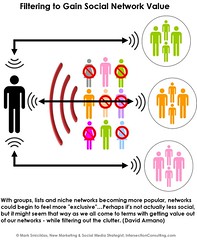
Filtering to Gain Social Network ValueImage by Intersection Consulting via Flickr


Paul Adams works as a Senior User Experience Researcher at Google. He is the research lead for sociability, and work with teams building products and features for the social web. He previously worked as a User Experience consultant at Flow and as an Industrial Designer at Dyson.  For the data behind the presentation below, Adams writes that "I’m truly standing on the shoulders of others. For the most part, I’ve taken other people’s research and synthesized it, looking for patterns and trying to figure out how it all relates together."  Tons of links here - from mapping people's real social life and Adams' research from 2007 to the magic number of 150.

This is about seven  months old and quite long, but is quite interesting especially if you are working the social media beat.


Check out Paul Adams' blog at http://www.thinkoutsidein.com/blog/ and also here http://padday.posterous.com/


Thursday, November 25, 2010

Thanksgiving Roundup: Around the Foreign Service

November 24, 2010 - Community Thanksgiving Lunch
New Zealand


US Ambassador David Huebner during the Thanksgiving lunch
Photo from US Embassy New Zealand
From US Embassy New Zealand: A traditional American Thanksgiving lunch was held at the Wesley Church Hall on November 24, 2010. The lunch a joint effort, with the U.S. Embassy, Downtown Community Ministry and the Wellington Branch of the New Zealand Chef’s Association working together to feed nearly 200 people.


November 24, 2010 | American Road Show - Pancakes
Sweden


Ambassador Matthew Barzun making pancakes
Photo from BlogOm Sweden
From BlogOm: Pancakes: "The Road Show started in earnest outside the Umeå Folkets Hus early Thursday morning. We unrolled the red awning of the classic Airstream Bambi trailer that was still hooked up to our Chevy Avalanche FlexFuel pickup truck, and then set up some tables to begin the American pancake breakfast. The plan was for me to cook pancakes outside for our host committee, members of the press and the local police, for Bengt from Campia.se who lent us the Airstream (his company imports them from the U.S.), and for curious passers-by who dared to see what we were up to." Click here to read more and see the video.


November 25, 2010 | Thanksgiving: an American Eid
Lahore, Pakistan

Lahore's CG Carmela Conroy pens Thanksgiving: an American Eid for the Daily Times

"Last week, some Pakistani friends welcomed me to their homes for Eidul Azha. As someone living far away from loved ones, it was wonderful to enjoy their hospitality and witness the warmth of family and food during this special time in Pakistan. It reminded me of our American Thanksgiving holiday, which is celebrated on the fourth Thursday of November.
[...]
This year, the Thanksgiving and Eid traditions of charity and sharing are more important than ever here. The severe flooding this summer was the largest natural disaster that Pakistan has ever experienced, and I am proud to say that the American people contributed over one-third of the total relief provided by the international community to help people whose livelihoods and homes had been destroyed.
[...]
Today, Thanksgiving Day, I take time to reflect on my blessings, including the warm Eid hospitality so recently offered by Pakistani friends. Inshallah, I hope that the spirit of generosity and support from our “two Eids”, both American and Pakistani, can continue through the holiday season and into coming new year.


November 25, 2010
Zabul PRT, Afghanistan


DOD Photo by Brian Ferguson via dvidshub.net
Airmen and soldiers use a single sink to wash their hands as they arrive for Thanksgiving dinner on Forward Operating Base Smart, Zabul province, Afghanistan, Nov. 25. More than 200 soldiers, airmen and civilians are stationed here.


November 21, 2010 | Thanksgiving with the Silliman Family
Ankara, Turkey

Photo from US Embassy Ankara

Chargé d'Affaires Doug Silliman, Catherine Silliman and their two sons opened their door to Turkish television channel “Kanal D” for a traditional American Thanksgiving, demonstrating family recipes for such American classics as peppered corn bread, Indian pudding and – of course – stuffing for the turkey. While the Silliman parents cooked, the Silliman sons played piano and romped with the family dog in an effort to show typical family pursuits on Thanksgiving.  Recipes: Massachusetts Best Indian Pudding, Texas Hot Pepper Corn Bread and the Silliman Apricot and Walnut Stuffing.


To be continued  ....


WikiLeaks/Manning's aspiration for "open-diplomacy" may spoil your post-Thanksgiving days

The Harry S. Truman Building located at 2201 C...Image via WikipediaVia Wired's Threat Level by Kevin Poulsen: 

[A]ccording to an e-mail from Assistant Secretary for Legislative Affairs Elizabeth King to the Senate and House Armed Services Committees quoted in the report. “State Department cables by their nature contain everyday analysis and candid assessments that any government engages in as part of effective foreign relations…. The publication of this classified information by WikiLeaks is an irresponsible attempt to wreak havoc and destabilize global security. It potentially jeopardizes lives.”
[...]
“Hillary Clinton and several thousand diplomats around the world are going to have a heart attack when they wake up one morning, and find an entire repository of classified foreign policy is available, in searchable format, to the public,” Manning told former-hacker Adrian Lamo.
[...]
The cables were widely accessible within the U.S. military under an information-sharing initiative called Net-Centric Diplomacy.

Established in the government’s post-September 11 drive to break down information barriers between agencies, Net-Centric Diplomacy makes a subset of State Department documents available on the Secret Internet Protocol Router Network, or SIPRNet, the Pentagon’s global, Secret-level wide area network. SIPRnet is accessible to cleared American military service members and civilian agencies around the world.

To put their cables on SIPRnet, foreign service officers add a special designator to the header: “SIPDIS,” for SIPRnet Distribution. Department rules preclude certain types of communications from being marked SIPDIS, such as sensitive cables between an ambassador and the U.S. Secretary of State or the White House. Cables containing personally identifying information, such as Social Security numbers, and cables describing department personnel issues would also be omitted.

Though the leaked cables wouldn’t include the most sensitive communiqués between diplomatic posts and Washington, nearly all State Department “reporting cables” carry the SIPDIS designator, and most of those are classified at the Secret or Confidential level, says a former State Department official.

Read the whole thing here.

This is serious business.  As PJ Crowley, State's Spokesman in the Daily Press Brief  says:
"This is – without getting into any discussion of any specific cables, the kinds of cables that posts send to Washington are – they’re classified. They involve discussions that we’ve had with government officials, with private citizens. They contain analysis. They contain a record of the day-to-day diplomatic activity that our personnel undertake. And this back and forth between government, the government of the United States and governments around the world, it is diplomacy in action. It is part of the system through which we collaborate and cooperate with other countries. Inherent in this day-to-day action is trust that we can convey our perspective to other governments in confidence and that they can convey their perspective on events to us. It helps inform us of what’s happening around the world. It informs our – the policies that we undertake on behalf of the American people.

And when this confidence is betrayed and ends up on the front pages of newspapers or lead stories on television and radio it has an impact. We decry what has happened. These revelations are harmful to the United States and our interests. They are going to create tension in our relationships between our diplomats and our friends around the world. We wish that this would not happen. But we are, obviously, prepared for the possibility that it will."

We went looking for the publicly available regulations that talk about SIPDIS (see below).

5 FAH-2 H-443.1 When and How to Use SIPDIS (PDF link)
(Secret Internet Protocol Router Network) SIPRNet Distribution
(CT:TEL-29; 07-16-2008)
(State Only)
a. The SIPDIS caption should only be applied to reporting and other informational messages deemed appropriate for release to the U.S. Government interagency community. SIPDIS-captioned messages must not include restrictive captions (e.g., NODIS, EXDIS, STADIS, ROGER, DS, or DSX) that explicitly limit distribution. If a message carries conflicting captions, the more restrictive caption will be controlling and the message will not be loaded into the NCD (Net-Centric Diplomacy) database. (Refer to Department Notice, 2007 11 122, Correction: Sharing Washington Outbound Cables with Other Agencies via “SIPDIS” regarding cables containing Privacy Act-protected information that should NOT include the SIPDIS caption.)
[...]
c. The SIPDIS caption should be used on all messages appropriate for sharing with the broader U.S. Government community. SIPDIS can be used in conjunction with NOFORN, CODEL, SENSITIVE, TERREP. [Note on acronyms: NOFORN (Distribution to non-US citizens is prohibited), CODEL (congressional delegation), SENSITIVE, TERREP (information about terrorism distributed to members of the EAC)].

d. SIPDIS is a distribution caption, not a TAGS, and must be appended to the caption line of the message. If SIPDIS is used in conjunction with another distribution caption such as TERREP or CODEL, the SIPDIS caption should be placed on a separate line below the primary distribution caption. Post information management officers can add "SIPDIS" to post's locally managed CableXpress (CX) or enhanced alternate communications terminal (EACT) application since it is a distribution caption. No Terminal Equipment Replacement Program (TERP)-related action is required to process SIPDIS messages.

e. Drafting officers are encouraged to use the SIPDIS caption only on those messages deemed appropriate for sharing such as reporting messages, analytical pieces, and policy instructions. Posting or making available personal information of U.S. citizens or lawful permanent residents (including Social Security Numbers; information concerning employees, such as travel messages, performance reports, and medical assessments; and arrest reports of U.S. citizens) may violate the Privacy Act and/or new Federal requirements on safeguarding personally identifiable information (PII).

f. Information protected by the Privacy Act (Public Law 93-570) is not suitable for posting on SIPRNET and thus messages containing privacy information should not include the SIPDIS caption.

Based on the above regs available online, we can conclude that:

1) The most restricted cables, like Ambassador Eikenberry's NODIS cable leaked to NYT on the US strategy in Afghanistan are excluded from SIPDIS, so most probably won't be included in this cable dump.

2) Personnel issues and most consular cables with PII are excluded from SIPDIS so probably won't be in this cable dump either.

3) The regs says "drafting officers are encouraged to use the SIPDIS caption only on those messages deemed appropriate for sharing such as reporting messages, analytical pieces, and policy instructions."  This could still be a long diplomatic hangover...

How will this cable dump, if it happens, affect interagency information sharing in the future within the Government? 

One thing we still do not quite understand is why DOD was unable to monitor such a huge download from its SIPRnet in the first place? Where was their risk assessment on this system? You'd think that when SIPDIS was rolled out, that somebody had thought of this possibility. Ay, caramba!

Meanwhile, over in Twitter, WikiLeaks citing local press reports tweeted that  the UK, Australia, Canada, Denmark, Israel have been briefed by US embassies over the presumed pending cable released. As of this posting, the WikiLeaks website is not accessible online.   Cryptome just now noted that "Wikileaks is not responding to HTTP requests or pings, either due to an attack or being loaded with new material. Note the recent tweet to download "history insurance."


We give thanks for all our Sal Guintas ...

Sebastian Junger and Tim Hetherington did a war documentary chronicling the men of B Company during their yearlong deployment in the Korengal Valley. The documentary Restrepo won the Grand Jury Prize for best documentary at the 2010 Sundance Film Festival. Restrepo will have its world television premiere on the National Geographic Channels, unedited and with limited commercial interruption, on Monday, November 29, 2010, at 9:00 p.m. ET/PT. 

Staff Sergeant Sal Giunta of the 173rd Airborne became the first living Medal of Honor recipient since the Vietnam War. His actions occured in Afghanistan's Korengal valley during the deployment chronicled in the movie 'Restrepo'. Below is a 14 minute Sal Guinta video by Junger/Hetherington. You can also read the complete text of Tim Hetherington's interview with him on Vanity Fair.


Via Vanity Fair: Medal of Honor Winner Salvatore Giunta on Bravery, Brotherhood, and the Korengal

What else sticks in your mind about the Zabul Province deployment?
On September 1, 2005, Lieutenant [Derek Haines] died in the Baylough area, and that made me really feel my own mortality at 19 or 20. My team leader, Nicholas Post. talked to me. He said, “It is what it is and you just got to try to do everything you can when it’s your time to do it. It might be you tomorrow. It might be me tomorrow. It might be, you know, all of us tomorrow. But that’s tomorrow.” I’ve pretty much taken that with me the rest of my life from the time we had that talk.

Did you re-up after Zabul, or had you signed up for a certain length of time?
I signed up for four years when I came into the army. I didn’t think that I was going to go again, but Stop-Loss. I didn’t really understand Stop-Loss, until Stop-Loss.

So as a result of Stop-Loss you went to the Korengal?

We were in the Korengal, but I couldn’t leave the Korengal as a result of the Stop-Loss, yes.

When did you first hear that you were going to be up for a Medal of Honor? It was some time after you returned from the Korengal, wasn’t it?
It was a couple of days later that I heard. Sergeant Gallardo went down for a meeting and came back up and told me. That’s when I found out.

What went through your head when you heard about it?

“Fuck you,” I said. It sounds really awesome in theory, but what’s it worth? Brennan? Mendoza? No. I did what I did because in the scheme of painting the picture of that ambush, that was just my brush stroke. That’s not above and beyond. I didn’t take the biggest brush stroke, and it wasn’t the most important brush stroke. Hearing the Medal of Honor is like a slap in the face. I don’t think you know what I did. I didn’t do shit.

What does the Medal symbolize for you?
I want to stress the fact that this is the nation’s highest honor. Awesome. And it’s given to me, but just as much as me, every single person that I’ve been with deserves to wear it—they are just as much of me as I am. This isn’t a one-man show. I’m here because someone picked me. I hope that everyone around me can share in whatever pride that comes from it. They deserve that pride.

And here is President Obama:
"You may believe that you don’t deserve this honor, but it was your fellow soldiers who recommended you for it.  In fact, your commander specifically said in his recommendation that you lived up to the standards of the most decorated American soldier of World War II, Audie Murphy, who famously repelled an overwhelming enemy attack by himself for one simple reason:  “They were killing my friends.”


Related item:

President Obama Presents the Medal of Honor to Staff Sergeant Salvatore Giunta: "We’re All in Your Debt"
Congressional Medal of Honor Society


Wednesday, November 24, 2010

Fox v. Clinton: Court grants motion to dismiss citizenship renunciation case but remains mystified

This case relates to a renunciation of US citizenship.  US District Court Judge Rosemary Collyer in her decision writes:

Kenneth R. Fox wants the Department of State to recognize what he claims to be acts of expatriation under 8 U.S.C. § 1481, the statute governing the procedure for relinquishing one’s citizenship, dated as of 2002, the year in which he became a citizen of Israel. Mr. Fox insists that he has relinquished his citizenship by two expatriating acts under § 1481: (1) obtaining naturalization in a foreign state by application, see 8 U.S.C. § 1481(a)(1); and (2) taking an oath or formal declaration of allegiance to a foreign state, see 8 U.S.C. § 1481(a)(2). The Department of State finds the proffered evidence of such acts lacking, but suggests an alternative course under § 1481 that would suffice: make a formal renunciation of nationality before a diplomatic or consular officer of the United States at the U.S. embassy in Tel Aviv, see 8 U.S.C. § 1481(a)(5). For some reason, Mr. Fox is unwilling to take this route to expatriation and, instead, has retained counsel and sued Hilary R. Clinton, Secretary of State, and Edward Betancourt, Director of the Office of Policy Review and Interagency Liaison, demanding that they recognize the validity of his stated acts of expatriation. Defendants have filed a motion to dismiss for failure to state a claim. Mr. Fox most gracefully opposes, but does not explain why he doesn’t just go to Tel Aviv and make a formal renunciation of nationality. The motion to dismiss will be granted and the Court will remain mystified

Read the court case here.

By the way, in July this year, the US Government started charging a fee of $450.00 for renunciation of citizenship.  

Documentation for Renunciation of Citizenship

The CoSS demonstrated that documenting a U.S. citizen's renunciation of citizenship is extremely costly, requiring American  consular officers overseas to spend substantial amounts of time to accept, process, and adjudicate cases. A new fee of $450 will be established to help defray a portion of the total cost to the U.S.
Government of documenting the renunciation of citizenship. While the Department decided to set the fee at $450, this fee represents less than 25 percent of the cost to the U.S. Government. The Department has determined that it must recoup at least a portion of its costs of providing this very costly service but set the fee lower than the cost of service in order to lessen the impact on those who need this service and not discourage the utilization of the service, a development the Department feels would be detrimental to national interests. See 31 U.S.C. 9701(b)(2).

For more on Renunciation of U.S. Citizenship, click here.


No exemptions from TSA full body scanners or enhanced pat-downs, not for religious reasons --- but yes, exemptions yes, for special politicos

John-BoehnerImage via WikipediaOn November 17, 2010, we wrote about the TSA administrator's insistence at a committee hearing up the Hill that there will be no exemptions, not even for religious reasons from the enhanced security screenings (see  The TSA, the terrorists who succeed even when they fail, and who the heck is going to do my cavity check?):

TSA administrator John Pistole told the Senate Homeland Security Committee yesterday that there will be no exemption from the full-body scanners or the enhanced pat downs.  Not for religious reasons. And obviously no exemption either for 96 year old grandma, or the two-month old sweet Samantha or that would give ideas to the bad guys..

Oh ... and since presumptive House speaker John Boehner says he will fly commercial between his Ohio district and Washington instead of using military aircraft, can we expect that he, too will not/not be exempted from the backscatter or the enhanced pat down?

Um, sorry, to disappoint -- it seems we expected too much too soon.

NYT's The Caucus reported November 19 the No Security Pat-Downs for Boehner:
Representative John A. Boehner, soon to be the Speaker of the House, has pledged to fly commercial airlines back to his home district in Ohio. But that does not mean that he will be subjected to the hassles of ordinary passengers, including the controversial security pat-downs.

As he left Washington on Friday, Mr. Boehner headed across the Potomac River to Reagan National Airport, which was bustling with afternoon travelers. But there was no waiting in line for Mr. Boehner, who was escorted around the metal detectors and body scanners, and taken directly to the gate.

Mr. Boehner, who was wearing a casual yellow sweater and tan slacks, carried his own bags and smiled pleasantly at passengers who were leaving the security checkpoint inside the airport terminal.

We were disappointed to be so quickly disabused of our expectation.

But -- had the TSA touched the junk of the incoming Speaker of the House (and our second in line to the Presidency) -- we probbaly would see more hearings and expert witnesses about these TSA procedures and technologies pronto. If you are the SOTH (horrible acronym, yes?) and you go through this every time you travel, I imagine you, too would want to know the things these scanners can do to your junk, your skin, or even if it really "unzips double-stranded DNA."

In any case, we think that Mr. Boehner could have done a great public service -- by helping diffuse the furor over the screenings with "I was groped; it was no biggy." After all, he is the incoming Speaker of the House, and the media, of course, would want to tell us what he says!

So, a teachable moment was forever lost, unfortunately.

At our house, this TSA issue is a pretty contentious subject for a variety of reasons (security theater? does it work? health effects? follow the money, yada, yada mo).  Just last night the head of my household said that "Of course, Mr. Boehner should get an exemption."

Head: "Can you imagine the Speaker of the House in pat-downs like a common criminal on suspicion of a blurred groin syndrome?" That's the Speaker of the House!

Me: But ... but ... how do we know it is really him unless he is subjected to aggressive screenings? And he's not officially the Speaker of the House, yet.

Head: Everybody knows what he looks like.

Me. I bet you can't even pick him from a line-up!

Head: How hard could it be, he's all over the news.

Me. Exactly! Did you see that 20 year old Chinese male who boarded the Air Canada flight in Hong Kong last October wearing a silicone mask ala Mission Impossible to make him look like an elderly white man? See these photos (show prop)?  What if a terrorist wears a mask that makes him look like ....

Photo from CBS Alert

Head: Honeeeeey -- I really don't want to talk about John Boehner, or the TSA, anymore.  May I go to sleep now, please.

Me: BUT! (uppercase voice) HONEY (uppercase voice and stomp foot here)! What if that man on the Ohio flight was wearing a John Boehner mask? How would TSA know?

Head: Zzzzzzzzzz 


So that was that; we were talking national security and head of household went to sleep! 

Oh, right -- so, how would TSA know? Um, I don't know.... But I'm not traveling to Ohio unless everybody in my plane gets screened for bombs or masks.


Monday, November 22, 2010

Peer Review Points to Quality Control Deficiencies in State/OIG's MERO Audits, Job Opens for Assistant Inspector General

Peer review caused the conversion of Audit Reports to Assessment Reports, the merging of MERO with Office of Audits and State/OIG is now looking to hire an Assistant Inspector General for MERO
(scroll below for official response on the AIG job posting)

We have posted over the weekend on POGO's letter to President Obama which urged the appointment of a "truly independent and aggressive" Inspector General for the State Department (see POGO writes Pres Obama about State's Inspector General, urges appointment of a "truly independent and aggressive" IG | November 20, 2010).

One of the items in that POGO letter that caught our attention is the mention of the peer review report conducted by the National Aeronautics and Space Administration (NASA) OIG on behalf of the Council of Inspectors General on Integrity and Efficiency (CIGIE), which identified numerous troubling deficiencies in MERO’s performance.  The report went so far as to recommend that "State OIG retract any report that fails to meet generally accepted government auditing standards" or GAGAS.

According to its website State's OIG opened its first permanent office outside of the United States January 23, 2008, when the Middle East Regional Office (MERO) began operations in Amman, Jordan. The Assistant Inspector General for MERO is located in Washington D.C.; however the office director is at the U.S. Embassy in Amman, Jordan. It serves as the principal planning and coordinating office for all OIG activities within the regional area from Northern Africa to the Middle East and Central/Southern Asia. The office's purpose is to provide oversight and assistance for high-cost, high-risk Department programs located in crisis and post conflict areas and countries.

If we did not see this in POGO's letter, we would never have known about it.  The peer review document is posted in State/OIG's website, but it's four levels deep and unless you know what you're looking for, you probably would spent tons of time digging in the various report "buckets" that have no central index.

Some excerpts from the NASA OIG peer review report:

  • State OIG has two Assistant Inspectors General (AIGs) for auditing: one leads the domestic Office of Audits and the other leads MERO. The MERO AIG told us that when his division was first created, he had planned to develop a separate audit manual for MERO. However, this manual was never developed. In April 2009, State’s Acting Inspector General directed MERO to adopt the manual used by the domestic Office of Audits. Consequently, MERO auditors conducting reviews between January 2008 and April 2009 were operating with no officially documented audit policy.
MERO Deficiencies in Complying with a System of Quality Control

1. Lack of Documented Evidence in Support of Audit Conclusion – We did not always find documented evidence to support audit conclusions. GAGAS requires that auditors determine the overall sufficiency and appropriateness of evidence to provide a reasonable basis for findings and conclusions. The State OIG Office of Audits’ audit manual states that evidence is sufficient and appropriate when it provides a reasonable assurance that the findings or conclusions are supported within the context of the audit objectives. We determined for one MERO report that the evidence contained in the audit files did not support audit conclusions. Specifically, the audit documentation for the report was inadequate and finding summaries were often incomplete (MERO-IQO-09-02, “Review of Diplomatic Security’s Management of Personal Protective Services in Iraq,” January 9, 2009). We also identified two deficiencies in another report: (1) audit steps were not crossindexed to supporting work papers; and (2) auditors did not consistently follow State OIG’s quality control policies and procedures for performance audits (MERO-A-09-10, “Performance Audit of Embassy Baghdad’s Transition Planning for a Reduced United States Military Presence in Iraq,” August 19, 2009).

In addition, for two reports we found MERO did not complete quality control checklists or provide other evidence of a comprehensive quality control review to ensure the audits complied with GAGAS (“Review of Diplomatic Security's Management of Personal Protective Services in Iraq,” MERO-IQO-09-02, January 9, 2009, and “Performance Audit of the Triple Canopy Contract for Personal Protective Services in Iraq,” MERO-IQO-09-03, April 30, 2009).

According to MERO officials, its auditors did not include the elements discussed above in work papers because MERO did not begin to follow the State OIG Office of Audits’ or any other written audit manual until April 2009. Accordingly, we could not determine whether MERO audit conclusions were adequately supported by documented evidence in accordance with GAGAS.

2. Inadequate Evidence of Staff Supervision – We did not consistently find consistent evidence of adequate supervision of MERO staff. According to GAGAS, supervision involves providing sufficient guidance and direction to staff assigned to the audit to address the audit objectives and follow applicable standards. In addition, the State OIG Office of Audits’ audit manual states that it is the responsibility of the audit manager to document evidence of reviews to show that the project has met supervision standards. Three reports we examined (MERO-IQO-09-02, “Review of Diplomatic Security’s Management of Personal Protective Services in Iraq,” January 9, 2009; MERO-IQO-09-03, “Performance Audit of the Triple Canopy Contract for Personal Protective Services in Iraq,” April 30, 2009; and MERO-A-09- 10, “Performance Audit of Embassy Baghdad’s Transition Planning for a Reduced United States Military Presence in Iraq,” August 19, 2009) lacked adequate evidence of supervision of staff. Specifically, the level of direction and supervision of staff was inadequately documented in the work paper files. In addition, MERO staff signed and dated almost none of the work papers to indicate they were prepared and ready for review nor did supervisors sign and date the work papers to indicate they had been reviewed.

Insufficient Documentation of Audit Planning – We did not find sufficient documented evidence to give reasonable assurance that MERO adequately planned its audits. GAGAS requires that auditors must adequately plan and document the planning of work necessary to address audit objectives. The State OIG Office of Audits’ manual lists several elements that audit teams must document in their audit work paper files to ensure adequate planning of audits, including assessing the risks of fraud, assessing internal controls, documenting relevant laws and regulations, and documenting the audit’s scope and methodology. Based on our review, we concluded that MERO did not consistently include documentation to provide assurance that its audits were adequately planned.

3. MERO Did Not Have Adequate Control of Audit Work Papers
– MERO was initially unable to locate the work papers for one audit we requested to review (MERO-I-09-09, “Review of the Roles, Staffing, and Effectiveness of Regional Embassy Offices in Iraq,” August 25, 2009). GAGAS requires audit organizations to establish and comply with policies and procedures for the safe custody and retention of audit documentation. However, when we requested the work papers for this audit, MERO could not locate them. Accordingly, we selected another audit report for review. The MERO AIG informed us 2 months after our request that the missing work papers had been located on the MERO Baghdad server. Although we are aware that MERO auditors faced extreme war time conditions and were required to use State Department servers containing strict security access controls, upon returning to a stable working environment the auditors were required to properly document and file work papers to ensure that the information is safeguarded and readily accessible
when needed.

In a memo to the Secretary dated October 15, 2010, State's Inspector General Geisel attached the NASA OIG report and writes:
Generally accepted government auditing standards (GAGAS) require OIG organizations that perform audits or attestation engagements to have an appropriate system of quality control and to undergo external peer reviews at least once every 3 years. State OIG's response to NASA (Exhibit B to the NASA report) is included as a part ofthe external peer review report and describes the actions taken and actions planned for 2011 to address the reported deficiencies. Both the report and OIG's response will be posted on IG's website.

NASA OIG opined that the system of quality control for State OIG's audit organizations in effect for the year ending September 30,2009, although suitably designed, was not consistently followed by one of State's two audit divisions OIG's Middle East Regional Office (MERO). Consequently, State OIG received a peer review rating of pass with deficiencies.
[...]
Finally, in September 2010, I directed that all MERO activities and functions merge within the Office ofAudits, effective October 1, 2011, ensuring that only one office within OIG issues GAGAS reports. This internal reorganization will not disrupt MERO's work or change its mission and will result in strengthening our quality control system through adherence to a single standard. OIG staff and personnel will continue to be based in Baghdad, Islamabad, Kabul, Amman, Cairo, and Washington, D.C.

Read the whole thing here.

As to the MERO reports, eight are currently unavailable for download and marked "This report is currently under revision."


In a related development -- USAjobs.gov has a job announcement dated November 18 (the same day POGO released its letter to the President) for an Assistant Inspector General for OIG's MERO office. 

Job Title: Assistant Inspector General
Department: Department Of State
Agency: Department Of State
Sub Agency: Civil Service Personnel-Civil Srvc and Iraq Jobs
Job Announcement Number: CSP-2011-0006

SALARY RANGE:
    $119,554.00 - $179,700.00 /year
OPEN PERIOD:
    Thursday, November 18, 2010 to Monday, December 06, 2010
SERIES & GRADE:
    ES-0301-99/99
POSITION INFORMATION:
    Full Time Permanent
PROMOTION POTENTIAL:
    99
DUTY LOCATIONS:
    1 vacancy - Washington DC Metro Area, DC
WHO MAY BE CONSIDERED:
#     All groups of qualified individuals within the civil service.

# Noncompetitive (Current career SES, QRB certified graduates of SES candidate development programs and individuals with SES reinstatement eligibility)

Over at the OIG website, an incumbent is still listed as Assistant Inspector General for the Middle East Regional Office.  It does not look like this is additional staffing if you read the job announcement here.  Does this mean the current AIG  for MERO has quit/will quit or has been asked to take a walk?  We have sent that question to the OIG's press shop but have yet to receive a response as of this writing.

Updated @11/23 7:36 pm with OIG response:
Douglas Welty, OIG's Congressional & Public Affairs Officer responded to our inquiry about the AIG job posting, reprinted below in full:
"In response to your inquiry regarding the recent posting of a job announcement for the position of Assistant Inspector General, Middle East Regional Office with the Department of State’s Office of Inspector General, this is NEITHER a result of the resignation NOR termination of Richard “Nick” Arntson who currently fills that position. The position has been elevated to the Senior Executive Service level and, as is required, has been posted on both the OPM and OIG Websites, soliciting qualified applicants. Under OPM rules, incumbents must re-apply – and Mr. Arntson has expressed his intention to do so."