Showing posts with label Transformation. Show all posts

Wednesday, April 28, 2010

FS Blog: As Some Blogs Go Private, “The Slow Move East” Goes Public

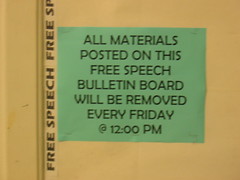
Free speech has a timeboxImage by hey skinny via Flickr
This blog has been around a while but until recently has been a closed blog. Written by an “Arkansan on the move,” who is also an admitted Type A personality seeking temporary residence abroad. Looking for challenging work, intellectual stimulation, and good stories. Aquarian,” the blog sports a straight forward disclaimer:
The views and opinion I express are my own and do not in any way reflect those of the U.S. Government or any of its agencies or officials. All the information and materials I present, or link to, are in the public sphere and are fair game for public comment.

Her recent post,
Going Public, or How I Learned to Manage My Healthy Awareness of Diplomatic Security caught my attention and made me wonder if we are at the start of a wave of the coming Generation Next in the FS.  As Gen Next comes of age in the old bureaucracy (established in 1789 and almost as old as this country) they will be crucial in dragging this organization in words and deeds into the 21st century. It’s worth watching …

Excerpt from HD | The Slow Move East:

After seeing the shaming of a new FSO last January over her public blog, I've been thinking a lot about going public with this site, and what that might mean for me.

The simplest thing, of course, is that DS or Management just tells me to shut this down, with no further consequences.  That has happened to a few of my friends who maintained sites that were little more than travel blogs - certainly no policy discussions.  I don't intend to weigh in much on the most pressing issues of FS life (like Digger admirably does) or the greater scope of State policy (such as Diplopundit does).  Frankly, I'm not experienced enough in State to be able to pick up on a lot of the nuances of the debates that rage on other, bigger blogs.  And I'm certainly not a subject matter expert in a technical field, like Madam Le Consul, so I doubt that any of my posts will catch my superiors' eyes.

The shakedown of FSO Rookie really struck me as emblematic of the battle between the Old School State people and the newbies in the Department.  I certainly don't want to disparage the old hands, who have knowledge and experience that will take me years to accumulate.  However, I think that things have changed in the Department, and those of us in the new generation don't have quite the same point of view that our superiors have on a number of FS traditions.  This job is wonderful, but it's not the only thing in my life - I'm not sacrificing my sanity and my personal life to uphold the self-imposed ideal of a US diplomat.  As programs like Pickering, PMF, and Rangel bring in a younger, more technologically connected, and more diverse set of FSOs, the face of our diplomatic corps is changing, as is our attitude towards the work-life balance, the way that we interact with and engage the world, and the values we hold dear.

This is a long way of saying that I'm opening up this blog as a way to stake out my position on free speech for federal employees and our right to talk about our lives in a mature, logical way online.  I understand the need to stay on message and the need to be secure.  Neither of those concerns should preclude me from writing generally about my job, its benefits and difficulties, and the joys and struggles of living overseas as an American with an unusual position in my host country's society.


Saturday, December 19, 2009

Video of the Week: The Future of the Internet

Vinton G. Cerf, vice president and Chief Evangelist for Google, discusses the past, present, and future of the Internet. Cerf predicts that Asia's cultural influence will grow as the continent's Internet penetration rates reach European levels. He says that, while IPv6 will provide enough Internet addresses to last through his lifetime, the implementation of IPv6 creates difficulties for the Internet in terms of compatibility, security, and broadcasting. Cerf describes the trends and opportunities of the Internet in the 21st century: the transformation of information consumers into information producers; the rise of social networking; the emergence of new economic systems in online games; the development of user-generated advertising content via streaming IPTV; and the transformation of mobile phones into multi-purpose devices that provide geographically indexed information. In Cerf's view, the increasingly lower cost of storing and transporting bits fosters a new economics of digital information and the emergence of new Darwinian business models that challenge existing entities to "adapt or die." As a result, Cerf says the Internet is an unprecedented and unpredictable innovation engine because its infrastructure enables people to invent new applications simply by writing new software on the edge of the network without having to ask for permission.

Video length: 1h 13min 15sec

From: Stanford University’s eCorner

Wednesday, October 21, 2009

QDDR: Transforming State/USAID for the 21st Century?

The Art of Transformation album coverImage via Wikipedia

Deputy Secretary Jacob J. Lew delivered his Remarks on the QDDR at an event hosted by the U.S. Global Leadership Coalition last week. His prepared statement has now been posted online here. You can also read the transcript of the panel discussion here (Panel participants: Jack Lew, Anne-Marie Slaughter, Director of Policy and Planning, Department of State, Alonzo Fulgham, Acting USAID Administrator and moderator, Judy Woodruff). Quick excerpt below from D/S Lew:

[…] I am the first to acknowledge that resources are only a beginning. The world has changed, and we at the State Department and USAID have not done enough to change along with it. We use outdated tools and our organization was not designed to meet today’s challenges -- the rise of new powers and non-state actors, increasing interdependence, the dangers of transnational challenges and weak, impoverished states. […] We have an excellent QDDR leadership team with veterans of State and USAID as well as the private sector and the nonprofit community.

Five working groups led by key stakeholders from State, USAID, and other relevant agencies will drive the details. They will work quickly and pragmatically to produce both analysis and solutions. There is a lot of fine work to draw on, which will make it easier to work quickly. The goal is full engagement of senior leadership informed by the people who can make bottom-up transformation a reality.

Here are the working groups' goals:

First, we are examining the kinds of capabilities needed to develop a new architecture of global cooperation.

Second, we are looking at how we can reform ourselves to both lead and support a whole-of-government approach to foreign policy.

Third, we are considering what capabilities we need to help contribute to the building blocks of strong societies.

Fourth, we are looking at ways to build a strong civilian capacity to respond to crisis and instability.

Finally, we are evaluating how the State Department and USAID should be organized to maintain core capabilities and execute them effectively.

I note that the fifth goal also says, “This group is considering how we recruit, train, and promote our own diplomats and development professionals, and how we can better equip them to meet these challenges. They are also reviewing how we manage our own resources, including how we work with outside partners.”

Read the whole thing here.

You might remember that “transformation” was a buzz word during a certain former Secretary’s tenure at the 7th Floor. Transformational diplomacy shifted resources from one end of the world to another, there was whole lot of commotion and a lot of ink spent on it. It was transformation this, transformation that without new staffing or funding. It was done quickly and on the cheap with great results if you believe everything you read.

Transforming an old, traditional bureaucracy such as the State Department has never been easy. Just about every administration, Democratic or Republican have tried stretching that rubber band only to see it slap back into place. It is a journey littered with good intention but also with disappointments …

Organizational transformation starts with the people and its internal culture. A strong leader with a vision is necessary to drive change to fruition. The people who sit at the base of the pyramid must be willing to trust and follow that leader, even if the outcome is not totally clear.

Jack Lew is probably the one great hope at the moment to shepherd that State/USAID transformation into the 21st century. Let’s wish him the best.

Related Posts:

Thursday, December 11, 2008

Insider Quote: Not Just in the Army

"People are central to everything we do in the Army. Institutions don't transform, people do. Platforms and organizations don't defend the nation, people do. . . . Without people in the equation, readiness and transformation are little more than academic exercises."

Retired Army General Eric K. Shinseki Former Army Chief of Staff and Obama’s Veterans Affairs Secretary-designate From private letter to Rumsfeld in 2003 Reported by WaPo, Sunday, December 7, 2008; Page A04