Showing posts with label Leadership and Management. Show all posts

Thursday, January 19, 2012

2012 Consular Leadership Day Theme: Follow Courageously, Just Not Peter Van Buren

The Bureau of Consular Affairs (CA) recently announced its new leadership theme for 2012 which is "Follow Courageously." CA, of course, is the home bureau of some of our consular officers who offended the tigers with their blogs -- MLC, Peter Van Buren, to name a couple. Others will remain unnamed in this blog, no sense dragging the blog carcasses out in the open.  The consular officers are natural targets; they are some with the most interesting stories in the Foreign Service.  But it's a love/hate relationship, see? Anyway, one of our friends inside the Big House excitedly told us this year's theme of following courageously.
 
I said, hey, what does “Follow Courageously” mean?  Here is what I'm told:

The CA Leadership Tenets describe it as the ability to “take ownership of our work and hold ourselves accountable for improving performance and making our organization stronger,” and to “dissent respectfully and help the boss become more effective in the interest of the team and the mission.” 
So if you use bad, undiplomatic words in following your conscience, that's probably not following courageously? You should be able to swear without opening your mouth. You should also be able to rock the boat without getting anyone wet.  What else?
Following courageously does not mean following blindly.  In this day of limited resources, growing workload, and changing circumstances that drive our ability to respond to new challenges, we all need to follow courageously – and that can take many different approaches. 

Following courageously includes challenging the status quo in favor of exploring new, more efficient ways to work – whether enlisting new technologies, changing business processes, or even delegating certain tasks to others.
CA/P has led the way on social media, using tools such as Facebook, Twitter, and YouTube to engage stakeholders and customers in new and exciting ways.  Many have proposed, either in FSI classes, via cables, or in forums such as CA Leads, the Sounding Board, ACS  , and VOxPopuli, innovative solutions to improve processes.  For Consular Leadership Day 2012, employees are invited to think about the many ways the section, office, or agency has followed courageously and pushed the status quo envelope. 
Challenge the status quo, but not/not in your blog, silly.  No mention of Blogger, Wordpress -- either those are not exciting tools or they are dangerous engagement tools. So what do you do if you want to "follow courageously," and "dissent respectfully" and waaaahhhhhh, excuse me, but no one, NO ONE is listening?
"Following courageously often means speaking truth to power, especially when the message is unwelcome.  Many of us have faced instances when we had to deliver bad news to our bosses, or push back against a decision that was contrary to consular law or policy.  It isn’t easy, and some bosses simply don’t want to hear dissenting views, no matter how respectfully presented.  Failure to report problems, however, means they just get worse.  Offices that do not allow, and even encourage, respectful dissent only undermine their own effectiveness.  Successful offices create an environment where employees know they can raise issues safely and be taken seriously – and that management will work with them to remedy problems.  As an organization, do you encourage people to speak up about problems and explore solutions?  How do you follow courageously with those above your work unit?  How can you encourage them to create an environment where respectful dissent is given appropriate attention?"
Nice words but really, in which State Department sector is this real?  And when you are not working in a "successful office" what then?  What happens when you report certain problems and the tigers bite your head off?  Is there anyone in CA who would be willing to loan the courageous follower a Scottish targe or shield for protection from incoming projectiles? My CA friend, unfortunately does not have the answers.
"Following courageously can mean recognizing and nurturing someone who is a leader without rank - that person who is the “power of one” within your section, office, or agency.  You know the type – someone who is a ten-star leader, the “go to” person who gets things done, and is always thinking about what should happen, not just what does happen.  It is not always easy for more senior managers to acknowledge and promote the leadership role of these employees, but the best managers will follow courageously themselves, and put the good of the organization first."
"Following courageously can mean thinking holistically about how we work, creating a “one-team” approach, and achieving economies of scale that maximize the use of scarce resources.  Consular Team India’s example of assigning specific country-wide responsibilities to a consulate, or the functional cross-training that occurs in so many posts, are only a few ways that posts are making better use of their resources.  
I said, hey, where are these ten-star leaders? Are they in India; I mean, why the special mention? Either they are in India or the consular bureau favorites insiders are now in India.
 
Thus it was made clear to us that following courageously can take many forms. But I am certain that it does not include writing a book like you know who. 

I mean, did you know that they took away his desk, and his badge, and he's not even allowed to play with paper clips? If he ever gets back to Foggy Bottom, there is a bar of Lifeboy soap with his name on it.  Anyway, I heard that he got away with a Skillcraft pen, so he's still writing and doing things and giving folks migraine. But that's a blessing in disguise, the migraine, that is; there is something that beautifully treats migraine -- Botox! An Indian cosmetologist promised, "A few prick jabs are like god's gift for the chronic migraine patients."

Folks, the migraine line starts over there. Follow courageously and stay quiet.

Pardon me?  No, there is absolutely no truth to the rumor that Consular Leadership Day has been renamed Peter Van Buren Day. 


Wednesday, January 11, 2012

Secretary Clinton's Sounding Board, Primarily a "Cathartic" Outlet for Employees?

ca·thar·tic [kuh-thahr-tik]
1. of or pertaining to catharsis.
2. Also, ca·thar·ti·cal. evacuating the bowels; purgative.
3. Psychiatry
a. psychotherapy that encourages or permits the discharge of pent-up, socially unacceptable affects.

b. discharge of pent-up emotions so as to result in the alleviation of symptoms or the permanent relief of the condition.
An FSO once called the Sounding Board, "one of the greatest things to come from Secretary Clinton's reign over the foreign affairs."    He explained that it is "a message board where people can post ideas on ways to improve the State Department and other people can viciously shoot them down.  It is high entertainment." 

I don't know about "high entertainment" but according to a December 2009 issue of State Magazine, the Sounding Board, at http://soundingboard.state.gov (behind the firewall, sorry!) provides Secretary Clinton a window into employee concerns at the State Department, but that it also serves another valuable purpose: "It promotes communication between employees, alerts management to problems and concerns and gives management the opportunity to provide feedback or dispel myths."

Here is how it works (extracted from State Magazine):
  • First, employees submit ideas about how to better achieve our foreign policy goals (with an emphasis on the “how,” not necessarily the “what” or the “why” of foreign policy). The ideas should discuss the impact or cost savings, resource requirements and any obstacles or challenges. Colleagues can then comment on the ideas, adding perspective, highlighting concerns and filling in details that may be missing.
  • Unlike an e-mail suggestion box in which only a few people see an idea, question or response, an online forum such as The Sounding Board opens the conversation to everyone who is interested. The interactive dialogue fosters a community of ideas where employees can share thoughts and best practices.
  • Since its launch in February [2009], employees have logged more than 250,000 visits to the site and submitted more than 900 ideas, which have generated more than 3,200 follow-up comments. The response has been so overwhelming that The Sounding Board staff has been unable to keep up with submissions.

The article includes a couple of its touted results:
"The Bureau of Administration implemented a bike-share program to facilitate local trips to interagency meetings and will also build more showers for bicycle commuters. The Harry S Truman Building and the Foreign Service Institute cafeterias introduced “greenware” disposable food packaging and committed to reducing non-biodegradable waste."

Also, some nine months after it was launched, the Sounding Board reportedly was recognized as "a model for employee outreach and was one of three innovative programs studied by the National Economic Council and the White House Office of Science and Technology Policy."  Apparently, other agencies, such as the Department of Health and Human Services, were looking to the Sounding Board for good ideas as they launch their own initiatives.

Fast forward to December 2010.  Below is an excerpt from Everything Is Broken: My Two Years at the U.S. Department of State, written by Brendan O’Connor, a master’s student in Community Development and Action at Vanderbilt University. He worked in the U.S. Department of State’s Bureau of Overseas Building Operations from July 2008 to July 2010:
"[B]efore resigning to attend graduate school in the summer of 2010, I had the chance to meet one-on-one with a high-level manager (and now ambassador) involved in oversight of the Sounding Board. He stated that the Sounding Board, which had been sold to us as a bottom-up tool for employee ideas in early 2009, was primarily a “cathartic” outlet for employees. Someone might want to explain that to the mass of State employees who cropped up to suggest specific, often in-depth ideas online — over 1,500 by the summer of last year. Indeed, when I left there was no meaningful process in place to review and take appropriate action to either reject or on some level adopt these employee suggestions."
Read in full here.

So hundreds of ideas later -- a senior official of Secretary Clinton's staff called the Sounding Board a "cathartic" outlet?"  Cathartic as in "purgative," as in "strongly laxative."

Sounds dirty.

We have a few nosy questions concerning this new model of employee engagement:
How many ideas have been submitted to the Sounding Board since its launched in Feb 2009?

How many submitted ideas are currently under official consideration?

How many ideas have been implemented?


How much cost-savings have been realized through the implemented ideas?

Is the amount of the cost-savings more than or equal to the cost of manhours to run and manage the Sounding Board?


What process is used by the Sounding Board Team to screen the submitted ideas for review and action?

Since the Board provides Secretary Clinton "a window into employee concerns" how many ideas have been brought to her attention?

If you had luck getting your idea to stick using the Sounding Board, we'd like to hear from you - on the record or on background.


Related Post:
Oh, No! The Sounding Board is in WaPo's In The Loop


Friday, October 28, 2011

What do you do with a "problem" like Peter Van Buren? Take away his badge, escort him out, bar the door, throw away the key and ....

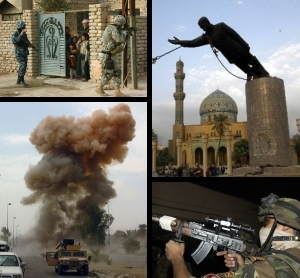
Collage of images taken by U.S. military in Ir...Image via WikipediaHey! That's going to really shut him up.

Yesterday, AFP reports that Mr. Van Buren was escorted out of the State Department on Monday and barred from returning while officials there decide what to do next with him.  Our own source said that Mr. Van Buren has been placed on administrative leave for the next couple of weeks. Admin leave is like "we'll pay you so we don't have to see you."  I supposed that's until they can find the citation in the FAM that would fit this "problem."  Mr. Van Buren's current assignment reportedly had also been curtailed. If true, that means they just took away his desk and chair, too. So even if he is allowed to return after his admin leave, he won't actually have a job to return to. 

As an aside, Mr. Van Buren's book is the main selection in our house's book of the month club.  Our 5th grader is currently reading it at home and at school. I don't think it's going to damage the kid in any way.

Mr. Van Buren's book is highly critical of the State Department's work in Iraq, the accompanying blog, just as critical. Not sure if the punishment is for the book, the blog, or for both. No one would speak on the record. The suspension letter did not cite the book, but did cite as one of the author's faults, "an unwillingness to comply with Department rules and regulations regarding writing and speaking on matters of official concern."

This is the first time, as far as memory goes, that the State Department had actually yanked somebody's clearance over "publishing articles and blog posts on such matters without submitting them to the Department for review." Whereas, in the past, I was aware of the shock factor in threatening bloggers with this in-house version of the "nuclear" option, this is the first time where somebody actually pushed the red button. And in a very public way. 

This is the part where I should also note that although Mr. Van Buren is the first ever blogger escorted out of the building, he was only the latest casualty in the tigers can bite you escapades inside the State Department.  Some FS bloggers have been unable to get suitable ongoing assignments - or even normal responses to their bid lists.  As one recently told me, "these officers have not asked for extraordinary favors:  just regular, humdrum postings that fall comfortably within the bidding rules, that are not heavily bid or bid on by superstars, and for which they are completely competent. ....they have heard only silence."

Assignment issues, blogger disappearances and PVB's case undoubtedly will bring a big chill to the FS blogosphere. Don't be shocked if folks go back to the 50's and start hiding their journals under their pillows, as was quaintly suggested elsewhere.

But here is the big question.  Now that State had unleashed the "nuclear" option and suspended Mr. Van Buren's security clearance, what other threats can you cite to help with behavior modification inside the Big House? He's really going to stop talking/writing/giving interviews now that he had his clearance suspended, or now that he is barred from Foggy Bottom.

You think?

You suspend his clearance hoping that will scare him enough he'd stop blogging; he did not. You take away his badge, hoping that will scare him enough he'd stop blogging; he did not. You bar him from entering any door of the State Department hoping that will scare him enough he'd stop blogging; he did not. You take away his desk and his chair hoping that will scare him out of his wits he'd stop blogging. Instead, on October 27, he was the guest of the National Press Club, his appearance covered by WaPo's Joe Davidson. The hometown paper has finally caught up with the news.

And look just now -- the book even meets the approval of NYmag, which ranked the book significantly higher than the Mexican cyclops shark.  See the unintended consequences here?

So how do you solve a "problem" like Peter Van Buren? Well, certainly not the way the State Department is "solving" it right now.

First, I think it must be said that the State Department handled the book clearance badly. Somebody should have owned up to the snafu instead of gunning after the author. The 30-day timeline for clearing the book lapsed. It was not the author's fault regardless of whether or not the person responsible for clearance had a meltdown, a baby, was sick or was on vacation. But State like any old and cumbersome bureaucracy is loath to admit to its own mistakes.  They cleared Condi's book within the 30-day timeline, yet Mr. Van Buren's book was not afforded the same courtesy. The State Department, in short, broke its own clearance procedure. And when Mr. Van Buren published the book as allowed under its own regulations in the Foreign Affairs Manual (FAM), a Deputy Assistant Secretary of State accused him of "unauthorized disclosures of classified information," and asked his publisher for redactions six days before the book hit the stores.  Can you imagine them doing that to Secretary Rice's book? Nope. Big fry, small fry; are there different rules?

But hey - like Joe Davidson says, "The best way for the federal government to publicize a book? Attempt to muzzle the author."And it's free!

Second, given the potential fallout from a book about reconstruction in what has always been an unpopular, contentious war, and given how much money we're spending on reconstruction projects over in Iraq, somebody higher than a Deputy Assistant Secretary should have read the book, cleared his/her calendar and spoke privately with the author. Instead of sending the tigers with sharp teeth. I have not meet Mr. Van Buren in person, and he may be far from cutesy and cuddly, but he has written a vivid, engaging account of our reconstruction debacle in Iraq seasoned with absurdities, great and small. To dismiss him as nothing but a disgruntled employee is just plain brainless. Public opinion is already against the Iraq war. Add to that the rest of the domestic headaches that the American taxpayers have been suffering in the last several years. And what do you get?  A public relation disaster, with the State Department as the big, bad growling tiger in a starring role. It does not help that State appears to be acting like a big, bad growling tiger trying to eat an angry mouse. Grrrr....diplomatic skills exercised?  Zero.

Remember when Matthew Hoh resigned over Afghanistan? He had two tours of duty in Iraq and five months under his belt in Afghanistan when he quit.  Hoh received offers of new gigs from both Ambassadors Eikenberry and Holbrooke. I understand, he even got some face time with the VPOTUS. I think both ambassadors understood that in our top foreign policy engagement, they cannot be perceived as tone-deaf to the concerns of their man on the ground.

I'm not saying State should have offered Mr. Van Buren a fancy gig in Paris. But at the very least, somebody from the Seventh Floor should have attempted to speak with him. He, after all, spent 23 years with the State Department and cared enough to write the Iraq Experience down in a book. With his name on it. Not even the folks interviewed by USIP were willing to put their names down in that Oral History Project.  But no one bothered to speak with him. A DAS alleging his disclosure of classified info did eventually write to him, albeit belatedly, and not really to listen to what he had to say.

It's as if the State Department is proud of all its smart people except for those with the guts to speak up, or write a critical book.  Or are they only proud of our smart diplomats when they dissent in private, in a channel that the American public never ever gets to hear, and that which the organization is free to ignore?  The guy who talks too much not only gets a good hearing in my book, he or she should be afforded an opportunity to contribute in fixing the problems that he cites. No, we do not shoot the messengers in our book. Most especially if they are bearing bad news. But that's us.  Unfortunately, that is often the case in the bureaucracy, the State Department perhaps more so than most. A dead messenger is a good messenger, no news is good news. Ta-daa! And all is great in Iraq. Amen.

Three, Mr. Van Buren is not without faults.  He posted articles in his blog without obtaining clearance as required in the FAM. Mr. Van Buren, like his employer, also broke the clearance procedure in the FAM.  He even admits to that.  But I don't know of any FSO who blog who had requested clearance for his/her every blog post.  The regs make no distinction whether what you write is critical or not, a clearance is required on matters of official concern.  And since State's purview is the entire world, that covers just about everything.  So to go after Mr. Van Buren in a singular fashion invites the suspicion that he is targeted for his critical views, not just for the blog but also for his book.

Four, that convoluted business of the use of a disclaimer. You put up a disclaimer to ensure that what you write is not attributed to the State Department or the US Government. 

Here is Mr. Van Buren's disclaimer in his blog:

Copyright © 2011. All rights reserved under International and Pan-American Copyright Conventions. The views expressed here are solely those of the author(s) in their private capacity and do not in any way represent the views of the Department of State, the Department of Defense or any other entity of the US Government. The Department of State does not approve, endorse or authorize this blog or book.
A spokesman went so far as confirmed Mr. Van Buren's disclaimer, telling NPR that "the author's views are his own, and not necessarily those of the State Department." And really now, if you read his blog, it is hard to imagine anything similar coming out from Mr. Toner or Ms. Nuland from State's Public Affairs shop. 

And then you have the following disclaimer from the personal blog of the Deputy Director of the State Department's  Office of Innovative Engagement:
......  is an employee of the United States Department of State.  She has been with the Department of State for fourteen years in both traditional Information Technology roles and also as the Deputy Director for the Department’s  first social media office – The Office of Innovative Engagement.  The viewpoints, opinions and ideas expressed here do not represent the official opinion or policy of the United States Government or the Department of State.
She went on to blog about her Twitter cliff notes writing about her agency's social media policy:
Public engagement should only be conducted by trained professionals.  You should not tweet about something you are not an expert in.  An example would be if you are not a consular officer do not talk about the visa or passport process.  Direct those people to the appropriate subject matter expert.

Twitter is a live community of humans and reacts the same way as people do when engaging with them in real life.  You should focus on developing a “human voice” or persona for your community.  This means no generic tweets or “ever green” tweets!  Mass messages across all Department accounts are also considered to be an inappropriate use of Twitter.
[...]
Before using any new social media tools for official State Department purposes, it is important that you are familiar with State Department Policy on Social Media: 5 FAM 790. You should also review the Managing Your Social Media field guide.  This guide is very important to helping you plan, create, and execute a successful social media campaign.

Personal vs. Professional Self:

You must have permission to tweet in your professional capacity.  Permission is granted by the head American officer in the section or the Office Director for domestic offices.

If you are tweeting in your professional capacity, you must disclose the account as being an official Department of State account.

If you are tweeting on someone’s behalf, you must state who is on duty.  Transparency is critical to building trust with your community.

When tweeting in your personal capacity you should not talk specifically about your job.  See 3 FAM 4170 for additional information.

Whether or not this deputy director had clearance to post this policy item in her blog as a personal item is between her and Public Affairs. However, I do have to point out that both blogs used disclaimers claiming to be writing in their personal capacities. Mr. Van Buren blogs about Iraq and affairs of the state, all on matters of official concern. Ms. Deputy Director blogs about the Department's social media policy, also a matter of official concern. One is under investigation, the other as far as I know is not.

According to the regs, some of the factors to be considered in overcoming the presumption of private capacity with the use of a disclaimer include, but not necessarily limited to: 1) The current or former position, rank, and/or duties of the employee; 2) The relationship between the employee’s position, rank, and/or duties and the subject matter of the speaking/teaching/writing.

It is perhaps worth noting that Mr. Van Buren, a midlevel FSO was a PRT guy in Iraq from 2009-2010, and if my source is correct, is now an employee without a job.  The Deputy Director presumably is in the GS scale; could be GS-14/15 and the incumbent in her office. 

By the way, if you find 5 FAM 790, the State Department Policy on Social Media significantly imperfect and hard to wrap your head around, you have the deputy director to thank for that. She reportedly is the co-author of this first social media use policy for the Department of State.

Finally, there is that notion that they drummed into your head from A-100 on, that as a Foreign Service Officer, you are on duty 24/7.  They like saying that. And for the most part, folks in the Foreign Service understand that to be true. You like to think you have a personal life until you have to report to the Regional Security Officer who you slept with the previous night. Or until they tell you -- hey, you are actually blogging on official time, since you are considered on duty 24/7. They have not told you that? Don't worry, they'll eventually come around to telling you that when they can't figure out what to do with bloggers.

In any case, you are on duty 24/7 until the government decides that you are not. Remember the case of Douglas Kent, the U.S. consul general in Vladivostok who was involved in a car accident in October 1998 while driving home from his office?  State concurred with DOJ that he was not on duty 24/7 when the accident occurred.  Here is a trip down memory lane via U.S. Diplomacy:
After Kent left the post on reassignment, a Russian citizen injured in the accident sued Kent in his individual capacity in a district court in California.  According to an August 31, 2006, “AFSANET” message from the American Foreign Service Association (AFSA), “The Department of Justice with State Department concurrence refused to certify that Kent was acting within the scope of his employment when the accident occurred,” thus undermining his claim of immunity.  Ultimately, with AFSA supporting FSO Kent’s legal defense, the case went to the U.S. Court of Appeals for the 9th Circuit, which ruled in his favor by determining that he was acting within the scope of his employment when the accident took place.  The Kent case clearly demonstrates that while Foreign Service personnel, especially those in senior positions, may consider themselves on duty 24 hours a day while stationed overseas and thus fully protected, particular circumstances may put those immunities at risk.

In theory, the rules are there to protect you. In practice, the rules can mean many different things to many different people -- human interpretation, unless it's done by droids, see?  The folks who write the rules can break it with no consequences. The folks who are covered by the rules are also allowed to break it but somebody's gotta pay the price. If you come to think of it -- the big fry, small fry rules only really sucks if you're the small fry.  But if offends our sense of fairness.


In the end,  organizations particularly one as traditional and hierarchical as the State Department cannot tolerate people falling out of a straight line; it's contrary to its sense of order and proper functioning of the organization. And really -- "open door," "innovative engagement," "smart power," and whatnot can only go so far.  An organization like State must do what it must do to protect its "brand," (like any commercial company, only with less money); it is after all, one of the best places to work in the Feds world.

I doubt if the State Department will fire Mr. Van Buren for "disclosure" of alleged classified information in his book, or for linking to a WikiLeaks cable, or even for writing/speaking without clearance. That would make it look petty and seem vindictive and would drag this case long and possibly into court.  But organizations are not without power; it always has an ace up its sleeve, so to speak. In this case, a catch-all slam dunk section in 3 FAM 4130 otherwise known as  "Standards for Appointment and Continued Employment," could be the ace up its sleeve. A much used up phrase of "poor judgement" is like a flyswatter that can be used for employees writing outside the chalked lines, as well as employees who patronize prostitutes.


Thursday, October 20, 2011

HBR: Why You Should Question Your Culture - Three Simple Questions

Ron Ashkenas, a managing partner of Schaffer Consulting and a co-author of The GE Work-Out has an article in the HBR Blog Network on Why you should question your culture. Excerpts below:

I often hear executives reassure me that projects will get done because "we have an execution culture," or that customers will be well taken care of because "we have a culture where the customer comes first." At the same time, culture is also one of the great rationalizations for managerial shortcomings. Many times I've heard that a project was delayed because "we don't make quick decisions around here," which is the managerial equivalent of "the dog ate my homework."
But the problem with all of these statements — both positive and negative — is that they don't really mean anything. Worse yet, they can't be translated into any kind of action. At best these declarations are vague generalizations; and at worst they are misleading stereotypes.
[...]
Any management team can assess its culture by asking these kinds of simple questions across a range of organizational behaviors. For example: To what extent do we reward individual vs. team results? To what extent do we share information broadly or parcel it out narrowly? To what extent do we encourage or discourage risk?

Asking these kinds of questions can smoke out the differences in expectations that people have about the organization. Not everyone experiences culture the same way, so a structured way to discuss those differences can increase alignment and the ability to take collective action. In practical terms, culture is not an intangible cloud that hangs over a company, but an outcome of the way people behave on multiple dimensions. Better understanding of these behavioral patterns — and how each person experiences them — makes it possible to decide whether to continue them or not.

Read in full here.

The three simple questions sound like great questions to ask if you're inside the State Department in general, and the U.S. Foreign Service in particular. Great questions, not sure you'll find your answers.


Thursday, October 6, 2011

Asst Sec'y for Something Affairs Formally Announced Forensic Document Design and Integrity Coordination Unit Created in 2009?


This came out recently as a notice from the Something Affairs Bureau (SAB):

"Assistant Secretary [REDACTED] formally established a Forensic Document Design and Integrity Coordination Unit (FDDI/C) within the Something Affairs Front Office in 2009.  FDDI/C advises on and coordinates all issues involving the development, evaluation, and selection of document security features, as well as quality assurance processes of new improvements to all of Something Affair's secure documents to include the U.S. Passport, U.S. Passport Card, U.S. visa foils, Consular Report of Birth Abroad, Consular Report of Death Abroad and the Border Crossing Card.
yadda yadda yadda  is developing material testing procedures to provide quality assurance evaluation for all of Something Affairs' secure documents."

Wait ...wait a minute ....

This doesn't have anything to do with our post on September 8, 2011 on Spouse of Former Asst Sec'y for Something Affairs Lands Senior Job at Something Affairs?  It doesn't. Right-o. It doesn't have anything to do with it. The two are absolutely not connected whatsoever.

Thank you, that's good to know; did not want to upset our friends at the Something Affairs Bureau.

That is a strange notice though, don't you think? If the Unit was created in 2009, why would the A/S announced it like now? Perhaps the domestic staffers of Something Affairs did not know that they have a Forensic Document Design and Integrity Coordination Unit?  Perhaps the overseas staffers of Something Affairs did not know that they have a Forensic Document Design and Integrity Coordination Unit since 2009 - they are abroad, after all?  Perhaps the Unit has a new person in charge? Perhaps the Unit has a new fax machine?  Perhaps ... perhaps .... otherwise, it's kinda hard to imagine somebody writing a late announcement like this. And not just late, late but like two years late. If I were A/S, I would fire that announcement drafter already because really -- how long does it take to write a 500-word announcement?

And not to pick on our friends over at SAB or anything but since when has the Consular Report of Death Abroad been considered a "secure document?"  This document is not controlled or numbered in anyway. It's not hidden in the vault under lock and hard to remember combination. If you look in the ACS shelves, you'll probably find these forms hanging out over there without a care in the world.

Pardon me? What, not anymore?  Oh, sorry, you don't actually type on it anymore.

The Consular Report of Death Abroad is now automated, so those forms are not palling around under the shelves anymore.  Although now online, apparently this document still has no control number of any sort.  My beer-buddy complains that it is the most non-user friendly computer thingee to fill out online.  So, this might just be a project that the Forensic Document Design and Integrity Coordination Unit (FDDI/C) can really sink its baby teeth in. The document provides essential facts about the death, disposition of remains, and custody of the estate of the deceased American and generally used in legal proceedings in U.S. as proof of death.  So, of course, it must be made secure, that is, if it's not secure yet.

Why didn't you just say so?


Thursday, September 29, 2011

US Embassy Kabul: We know duck and cover is hard, but clean up when you're done, okay?

Captain Underpants and the Preposterous Plight...Image via WikipediaWe heard about that shooting at an Embassy Annex from CBS shortly after it happened on September 25.

In an undated statement that I think came out on Monday, the U.S. Embassy Kabul gave a one-paragraph statement about the incident.  A "lone gunman" who happens to be a local employee was killed, a U.S. citizen civilian employee was killed, and another was wounded

The Kabul Nightingale told me that the the US Embassy Kabul Front Office (where all mission rivers run through) didn't officially tell the Embassy community about the death until two days after it happened. Because it's always good management practice to keep the truth from staffers who might get scared or get nightmares.

So presumably, if they had internet access over there, most of the staff had to read about what happened 700 hundred yards away, from the news outlets based in New York?

That shooting story broke wide on Monday, September 26. That same day, a Management Notice reportedly also went out reminding all employees that after a prolonged duck and cover scenario, they should clean up after themselves. Like clean and mop the place for the next duck and cover occupants?  What did you do there - have a party while doing the duck and cover.  Sheesh!

The Kabul Nightingale says that given that some people had to spend upwards of 10 hours, 10 hours, mind you, huddled in a tunnel with no access to food, water or restroom, mission members were pretty darn outraged. Outrage is understandable, have you ever tried to hold it in for 30 minutes? Gawd! That's the most awful experience; that's how purple people are made, even doing square roots in your head would not/not help. Take my word for it.

All I can say is if we could afford some $2 million dollars to put sod to green the front of the U.S. Embassy in Baghdad, I say, we certainly can afford portable potties inside the duck and cover tunnel, or something. 

But you know what requisition is like in the government. In the meantime, if you're heading there, you might need training on how to hold it in duck and hold.  Try the harder square roots.

Update: One of our blog pals who is at another post asked, "Wait, they built a duck and cover tunnel, without a potty?  Come on, even the commies know that bunkers need potties, kitchens, beds, etc.  Please tell me we're prepped for a siege, 'cause it could happen."

Um, sorry pal, I can't say they're prepped for a siege; I do agree that it could happen if that 20-hour embassy attack that was no big deal is any indication. The attack which lasted for 20 hours was conducted by 6 terrorists, now dead.  But can you imagine a more ambitious attack with a dozen or more terrorist, who presumably will plan on dying anyway?  I can. I can also imagine duck, cover and hold for 48 hours, can you?

Perhaps it is time for to the US Embassy in Kabul to issue employees Roadbag, a $5.40 German-made device that turns your pee to gel, just in case.  Also check out "America's Premier Preparedness Center" for their Pee Bags© at $7.99 + s&h per four pack you get liquid waste bags, pack of tissue and antiseptic hand wipe.

I'd personally prefer Roadbag, not Made in America, but quite frankly, I think the Germans get it.  Nothing to spill and clean up, see? Email this to your Front Office, please? 


Thursday, September 8, 2011

Spouse of Former Asst Sec'y for Something Affairs Lands Senior Job at Something Affairs?

A note from a long time employee landed in our mailbox recently, tweaked to protect identifying punctuation marks -:) Below is a quick summary: 

  • The State Department's Something Affairs Bureau (SAB) is serious about that leadership precept of hiring the best team possible. 
  • Need proof? SAB hired XXXX about a year ago as a ZZZZ, a position that "never existed before" in the Something Affairs Bureau.
  • The writer notes that I may not recognize the new hire's name but that I might recognize the person's other name, which is Spouse of Former Assistant Secretary for Something Affairs.
  • The note ends with something like "SAB is serious about hiring the best!"

Yeah, you go, dear! I don't know all the details but sounds impressive... sign me up!

Now -- if I marry that good looking Consul General over there, may I get a job that never existed before, too?

No? You mean a spouse of the Consul General is not high enough for a personalized job creation? Dammit! Now I have to find an Assistant Secretary to snag. Life just isn't fair and shhh! I'm not/not getting any younger!  

Wait -- if I cannot find a willing or available Assistant Secretary, would a Deputy Assistant Secretary do? Please, pretty, please? The DASes are almost as good as the AS.  I promise I'll be very good. And I will come up with my very own job title (never before seen anywhere), so you won't even have to worry about that. Deal?

Oh, the things you do for a job these days! But if I get a personalized job creation at the Something Affairs Bureau, that will give me health insurance, TSP, social security retirement, sick leave, etc. etc.!

Now, I gotta chore to run ...

BTW -- names and suggestions for blind dates with a dashing someone preferably ranked Assistant Secretary but no lower than a DAS accepted via email until further notice.  


Friday, May 13, 2011

On Performance Pay Awards and Why No HR Seniors to Rat-Tat-Tat-Kaboom Posts?

It's not everyday that the State Department’s Human Resources Office is called "as opaque as the black hole of Calcutta on a moonless winter night." Which sounds almost poetic and all, but not in any way something you want to brag about. Below is from this post at WhirledView by Patricia Kushlis. Excerpts below:   

As I noted in previous posts, ambassadorships have gone overwhelmingly to HR insiders over those who have put their lives on the line in Iraq and Afghanistan. The latest -- and most appalling -- examples? The most recent Director General and his Deputy -- both having spent their two-year tenures pushing their State colleagues off to war zones -- are going where? To Iraq or Afghanistan? Not a chance. They are both enjoying agreeable posts in the South Pacific.
Nor has the situation regarding bonus pay for senior foreign and civil service improved. HR insiders dot the lists as they have for years. As an example on the Civil Service side, a current senior HR official and a former senior HR official (now at the Department's training institute) have received either SES (Senior Executive Service) Performance Awards or Presidential Rank Awards every year for at least the last five years -- including 2009. Whether the awards lists are long or short -- these two women are on them.


HR is a support function at the Department -- not a line function. The several hundred SES employees in the State Department do complicated, high-profile work on the front lines of diplomacy; many of these people are ignored at awards time. It is difficult to imagine how these HR employees (who after all, have run a Bureau unable to put together six-person meetings on a regular basis) manage to snag the US government's top honors year after year. It certainly calls into question the integrity of the awards process -- from the selection of the boards that grant the awards -- to the choice of award recipients themselves.
I repeat my suggestion to Hillary and her people -- revise the regulations to bar any one senior employee (Civil or Foreign Service) from getting an award more than once in three years.
Not a new post but still relevant. Active links added above. Continue reading The Broom’s April Check Up.
 
OPM has an August 2010 order to freeze discretionary awards, bonuses, and similar payments for federal employees.  But wait - the directive has the following exception:
Although Foreign Service Officers and career members of the Senior Foreign Service (SFS) appointed under section 302(a)(1) of the Foreign Service Act receive PAS appointments, they are not political appointees and are not subject to the freeze.  Also, SFS members with PAS or PA appointments who elect to retain eligibility for SFS performance awards under section 302(b) of the Foreign Service Act of 1980 are not political appointees and are not subject to the freeze.  
So - I guess you better be in the lookout for the next performance pay cable.  Unfortunately, none of those cables seem to be available anywhere in the public domain. Wonder why that is, ward off the evil eye?  But isn't that taxpayer money?  You can look those up for comparison year to year if you are inside the firewall at State.  It now seems amusing to watch folks get all contorted over political ambassadorships when right in the front inside of the yard -- well ...

Anyhow, Patricia's suggestion that the revised regs should only allow senior employees in the Civil or Foreign Service to receive performance pay awards once every three years sounds extremely reasonable given our current budget pains.   

In the same spirit, shouldn't senior officials serving in the HR Bureau ought to have a "cooling off" period after serving in that bureau before being considered for career ambassadorships? I mean, if I'm the boss/next bosses of the bureau that puts together the names of the next ambassadors and my name is in it, too -- well, wouldn't you think that smells Epoisses cheesy? Unless, of course -- I'm going to one of the two, wait three, no - five war zones, two of them undeclared.

I do think that the next Director General of the Foreign Service ought to have experience not just in hardship posts but real on the ground experience from one of our increasingly rat-tat-tat kaboom posts, that now includes Pakistan and Mexico (although they're not listed as such anywhere).  Why? Because why not? The DG is the most senior HR person at the State Department. His/Her office is the arm twister, excuse me, the carrot dangler for all those folks who are volunteering to serve in the rat-tat-tat place.  One old friend could not get hold of anyone during the bidding season, that is, apparently, no one was reading the old friend's multiple emails until there was nothing left on the bidlist. In this case, the carrot was hidden not dangled.  When the old friend finally got a response, well, all the options in that short list says Iraq.  But she's the small fry!

As far as we are aware, one senior official at State went directly from an HR tour to a warzone tour.  That's Ambassador Joseph Mussomeli, now of the US Embassy in Slovenia. He was the Director of Human Resources/Entry-Level CDA at the U.S. Department of State for a year prior to deploying to the US Embassy in Kabul as Assistant Chief of Mission, then went on become ambassador to Ljubljana.  Yay for Ambassador Mussomeli!

But other senior HR folks seems to have skipped the warzone tours before proceeding to ambassadorial appointments.  HR's top recruitment guy went on to an ambassadorship in Europe. Another director of HR's Entry-Level Career Development and Assignments went on to an ambassadorship in Europe. Two former top HR officials, went on to ambassadorships in Asia. And one senior advisor to the Office of Performance Evaluation went on to a lovely island in the South Pacific.  

But if these are important enough foreign policy engagements that the HR bureau cajole colleagues every year to volunteer to go, shouldn't the HR seniors' names be on that volunteer list, too?  Because that's probably the best recruitment tool for the warzones ...

Everybody would finally come around to thinking -- hey, things must be really serious ... the boss who's asking me to go to the rat-tat-tat kaboom place, is also going to the rat-tat-tat kaboom place...


Note: The term "rat-tat-tat kaboom" to describe posts in war zones was absolutely originally coined by one of our favorite bloggers, Dakota of The Afghan Plan.
The rat-tat-tat-kaboom posts in our book includes all posts in Iraq, Afghanistan, Libya, Pakistan and Mexico.


Related item:

3 FAM 2870 | Senior Foreign Service Performance Pay and Presidential Awards 


Thursday, April 28, 2011

Insider Quote: The Problems of Now, the Knee Jerk Variety Response


Having been assigned to high threat posts and deployments for over eight years, I have seen the strengths and weaknesses inherent with using contractors versus agents. However, as in the case of Iraq, I have also seen the problems with using agents/contractors versus military protection details. Mismanagment and a lack of clear goals, coupled with the fact that the short length of the tour, inhibits any institutional knowledge from being generated. I would also point out that I feel many of DS's reactions and "solutions" to the problems have been short sighted and of a "knee jerk" variety. Often, it would seem that DS is reactionary in their thinking versus being proactive. It would appear that the problems of "now" are receieving the majority of the Department's attention, when some time and planning should be focused on what issues are going to be faced in the future. Many of the individuals making the decisions are from a generation that never faced situations like those that are currently threatening our missions in Iraq and Afghanistan. Sadly, I think that the situation will get worse before it gets better. The nature of protection details are primarily reactionary but the planning that goes into managing these programs needs to be forward thinking.

Diplomatic Security Agent #9

—p.104
Should the U.S. Department of State Continue to Use Private Security Contractors to Protect U.S. Diplomats?
June 2008 │140 pages PDF
By Special Agent Derek Dela-Cruz
(Master of Military Art and Science, Fort Leavenworth, KS)


Wednesday, April 27, 2011

WH to US Ambassador to Malta: Don't Expect Leader of the Free World to Stop Everything to Rescue You From Bad Guys

U.S. Department of State Official Photograph o...Image via Wikipedia“You cannot realistically expect the leader of the free world to stop everything to rescue you from bad guys.”

That's what one close White House adviser reportedly said according to the outgoing US Ambassador to Malta, Douglas Kmiec in a farewell letter to his Maltese friends published in the Times of Malta on April 24.

It looks like the "bad guys" are the bureaucrats at the State Department, and not just the scorpions at the Office of the Inspector General who were alleged to have engaged in a "sting-back" in their critical report for a legal opinion from the 1980's. Oh, dear.

I have posted here previously about the resignation of the Ambassador Kmiec following a report from the Inspector General's Office of the State Department released in early April.

While this is certainly not the first high profile resignation we have seen this year, this is the first time that we've seen a departing ambassador engage the press on his defense following his very public resignation.

From media accounts, it looks like Ambassador Kmiec was waiting for a response directly from the White House but did not get one.

“Presumably, if the President, unlike the Inspector General, was happy with my work he could easily affirm with a letter, phone call, or even a brief mention in a speech,” Prof. Kmiec said, adding, however, that he had only heard from the State Department so far.

In a telephonic interview with TPM Muckraker, Ambassador Kmiec complains about not being able to speak directly to President Obama:
 "What is really heartbreaking is not to be able to speak to the President about this, about the distortion -- intentional or unintentional, clumsy or politically motivated somehow -- by the Inspector General," Kmiec told TPM. "I love this work so much, and was so honored to be doing this for the country and for this President in particular."

"The thing that is so saddening to end this way, is that I haven't lost any of my enthusiasm for the President's ability to lead the country. I have seen it applauded and greatly appreciated here and in international settings," Kmiec said.

"I mean if I could get Barack Obama to fly into the Malta airport for 30 seconds, I think I'd be canonized. The man is extremely respected, and I think everything we've done has just magnified that respect, and in an honest way," Kmiec said.     

Ambassador Kmeic also took some issues with unnamed State Dept officials and their runaway red pens:
One particularly offensive overreach, says Kmiec, was when State Department officials edited an article Kmiec wrote memorializing his father in a way that changed his father's views.

"I thought it was highly offensive to have my father's memorial piece edited by the Department of State, and indeed what was edited out was reference to his faith and mine and also there was some substantive disagreement with views my father held, so they changed them," Kmiec said. "So there was a certain aggravation there."     
[...]
He also wrote a piece for the L.A. Times for what would have been Ronald Reagan's 100th birthday that the State Department rejected because it wasn't related to his mission.

But in his farewell letter to his Maltese friends, he also writes that the "The soulless, secular censorship of a few is not representative of the many." 

Imagine if he had a blog.

A double standards in ambassadorial resignations?

Ambassador Kmeic wanted to leave post in mid-August and had apparently been told he should leave by the end of May.  The Times of Malta helpfully points out the US Ambasador to China Jon Huntsman who resigned in February was allowed to stay for three months. Ambassador Huntsman's resignation was reported by NYT in late January with April 30 as its effectivity date.  Excerpts from the Times of Malta:
Outgoing US Ambassador Douglas Kmiec has been asked to leave his post in Malta two-and-a-half months earlier than he had planned, and will therefore miss the July opening of the new embassy.

Prof. Kmiec resigned last week after being chastised by the US State Department for focusing too much energy on his religious beliefs. In a letter, he invited President Barack Obama to visit Malta and reaffirm his credentials, hinting that his resignation should not be accepted.

However, the State Department said his resignation had been accepted and asked him to leave on May 31 rather than August 15 – the date he had proposed to coincide with the Feast of the Assumption.

Prof. Kmiec, who writes an article in today’s paper complaining on “soulless secular censorship”, told The Sunday Times that the State Department felt it was “usual” for him to have a shorter notice period.

However, the current US ambassador to China, who resigned in February, reportedly to prepare a Republican presidential bid, was allowed to stay on for three months.

Such double standards could indicate there is more than meets the eye behind Prof. Kmiec’s departure

And the ambassador seems sore and feeling rather under appreciated:
He also pointed out that those who took considerable personal risks in backing Mr Obama seemed not to be given reciprocal support when needed.

“But political friendships, of course, are not generally personal ones. One wag once said: ‘If you want a friend in Washington, get a dog’.”
[...]
“Even a dog knows the difference between being tripped over and being kicked.” I do too.

The country's Foreign Minister Tonio Borg has now waded into the resignation, expressing disappointment and surprise that the Ambassador is stepping down.
“He was and still is a good Ambassador who has served his country well, while winning the hearts of many,” Dr Borg said.

“Far from hindering the carrying out of his duties, his faith actually made him stronger and helped him gain respect and admiration.”

But a John Guillaumier of St Julians writes rather aptly:
If the next US Ambassador to Malta is a Muslim, it would be undiplomatic of him to use his post as ambassador to promote Islam, just as it was wrong for Prof. Kmiec to use his post as ambassador to promote his personal religious values.

Well, that is a mighty good point, don't you think?

Then, of course, one must ask -- who remembers that 1989 memo, by the way? Are we to believe that the OIG has been waiting all this time to seek vengeance for an opinion written in the last century? That's like attributing artificial emotional intelligence to a bureaucracy .... I'm sure we have yet to invent a bureaucracy that's as smart as that.   

There are a couple of things that may be lost in this minor controversy. The fact that all Foreign Service folks must agree to publicly support the policies of the US Government even if they personally disagree with them. That basically means, the policy of the administration of the day whether it is a Republican or Democratic administration.  The second and no less important is the fact that FS professional cannot have a personal opinion on official matters. By virtue of their positions as representatives of the U.S. Government (and the higher the ranks, the more it matters), they can only talk about the official positions of the government they represent, not their own personal opinions. 

Remember that Political Counselor cornered by an important local contact? Contact says, "Just between us, what is really your opinion on XYZ? Without batting an eyelash, the Pol Counselor replies, "But I don't have a personal opinion, it is however, my government's opinion that XYZ should XYZ."

If they can't do that, they can disagree in a dissent cable (all internal at State, not for publication). Or they quit.
               
Political appointees ought to know this like the back of their hands before they agree to their appointments.  When they take the short cut to join the diplomatic service and represent the United States of America, even they, must follow the rules, and there are tons of them.  And this includes, I'm almost sure of this -- the landline and virtual connections that hook them directly to the mother ship with its corresponding multiple hierarchies.  And the mother ship, like it or not, is in Foggy Bottom, not the White House, even in the latter is the appointing authority. 


Wednesday, April 20, 2011

State/OIG on US Embassy Denmark: "Ambassador has, in effect, become a first-line supervisor"

The Office of the Inspector General conducted an inspection of US Embassy Denmark in Washington, DC, between September 1 and 29, 2010, and in Copenhagen, Denmark, between September 30 and October 14, 2010.
Its reported dated March 2011 was published online recently.  The 57-page report contains 27 recommendations, 17 informal recommendations and shines a light on the management style of one more political ambassador. Key judgments below republished from the report:
  • The Ambassador has led an effective dialog with the Danes and been the driving force behind major initiatives on women’s issues and counterterrorism
  • The Ambassador also has fostered a high degree of collaboration among the various agencies at the embassy.
  • The reporting, analysis, and outreach functions are operating below potential, due to the concentration of decision making in the hands of the Ambassador.
  • The embassy staff perceives that the Ambassador is unwilling to delegate authority, and that this weakens the chain of command and disempowers section leaders, making it difficult for them to organize their work and to hold officers within their sections accountable.

  • The Ambassador has, in effect, become a first-line supervisor, and can be harsh in dealing with any lapses she perceives.[REDACTED]
  • The embassy has been consumed with a series of resource-intensive, one-off events: two presidential visits during the last quarter of 2009 and an ambitious international conference it is cosponsoring in fall 2010.
  • A small management section has adopted some of the Department’s newest innovations, delivering high quality services in most areas. Some general services operations, however, suffer from inexperienced leadership and a lack of staff training.
  • Increasing tourism, climate change, commercial opportunities, and the prospect of future independence will call for increased embassy attention to Greenland, currently an autonomous country within the Kingdom of Denmark.
  • The public affairs section runs an active and efficient public diplomacy program that is well adapted to the Danish environment, but it should make several administrative improvements, particularly involving grants. The Ambassador should engage in more policy-oriented press activities as part of a long-term media strategy.
A quick note on Denmark from the IG report:
Denmark is the only Nordic country that is a member of both the North Atlantic Treaty Organization and the European Union, and its international engagement has reflected interests that are convergent with those of the United States. The Danes value the United States as a close ally, and twice welcomed President Obama during 2009. At its peak, Denmark had some 540 troops in Iraq; it has a current deployment ceiling of 750 troops in Afghanistan (Helmand province), in addition to peacekeepers in Kosovo and Lebanon. Denmark will chair the Arctic Council until April 2011, the UN climate change process until December 2010, and the European Union in 2012.

A rough landing when there are staffing gaps, heavy turn-overs -- excerpts from the report:
The Ambassador arrived at the embassy as soon as she could, pressed for time to present her credentials to prepare for several high-level visits planned for fall 2009. As a result, she did not conduct all of the consultations in Washington that ambassadors normally conduct in advance of assuming charge. This situation left her less than fully prepared for the work she had to undertake immediately upon her arrival.

During that same transfer season, the embassy experienced a heavy turnover of personnel. Besides the Ambassador, the turnover included four of five political/economic officers, all three consular officers, the regional affairs chief, and the Defense attaché. The deputy of the political/economic section left a vacancy in his position when he took a 1-year assignment in Afghanistan. Continuity at the embassy further suffered when the Ambassador, after conferring with and receiving guidance from the Department, asked the former DCM to leave the embassy in January 2010. This departure resulted in a staffing gap of the DCM position for 9 months, which the political/economic section chief filled on an acting basis. There followed extended gaps in both the management officer and regional security officer (RSO) positions as well.

The Ambassador has felt these gaps, as well as the relative lack of preparation for her rather precipitous arrival, as a lack of support. She responded by shouldering a major portion of priority setting, sometimes directing the day-to-day operation of many embassy sections personally, which staff perceive as in effect displacing the authority of section heads and bringing the most routine tasks under her close supervision. For fear of having items “fall through the cracks” or “be sent out incorrectly,” the Ambassador frequently checks officer performance at all levels of preparation and has sometimes been reluctant to delegate authority, even to the DCM. Where she perceives lapses, her response has been sharp and, to those affected, frequently unpre­dictable. [REDACTED]
Reporting is a core, essential function of an embassy. In fact, most political officers in the shutdown plan of the State Dept are considered essential for national security that they get to stay and work during a furlough. But in the OIG report on Denmark, the inspectors say that diverted resources from the embassy's reporting crew caused officers to rely on the press and the Internet as sources for their reporting cables ...  
The section has been challenged to meet this agenda. The absence of the deputy section chief on a 1-year tour to Afghanistan has meant that the section has lacked the capacity to complete some of its planned reporting. In addition, two presidential visits, turnover in senior staff, and preparations for a large, U.S. cosponsored conference have diverted a large share of the remaining resources from core reporting. The consequent press of business has led officers to develop some of their reports with little and often no face-to-face interaction with Danish officials, relying instead on material from the press and the Internet. This is only nominally responsive to the embassy’s reporting responsibilities.
[...]
The Ambassador is deeply involved in all aspects of reporting and approves all substantive cables, regardless of whether the DCM has reviewed and cleared them. Her editorial intervention is frequent and substantial, and an excessively rigorous clearance process has resulted in some delays in filing cables. Even in the case of routine démarche cables, the section must prepare a package for the Ambassador’s approval that includes background to the issue, talking points, and recommenda­tions for the action officer and the démarche recipient. Once the officer has deliv­ered the démarche, the section produces a reporting cable package. In this way a routine function has become a time-consuming and staff-intensive activity, often significantly delaying the démarche process. In recent months, the Ambassador has agreed to receive only information copies of packages for the most routine démarches, rather than holding them for approval. While this is a positive step, it only partially addresses the time delay issue, and does not reduce the burden on staff. A similar document preparation protocol is in place for other reporting cables.

The OIG report also tells us something we already know, Denmark is a favorite stop for VIPs and nearly 50 CODELs:
The GSO has been battered by huge turnover in staff in the last 2 years, the addition of several new positions to support increased American staffing, and unusually heavy requirements for high-level visitor support in the past several months. President Obama visited twice, while the First Lady, Secretary of State, nearly 50 congressional delegations, and other high-level U.S. officials attended a major summit on the UN climate change process. The impact of those factors left the GSO staff feeling weary and underappreciated.


Related item:

-03/31/11   Inspection of Embassy Copenhagen, Denmark (ISP-I-11-19A) March 2011  [4434 Kb]


Friday, April 8, 2011

US Embassy Malta: OIG Slams Political Ambassador for "Outside Activities," Recommends Termination of Employees' R&R Benefits

The State Department's Office of the Inspector General had just released its inspection report of the US Embassy in Valleta, Malta. The embassy was the temporary safehaven location during the evacuation of US Embassy Tripoli weeks ago. It is one of the nine posts identified by the State Department to remain open at 100% staffing in the event of a government shutdown due to what it calls the "extreme nature of events."
 
A quick look on Malta from the IG inspectors: 

Malta is a small island country located in the south-central Mediterranean, astride some of the world’s busiest shipping lanes. It joined the European Union in 2004, the Schengen visa system in 2007, and the Eurozone in 2008. With a population of 412,000, it is the smallest country in the European Union.

The country is overwhelmingly Roman Catholic, with a Christian culture that reaches back to the beginnings of the church. Reflecting the church’s continuing influence, abortion and divorce remain illegal. There is a small Muslim population of about 10,000, almost half of whom are migrants from sub-Saharan Africa. Maltese and English are the official languages; English is widely spoken, a legacy of 150 years of British colonial rule between 1814 and independence in 1964.

The political ambassador on "a special mandate," reluctant to accept guidance and instruction from Foggy Bottom. Excerpts from the IG report:


The Ambassador had been at post more than a year at the time of the inspection, and had achieved some policy successes. He is respected by Maltese officials and most mission staff, but his unconventional approach to his role as ambassador has created friction with principal officials in Washington, especially over his reluctance to accept their guidance and instructions. Based on a belief that he was given a special mandate to promote President Obama’s interfaith initiatives, he has devoted considerable time to writing articles for publication in the United States as well as in Malta, and to presenting his views on subjects outside the bilateral portfolio. He has been inconsistent in observance of clearance procedures required for publication. He also looks well beyond the bilateral relationship when considering possible events for the mission to host in Malta. His approach has required Department principals, as well as some embassy staff, to spend an inordinate amount of time reviewing his writings, speeches, and other initiatives. His official schedule has been uncharacteristically light for an ambassador at a post of this size, and on average he spends several hours of each work day in the residence, much of which appears to be devoted to his nonofficial writings.

At the same time, he has not focused sufficiently on key management issues within the embassy, including the NEC.
[...]
The Ambassador advised the inspection team that he intended to discontinue his outside writings and focus on matters that directly pertain to the embassy and priorities outlined in the Mission Strategic and Resource Plan (MSRP). Within weeks of the team’s departure, however, he resumed drafting public essays that addressed subjects outside his purview as Ambassador to Malta and detracted from his core responsibilities. These activities also detracted from the core responsibilities of embassy staff members who devoted time and effort to reviewing and editing the ambassador’s drafts and seeking approvals occasionally after the writings had been submitted for publication from Department officials.
RECOMMENDATION 1: The Bureau of European and Eurasian Affairs should require the Ambassador to report on his efforts to refocus attention on mission priorities and eliminate his use of embassy and Department resources
on nonofficial writings. (Action: EUR)

New Embassy Compound: 60% Expansion of LE Staff, Budget Increase at 125%, Utility Costs at 10-Fold Increase

The major challenges facing the embassy are the scheduled May 2011 move to the NEC and the additional staffing it will require. The new $125.5 million compound consists of eight separate buildings on 10 acres. The new chancery will be approximately twice as large as the current one, and more than twice as expensive to operate. The NEC will require a 60 percent expansion of LE staff, primarily guards.

The NEC also has budget implications for the embassy and the Bureau of European and Eurasian Affairs. The embassy’s budget grew from $3.8 million in FY 2009 to $5.5 million in FY 2010. The projection for FY 2011 is $8.5 million, an increase of 125 percent in 2 years. In 2010, utility costs for the current chancery were about $130,000; utility costs for the NEC could reach $1.2 million annually, a 10-fold increase. Landscaping and cleaning contract costs also will increase significantly.

Upon completion, the 57,264-gross square feet chancery will provide a secure and functional space for the 62 employees for whom it was designed. The inspection team was surprised by several features, including three unclassified conference rooms, a political-economic section suite that will house just one officer, and a large IRC whose usage will be limited by the NEC location. The building also has air handling equipment within the controlled access area that will require cleared escorts for every maintenance and repair. In addition to the chancery, the compound also will have a 17,760- gross square feet warehouse, a 6,781- gross square feet Marine security guard quarters, and a 1,227- gross square feet recreational center, as well as a 2,142- gross square feet swimming pool.
OIG Calls Embassy's Rest and Recuperation, An Unnecessary Expense; Recommends Termination
Employees at Embassy Valletta have been receiving rest and recuperation (R&R) travel benefits since at least 1991, the year the last R&R recertification could be located in embassy files. U.S. direct-hire staff on 3-year assignments receive two R&Rs, and entry-level officers on 2-year assignments receive one R&R. According to 3 FAH-1 H-3721.4, all posts that receive R&R are required to submit documentation every 2 years to the appropriate regional bureau executive to justify continued eligibility.

Embassy Valletta has not done so. The inspection team found no evidence to justify continuing R&R. The post’s own report of conditions cites excellent weather, adequate medical care, good local transportation, and easy access to Europe. In FY 2010, the Department spent about $40,000 to fund R&R travel for employees in Valletta—an unnecessary expense.
RECOMMENDATION 16: The Bureau of European and Eurasian Affairs should discontinue the rest and recuperation benefit for Embassy Valletta. (Action: EUR)
Oh dear! A tiny island in the middle of the Med. And no getting off for three years, folks!   

Forbes
quotes Ambassador Kmiec saying he would not apologize for how he has conducted himself in the job.
“I must say that I am troubled and saddened that a handful of individuals within my department in Washington seem to manifest a hostility to expressions of faith and efforts to promote better interfaith understanding,” Kmiec said in an e-mailed statement to The Associated Press. “Our constitution proudly protects the free exercise of religion — even for ambassadors.”

And might just be coincidence, of course -- Pepperdine Graphic.com published Mr. Kmiec's email (
also Pepperdine Law Professor) about that rescue effort the mission conducted with US Embassy Tripoli -- headlined, "Ambassador Kmiec leads dangerous rescue:"
As you know, we — and when I say we, I mean some well trained consular, Coast Guard and Navy personnel under my direction — were able to rescue and evacuate all of the U.S. embassy employees in Tripoli ....
[...]
Former Secretary James Baker (a friend from my days as Ronald Reagan's constitutional lawyer) was so impressed with our rescue work that he wrote me, "It appears that you have been very busy ... It was nice to read the positive words that Prime Minister David Cameron said about your leadership."  Apparently, Secretary Clinton feels the same way since when the budget deficit was looming and no budget threatened to close down virtually the entire federal government, except for a handful of exceptional services, our Embassy in Valletta was one of a handful of embassies around the globe deemed "essential" and not to be shuttered.
 Read in full here.
I've read the OIG report front and back, nothing there that says he cannot have his expressions of faith, I presumed the inspectors just wanted his eyes on the core goals of the embassy -- after all that's why we, the taxpayers pays for him and his staff to be there: strengthening maritime security, promoting U.S. trade and investment, the enforcement of nonproliferation sanctions against Iran and other countries that use Malta’s shipping facilities, trafficking in persons and attending to key management issues within the embassy.

Based on the above, I doubt if this political ambassador is going to change how he does his job.  One more WH headache, which I suspect will be tolerated given the much bigger headaches out there.  Those at the Bureau overseeing Malta will probably just have to live with this, I mean, what else can they do, eh? May need lots of Aspirin.


Related item:

OIG Report No. ISP-I-11-16A - Inspection of Embassy Valletta, Malta - March 2011