Showing posts with label Learning. Show all posts

Monday, January 23, 2012

Foreign Service Overseas Crisis Readiness Online Course

FSI's Transition Center and the Leadership and Management School have put together this short course intended to help U.S Government families and members of household prepare for a crisis overseas. It covers preparations to be done prior to departure for post, and upon arrival at post. It also describes the responsibilities of post personnel who have roles during crisis response and have audio clips from recent evacuees.


The online course includes five modules, a summary and review questions in each module. I find the review quiz pretty tame with softball questions but it may still be useful to take them. (Example: You're going to Kingston, Jamaica, an island with a warm climate, should you pack sweaters and a warm coat?) 

The course is not embeddable so you have to check it out here:  http://www.state.gov/m/fsi/tc/ocr/
Introduction
Planning Ahead Overview
A Post
You and the Mission
Evacuations: What They Mean for You
Resilience
Planning Ahead: Your Personal Plan

At the conclusion of the brief course, there is a useful template for creating a Personal Crisis Preparedness Plan (see pdf below).  There is also an option to print out the materials. Make sure you check out the "Resources" tab at the bottom of the screen. 
Personal Crisis Preparedness Aid (pdf)

Go-Bag List (pdf)
You never know when a crisis might strike, especially overseas. Preparedness is half the battle, so check this out when you can.


Monday, November 28, 2011

Governor #HeBlowsALot Apologizes for Twitter Flap Over in Kansas, USA

Oh, Sam Brownback, one of the Senate's old advocate for human rights in North Korea who decamped to Kansas, USA after the last election is back in the news, and not in a good way.

As the story goes -- Shawnee Mission East senior Emma Sullivan, 18 and apparently newly registered voter went with a group of students to the statehouse for a Youth in Government program.

Must have been exciting, she tweeted:


Oops! Except that it's not even true ... she did not actually said that to the guv, but she did tweet it.

Normally, a tweet like that gets overtaken by well, a whole lot of noise in the twitterverse.

But not this time.  Apparently, Governor Brownback's office monitor social media comments over there in Kansas and saw this tweet. And so the highschooler was reported by the governor's office to Youth in Government officials. When this hit the news, Gov. Brownback’s spokeswoman Sherriene Jones-Sontag then said, “It was important for the organization to be aware of the comments their students were making. It’s also important for students to recognize the power of social media, how lasting it is. It is on the Internet.” She added of Sullivan’s tweet, “That wasn’t respectful. In order to really have a constructive dialogue, there has to be mutual respect.”

Holy molly guacamole .... where or where did this woman learn her public affairs skills, from Vladimir Putin's Russia?

So then, the highschooler was called into the principal's office where Mr. Krawitz, the principal asked her to write a letter of apology to Governor Brownback and his staff. Apparently, Monday was the due date for the letter.

In the meantime,  #heblowsalot started picking up on Twitter.

Somebody even bothered to make a poster here and here.

I imagined it was a rough weekend over there in Kansas.  As if the bad publicity was not enough, there is also a fake Sam Brownback Twitter account. And in the last 24 hours, a Govblowsalot account, specializing in twittermockery was born.

Then Monday came, and the school district, after a weekend of adverse publicity released the following statement:
"District officials have reviewed recent events surrounding the reported tweet by Shawnee Mission East High School student Emma Sullivan.  The district acknowledges a student's right to freedom of speech and expression is constitutionally protected.

"The district has not censored Miss Sullivan nor infringed upon her freedom of speech.  She is not required to write a letter of apology to the Governor.  Whether and to whom any apologies are issued will be left to the individuals involved.

"The issue has resulted in many teachable moments concerning the use of social media.  The district does not intend to take any further action on this matter."
Also on Monday, at 10:46am, Governor Brownback's statement regarding Emma Sullivan's tweet was posted on Facebook:
Topeka – Kansas Governor Sam Brownback issued the following statement today regarding the tweet by Emma Sullivan:

“My staff over-reacted to this tweet, and for that I apologize. Freedom of speech is among our most treasured freedoms.

I enjoyed speaking to the more than 100 students who participated in the Youth in Government Program at the Kansas Capitol. They are our future.

I also want to thank the thousands of Kansas educators who remind us daily of our liberties, as well as the values of civility and decorum.

Again, I apologize for our over-reaction.”

Yep, Emma, you're not in Kansas, Russia. 

As of this writing, Emma Sullivan http://twitter.com/#!/emmakate988 has 11,264 followers, up from 60.

The official Gov. Brownback account http://twitter.com/#!/govsambrownback is holding on to its 3,230 followers.

And the guv's social media monitoring shop just got a heck lot more stuff to monitor.


Thursday, October 20, 2011

HBR: Why You Should Question Your Culture - Three Simple Questions

Ron Ashkenas, a managing partner of Schaffer Consulting and a co-author of The GE Work-Out has an article in the HBR Blog Network on Why you should question your culture. Excerpts below:

I often hear executives reassure me that projects will get done because "we have an execution culture," or that customers will be well taken care of because "we have a culture where the customer comes first." At the same time, culture is also one of the great rationalizations for managerial shortcomings. Many times I've heard that a project was delayed because "we don't make quick decisions around here," which is the managerial equivalent of "the dog ate my homework."
But the problem with all of these statements — both positive and negative — is that they don't really mean anything. Worse yet, they can't be translated into any kind of action. At best these declarations are vague generalizations; and at worst they are misleading stereotypes.
[...]
Any management team can assess its culture by asking these kinds of simple questions across a range of organizational behaviors. For example: To what extent do we reward individual vs. team results? To what extent do we share information broadly or parcel it out narrowly? To what extent do we encourage or discourage risk?

Asking these kinds of questions can smoke out the differences in expectations that people have about the organization. Not everyone experiences culture the same way, so a structured way to discuss those differences can increase alignment and the ability to take collective action. In practical terms, culture is not an intangible cloud that hangs over a company, but an outcome of the way people behave on multiple dimensions. Better understanding of these behavioral patterns — and how each person experiences them — makes it possible to decide whether to continue them or not.

Read in full here.

The three simple questions sound like great questions to ask if you're inside the State Department in general, and the U.S. Foreign Service in particular. Great questions, not sure you'll find your answers.


Tuesday, October 18, 2011

The First Duty - One's Obligations In Correct Order

Via Secrecy News:

The Guide explains that when you are in the Army, your first duty is not to the Army, but to the U.S. Constitution.  “Put [your] obligations in correct order: the Constitution, the Army, the unit, and finally, self.”  See “The Soldier’s Guide,” Field Manual, 7-21.13, February 2004, with Change 1, September 20, 2011.


Tuesday, September 6, 2011

Which Ambassador is planning to unload his/her DCM shortly and other curtailment news

This blog recently received the following search queries:

Ambassador window of time to ask DCM to leave

When can the ambassador ask the DCM to leave
Uh-oh! Uh-oh! Like when can I toss my DCM out the window?  That last one is a joke, diplomats do not/not get physical, so no actual window tossing ... What? Oh, no, wait a minute, it's like a metaphor actually like Ms. Bachmann's.    

My guess is that the person doing the search is not in the career service and who else can you ask on matters like this but the Googles.  In diplo-speak, the query is about curtailment which means shortening an employee’s tour of duty from his or her assignment. It may include the employee’s immediate departure from a bureau or post.  In this instance, possibly that of the deputy chief of mission in some unknown embassy (where about a third of total posts is encumbered by political ambassadors). 

The Foreign Affairs Manual, fondly known as the FAM says that curtailment is an assignment action, not a disciplinary one. Ha-ha! Oops, did I laugh out loud? Hookay, it may not be a disciplinary one but it follows the employee around, kind of like a dark cloud that follows Eeyore all over the place.

Now on to the law of unintended consequences --

Remember the U.S. Ambassador to Denmark who according to the OIG report asked her DCM to leave post in January 2010?  That resulted in a DCM staffing gap of 9 months. That's 270 days where the chief of mission even with an acting DCM may be forced to function as her/his own executive officer dealing with the nuts and bolts of running an embassy.

The regs says that the ambassador can initiate an involuntary curtailment, which gives the chief of mission wide authority over this matter.  In fact, one political ambassador went though five DCMs during his tenure as George W's ambo in paradise. The whole two Bush terms. We even wrote a tanka about it.  Another political ambassador went through seven permanent and temporary DCMs in less than one presidential term.  Only one served more than six months! That one deserves a super tanka, I know, just haven't got around to writing it.

Anyway, kicking out the embassy's #2 officer may seem easy enough - he/she is not your relative and the USG pays for him/her to be relocated elsewhere but we must point out something kinda important here. See, State Department assignments are usually arranged so that folks have assignments a year before they move or rotate to their new posts. Which means, when the chief of mission unloads a staffer, particularly in the higher ranks, there isn't anyone waiting in the wings to take over at a moment's notice. Except sometimes, the mothership sends in a retired Foreign Service Office to be temp DCM. Which is fine and all, except what happens if you don't like him/her, too? I imagine that's how you could end up as a record holder of sorts or in the top list of folks who should get Bob Sutton's book for Christmas. And that's not something you really want to hang on your wall next to that stuffed moose head, trust me.

So like Eminem sings it ---
....be careful what you wish for
cause you just might get it and if you get it
then you just might not know what to do wit' it ....

Speaking of curtailments -- the junior diplomat at the U.S. Consulate General in Chennai who was in hot water for remarks made at a local school reportedly enrolled herself in a cultural sensitivity course. The State Department Spokesperson says:
"We consider the comments absolutely unacceptable. I think you saw that she apologized almost immediately. She’s also gone to – voluntarily enrolled in a cultural sensitivity course. But obviously, they’re unacceptable and inconsistent with core American values."
A few days later, the Indian press reported that Ms. Chao is leaving her post in Chennai. NDTV reported that "Ms Chao herself decided to leave her posting in Chennai in the near future", citing an unnamed US Consulate spokesperson in Chennai last Friday.

And here I thought the controversy was blowing over....

IBN India also reported the same thing word for word, but cited Anand Krishna, the spokesperson of the US Consulate in Chennai as the source. The report says that the spokesperson was seeking to delink the move from the controversial remarks and indicated that the officer was not coerced into taking the decision.  Queried about Ms. Chao's next assignment, Mr. Krishna reportedly said, “It is her personal choice, we have no idea about that.”

Personal choice is an organizational oxymoron, LOL! At least he did not say she was leaving as a regular part of staffing reassignment, or realignment or repositioning.

There are several ways an FS assignment is curtailed or cut short.

One through voluntary curtailment:  An employee assigned abroad may request curtailment of his or her tour of duty for any reason. The employee submits a written request for curtailment that explains the reasons for the request to the appropriate assignment panel through his or her counseling and assignment officer. Post management must also state its support for or opposition to the employee’s request.  For example, an FSO who can't stand his/her boss can request voluntary curtailment from post.  And then what? Need new shoes to walk up and down the C. Street corridors to find him/her-self a new job. Of course, they'd all want to know why he/she left the old job, bummer!  See why voluntary curtailment is tricky?  Most jobs are filled up a year in advance, too, which would make the curtailed FSO a candidate for the only places with rolling recruitment - Iraq, Afghanistan and ya betcha, Pakistan.

Two, there is involuntary curtailment at the request of the ambassador: If the chief of mission determines that curtailment of an employee’s tour of duty would be in the best interests of the post, the employee, or the employee’s dependents, the chief of mission may ask that the employee’s tour of duty be curtailed.  If I were a spouse with a great fondness for gin (and not just for rum-balls), drinks it like a fish in a tiny pond, then throws up at an official function, that might be grounds for involuntary curtailment, don't you think?

Three, is immediate involuntary curtailment, an exceptional measure in some situations: When the chief of mission deems immediate curtailment of an employee to be in the best interests of the Foreign Service or the posts; when time will not permit the necessary exchange of communications between the post and the Department. This part of the regs must have been written before the advent of the telephone.  In any case, if you were roaring drunk and naked, and found by local police with bondage gear, you most probably would be on the first plane back to D.C. before you could say "oops!"

Finally, according to the FAM, the Director General of the Foreign Service and most senior HR person has the authority to propose curtailment from any assignment sua sponte or on his/her own accord without prompting from anyone. With good reasons, of course since curtailment entails not just additional moving/shipping expense for the government, but also staffing/logistic upheavals at both the losing and gaining post. 

Read more about curtailment in 3 FAM 2440 here.


Monday, February 28, 2011

Any future SECDEF who advises POTUS to again send a big American land army to XYZ should “have his head examined”

US Secretary of Defense Robert Gates gives a g...Image via Wikipedia

Did not make that up. Defense Secretary Robert Gates actually said:  "[In my opinion, any future defense secretary who advises the president to again send a big American land army into Asia or into the Middle East or Africa should “have his head examined,” as General MacArthur so delicately put it."

Well, Bob Gates ... he was always a quotable one and I can't help but like the guy.

During Secretary Rice's tenure at the State Department, the United States Institute of Peace in Washington, D.C. launched its Dean Acheson Lecture in 2008.  It's first ever lecture speaker was no other than -- Secretary Gates. I probably was not the only one who thought it weird that a  Secretary of Defense delivered the first lecture named after a Secretary of State. In 2009, Secretary Clinton was invited to deliver the second lecture, I don't remember it as an exceptionally memorable speech, tell you the truth. But a sitting secretary of the State Department did deliver that lecture.

Last week, Secretary Gates delivered a speech at the US Military Academy at West Point.  As we have come to expect, it was down to earth, straight-shooting and always touching and inspiring. He says, "We have never once gotten it right" on predicting the next military engagements from the Mayaguez to Iraq.  I'm struck at how his speeches often looks inward, backward, and to the future and the next generation of soldiers.  He talks of entrepreneurial leaders who are "full-spectrum in their thinking." He says, "The military will not be able to train or educate you to have all the right answers – as you might find in a manual – but you should look for those experiences and pursuits in your career that will help you at least ask the right questions." He asks how to keep experienced soldiers in the Army after troop deployments end in 2014, and how it terrifies him that junior leaders and men and women in the prime of their professional lives may get stuck in cubicles. (I wished he talked about how to bring troops home from Asia and Europe but one can't have everything).  

Anyway, you don't hear that kind of talk in the State Department, which has never been particularly good about talking about its past or future, only of what is now.  Not enough money is often the excuse. Not in its institutional DNA is more like it.    

Here is Secretary Gates, still my favorite ultimate insider/outsider bureaucrat in all of DC:  

[W]hen it comes to predicting the nature and location of our next military engagements, since Vietnam, our record has been perfect.  We have never once gotten it right, from the Mayaguez to Grenada, Panama, Somalia, the Balkans, Haiti, Kuwait, Iraq, and more – we had no idea a year before any of these missions that we would be so engaged.
[..]
The need for heavy armor and firepower to survive, close with, and destroy the enemy will always be there, as veterans of Sadr City and Fallujah can no doubt attest.  And one of the benefits of the drawdown in Iraq is the opportunity to conduct the kind of full-spectrum training – including mechanized combined arms exercises – that was neglected to meet the demands of the current wars.  Looking ahead, though, in the competition for tight defense dollars within and between the services, the Army also must confront the reality that the most plausible, high-end scenarios for the U.S. military are primarily naval and air engagements – whether in Asia, the Persian Gulf, or elsewhere.  The strategic rationale for swift-moving expeditionary forces, be they Army or Marines, airborne infantry or special operations, is self-evident given the likelihood of counterterrorism, rapid reaction, disaster response, or stability or security force assistance missions.  But in my opinion, any future defense secretary who advises the president to again send a big American land army into Asia or into the Middle East or Africa should “have his head examined,” as General MacArthur so delicately put it.
[...]
I hope you take some instruction and inspiration from the career of Russell Volckmann, Class of 1934.  At the outbreak of World War II Volckmann was serving as a full-time embed in the Philippine army.  After the Japanese invasion, Volckmann fought alongside his Philippine unit, and rather than surrender, he disappeared into the jungles and raised a guerrilla army of more than 22,000 men that fought the Japanese for the next three years.  When the Japanese commander finally decided to surrender, he made the initial overtures not to General MacArthur, but to Volckmann, who went on after the war to help create the Green Berets.  My point: if you chart a different path, there’s no telling the impact you could have – on the Army, and on history.

Indeed, the Army has always needed entrepreneurial leaders with a broad perspective and a diverse range of skills.  As President Kennedy put it, speaking on these grounds half a century ago, “your military responsibilities will require a versatility and an adaptability never before required in war or in peace.”  And for an era of full spectrum conflict, when we confront security dilemmas that Kennedy called “new in intensity, ancient in origin,” America can succeed only with leaders who are themselves full-spectrum in their thinking.  The military will not be able to train or educate you to have all the right answers – as you might find in a manual – but you should look for those experiences and pursuits in your career that will help you at least ask the right questions.
[...]
Which brings me to the third and greatest challenge facing your Army, and frankly, my main worry.  How can the Army can break-up the institutional concrete, its bureaucratic rigidity in its assignments and promotion processes, in order to retain, challenge, and inspire its best, brightest, and most-battled tested young officers to lead the service in the future?  After the major Afghan troop deployments end in 2014, how do we keep you and those 5 or 10 years older than you in our Army?
[...]
Consider that, in theater, junior leaders are given extraordinary opportunities to be innovative, take risks, and be responsible and recognized for the consequences.  The opposite is too often true in the rear-echelon headquarters and stateside bureaucracies in which so many of our mid-level officers are warehoused.  Men and women in the prime of their professional lives, who may have been responsible for the lives of scores or hundreds of troops, or millions of dollars in assistance, or engaging in reconciling warring tribes, they may find themselves in a cube all day re-formatting power point slides, preparing quarterly training briefs, or assigned an ever expanding array of clerical duties.  The consequences of this terrify me.
[...]
One thing I have learned from decades of leading large public organizations is that it is important to really focus on the top 20 percent of your people and, though it may be politically incorrect to say so, the bottom 20 percent as well.  The former to elevate and give more responsibility and opportunity, the latter to transition out, albeit with consideration and respect for the service they have rendered.  Failure to do this risks frustrating, demoralizing and ultimately losing the leaders we will most need for the future.

Read his entire speech here.


Wednesday, March 3, 2010

Nine Themes of Outstanding Leaders Plus One

The British non-profit organization, The Work Foundation has released a paper on Exceeding Expectation: the principles of outstanding leadership (Authors:  Penny Tamkin, Gemma Pearson, Wendy Hirsh and Susannah Constable). It lists nine themes which characterize outstanding leaders.


1. Think systemically and act long-term
Outstanding leaders achieve through a combination of systemic thinking and acting for the long-term benefit of their organisation. They recognise the interconnected nature of the organisation and therefore act carefully.

2. Bring meaning to life
Outstanding leadership enables a strong and shared sense of purpose across the organisation. They emphasise emotional connection for people with a focus on passion and on ethical purpose.

3. Apply the spirit not the letter of the law
Outstanding leadership focuses on the few key systems and processes which help provide clarity, give structure, enable feedback, allow time for discussion and enable the development of vision. They use them to achieve outcomes rather than focus on the process, and put flexibility and humanity first.

4. Self-aware and authentic to leadership first, their own needs second
Outstanding leaders unite a deep understanding of others, high levels of self-awareness and a systemic appreciation of their symbolic position to become a role model for others.

5. Understand that talk is work
Outstanding leadership depends on trusting and positive relationships that are built over time for the long-term benefit of the people and their organisation. They spend a significant amount of time talking with people to understand what motivates and how they can support and boost enthusiasm in others.

6. Give time and space to others
Outstanding leaders both give significantly more time to people than non-outstanding leaders and allow their people considerably more freedom and influence over the work they do and how they do it.

7. Grow people through performance
Outstanding leaders passionately and constantly invest in their people and use the challenges presented every single day to encourage growth, learning and engagement.

8. Put ‘we’ before ‘me’
Outstanding leaders work hard on issues such as team spirit, shared decision making, collaborative working and a strong bond within and between teams. Sustainable performance comes from collective wisdom and intent, encouraging people to get involved, and giving them voice and autonomy.

9. Take deeper breaths and hold them longer
Outstanding leaders actively build trust by delivering on promises and acting with consistency, which in turn, leads to a sense of security and greater freedom of expression. They understand the power of trust to speed up interactions, enable people to take risks, diminish arguments or disputes and underpin innovation.

The report says that becoming an outstanding leader is likely to depend a great deal on maturity, self-awareness and self-development within the job. And points out that some of the outstanding leaders featured in the research did not originally have a people-focused approach, but realised the impact they were having on people and therefore adjusted their style accordingly.

The Work Foundation says it aims to improve the quality of working life and the effectiveness of organisations by equipping leaders, policymakers and opinion-formers with evidence, advice, new thinking and networks.

Read the whole thing here.

Perhaps this list of themes is missing a 10th item--
Do no harm, especially when it comes to the office coffee pot. Outstanding leaders understand that people at work know how to use the office coffee pot properly.  They issue 3-page memos sparingly; in fact, only when people start using gin instead of water in their coffee.    


Friday, January 8, 2010

Why can’t we have T-Hackers stay ahead of potential breaches?

Metal detectors at an airport

Clark Kent Ervin, the former inspector general of the State Department (2001-2003) and of the Department of Homeland Security (2003 to 2004) who is currently the director of the Aspen Institute’s homeland security program recently wrote an op-ed for NYT excerpted below:


"Perhaps the biggest lesson for airline security from the recent incident is that we must overcome our tendency to be reactive. We always seem to be at least one step behind the terrorists. They find one security gap — carrying explosives onto a plane in their shoes, for instance — and we close that one, and then wait for them to exploit another. Why not identify all the vulnerabilities and then address each one before terrorists strike again?


Since the authorities have to succeed 100 percent of the time, and terrorists only once, the odds are overwhelmingly against the authorities. But they’ll be more likely to defy fate if they go beyond reflexive defense and play offense for a change."

It’s hard to argue with his point, for we clearly are reactive.  It’s as if our enemies have found our magic buttons, and they know exactly which button would get the desired reaction.

On December 2001, shoe-bomber Richard Reid made an unsuccessful attempt to blow up American Airlines Flight 63 from Paris to Miami with PETN as explosive.   According to Wikipedia, pentaerythritol tetranitrate (PETN) is one of the most powerful high explosives known, with a relative effectiveness factor (R.E. factor) of 1.66. It is also used as a medical drug to treat heart conditions.


Soon after that, we all had to take off our shoes, get wand screenings and pat downs at security points in our airports and at airports overseas. Shoes have become weaponized; they might as well join those box cutters and a whole lot of items now enshrined in the list of prohibited items when we fly.  Some funnies and some not so funny stories here

In 2006, the transatlantic aircraft terrorist plot to detonate liquid explosives carried on board at least 10 airliners travelling from the United Kingdom was discovered which resulted in chaos on how much liquids one can carry onto commercial aircrafts.

Imagine if you were breastfeeding or pumping milk the day those restrictions took effect? TSA says air travelers may now carry liquids, gels and aerosols in their carry-on bag when going through security checkpoints but “all liquids, gels and aerosols must be in 3.4 ounce (100ml) or smaller containers. Larger containers that are half-full or toothpaste tubes rolled up are not allowed. Each container must be 3.4 ounces (100ml) or smaller.” Somewhere, some not so nice folks are laughing.   

What are they going to think of next?

According to this report from Stratfor, when suicide-bomber Abdullah Hassan al Asiri attempted to assassinate the Saudi Arabian Deputy Minister of Interior Prince Muhammad bin Nayef  this past August, al Asiri who was described as a human Trojan horse activated a small improvised explosive device (IED) he was carrying inside his anal cavity. (Eww!)  PETN was reportedly the explosives used. The minister survived, the bomber did not.

Then on 25 December 2009, PETN was also found in the possession of Underpants Bomber, Umar Farouk Abdulmutallab who attempted to blow up Northwest Airlines Flight 253 while approaching Detroit from Amsterdam. Abdulmutallab allegedly tried to detonate PETN sewn into his underwear, by adding liquid from a syringe.

In the aftermath of these recent failed attempts, especially the latter, it looks like we are now faced with the distinct possibility of 1) a full body security scan which uses high frequency radio waves to produce an image of the human body to determine if passengers are smuggling items (such as drugs, cash or diamonds) in or underneath their clothing or 2) a full body scan which uses X-rays that pass through the body to trace swallowed items. Here is a good article on what Spiegel Online calls “strip search scanners.”

What are they going to think of next?  What if they succeed in putting explosives in ..... um, never mind. 

Banks hire the best hackers money can buy to steal from them—and then show them the holes in their defenses; by compromising their systems, they are able to protect their systems.  Have we done that?  According to this September 2009 GAO report on aviation security, TSA has implemented activities to assess risks to airport perimeters and access controls but has not conducted vulnerability assessments for 87 percent of the nation's approximately 450 commercial airports or any consequence assessments.  We're talking just aviation here, what about the rest?

Why can’t we do the equivalent of hackers when it comes to terrorism and stay one step ahead of potential breaches? The thing is we can't pretend to seal the holes in the boat when we don't know where we are leaking.  Until we know which parts of “us” are vulnerable, we will always play catch up.  And while we are stuck with protecting ourselves for the next shoe-bombing or underpants assault, the enemy may have already imagined other more creative ways to do us harm. The attack may not even have to blow anything up -- just throw us into chaos; at significant costs to our peace of mind and sense of security, and to the taxpayers’ pockets.

You’re going to start thinking Domani Spero has gone bat crazy …


Well, okay, maybe – but hiring T-hackers, for lack of a better word, would be no more expensive than what was already spent on security screenings since 2002, or the inevitable body scanners.  For all that expense and inconvenience, we only get the perception of security.  The shoe bomber was the reason we now take off our shoes at security checkpoints in airports but PETN is a plastic explosive that is not picked up by metal detectors. So... why are we  taking off our shoes, again?

According to another GAO report, the Transportation Security Administration (TSA) and the Department of Homeland Security (DHS) have invested over $795 million in technologies to screen passengers at airport checkpoints since fiscal year 2002. News reports indicate that the cost of body scan machines range from 175,000-250,000 each. 

How many airports are there?  According to the Airports Council International, the United States has over 19,847 airports based on the Department of Transportation’s 2007-2011 National Plan of Integrated Airport Systems (NPIAS). More than 3,364 of those airports are recognized by the Federal Aviation Administration (FAA) as being open to the public.  382 are Primary Airports, defined as having more than 10,000 annual passengers.

I don’t even want to do the math. My head already hurts.

See what I like about those T-hackers? A squad of dark rangers, brainiacs who can imagine the most dastardly attacks, the most unimaginable chaos and destruction, the dark days we do not want to see in the future – they could poke holes at our security portals and blankets now before a lone wolf or some real bad guys get lucky with poking around. 


Thursday, December 31, 2009

Insider Quote: I now completely despise these words...

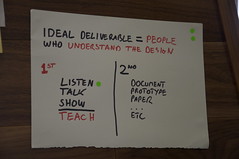
Wall of DeliverablesImage by Yandle via Flickr

"I'm spending all week this week in a training. This is also my last week on my current rotation, which means I have some projects to finish. This makes being unavailable 7 hours a day very inconvenient. Due to said training, I now completely despise the following words: "synergies", "deliverables", "results-oriented" and "tranche". We're only 2.5 days in. I'm sure there will be more."


Carrie in Are You a Whiiiiiiiiiiiner??

from FS Blog: Worldwide Available
My Opinions Are Mine and Mine Alone


Tuesday, December 15, 2009

Insider Quote: He Who Runs On is White Noise

"It has become increasingly apparent over these months that I have a problem, and it is all-too-common in the new-to-bureaucracy demographic. Ladies and gentlemen, I am too prosaic for my own good. Wordy, even. So, in recognition of this situation, I made an early New Year’s Resolution: to become “cogent Ben.”

You see, in a culture where millions of words are exchanged daily in the form of telegrams, e-mails, cables, and faxes, He Who Runs On is the one considered white noise. People like succinct and they like punch. There’s only 24 hours in a day and heaven forbid we waste these precious seconds working our minds around passive voice and dangling modifiers. Naturally, we would want to avoid this anyway — it is just terrible writing, after all — but simple S-V-O should be considered the sentence structure du jour."

By Ben Just Spit it Out Already from FS Blog: Random Neural Firings

Tuesday, November 17, 2009

Quickie: English Lessons Via Mobile Phones

Several mobile phonesImage via Wikipedia

Rhys Blakely of Times Online reports that the British Government has joined forces with the six largest mobile operators in Bangladesh to unveil the world’s largest project to teach a language using mobile phones (UK to teach English in Bangladesh via mobile | November 16, 2009). Excerpts:

Starting this week a scheme managed by the BBC World Service and funded by the British Government will offer the 50 million Bangladeshis who own mobile handsets the opportunity to dial up a series of three-minute-long English lessons for 3 takas (2.5p) each — less than the cost of a cup of tea at a roadside stall in Dhaka. […] With three billion mobile phones now in use globally (compared to 1.5 billion television sets), the use of handsets as educational tools is increasingly being explored. […] In Thailand, graduate students sit tests via text message, while in Japan — where mobile phones outnumber computers five-to-one — handsets have been used for several years to teach English as a second language. One survey found that 70 per cent of Japanese students preferred receiving lessons on mobile phones than on computers. […] Mobile learning may be particularly useful in countries where populations are widely dispersed, such as in Mongolia, where special English lessons have been developed for waiters and bank tellers, which are distributed through text messages.

Exciting times for micro-learning! Read the whole thing here.

Friday, August 28, 2009

Lessons Learned Resources

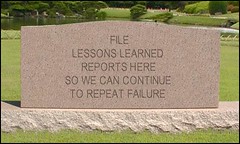
Lessons Learned. SureImage by Mike Licht, NotionsCapital.com via Flickr

I have put together a compilation of lessons learned resources with some relevance to the State Department and the Foreign Service here. The web page is live in googlepages and will be updated as needed; a new link is added from Diplopundit's Online Resources for easy access (see right side-bar). Any suggestion for additional materials would be deeply appreciated. I also found this Mike Licht image of a lessons learned tombstone. He writes in his blog that "A “Lessons Learned” report is a ceremonial corporate mea culpa that will be swiftly embalmed, buried, entombed in archives, and unread by the next set of leaders, who will embark on similar misguided projects of their own." I hope that is not the case here.

Hard Lessons: The Iraq Reconstruction Experience | Released by SIGIR in January 2009

Hard Lessons concludes with 13 lessons drawn from 6 difficult years of Iraq reconstruction. Virtually all the leadership interviewed for this report agreed that the US approach to contingency relief and reconstruction operation needs reform.

Oral Histories: Iraq Provincial Reconstruction Teams | 2008-2009

The Iraq PRT program has highlighted the challenges that the U.S. government faces in conducting operations in conflicted environments. The Iraq PRT Project collected insights and lessons learned from government, military, and non-governmental officials. Interviews were conducted by the Association for Diplomatic Studies and Training under a contract with the Institute of Peace.

Includes interviews with 72 Government Officials from 2008-2009. There are also several interviews of military officers and NGO personnel.

Provincial Reconstruction Teams in Iraq | Special Report, March 2007

This report examines the U.S. experience with PRTs in Iraq, notes shortcomings, and suggests ways they could be more effective. The report is based on statements by panelists at a public forum held at the Institute on February 14, 2007, and on interviews conducted by the author with government agencies and commercial contract firms that participate in the PRT program. Report is by Robert M. Perito, senior program officer at the United States Institute of Peace.

Oral Histories: The Sudan Experience Project | 2006-2007

Sudan's North-South Comprehensive Peace Agreement (CPA) is a unique example of an effort by the international community to negotiate and to implement a peace agreement. The Sudan Experience Project Oral History Library contains the transcripts of nearly 100 interviews with those who negotiated and who are implementing the CPA. These first person accounts and the lessons learned from their experience are a substantial contribution to our understanding of the challenges of negotiating and implementing complex peace agreements. Includes interviews with 33 Negotiators and 57 Implementers taken from 2006-2007.

Oral Histories: Afghanistan Provincial Reconstruction Teams | 2005 In November 2005, there were 22 PRTs in Afghanistan: nine were directed by the U.S. and countries belonging to the NATO-led International Security Assistance Force directed the other 13. The Afghanistan Experience Project collected lessons learned by Provincial Reconstruction Teams by interviewing 52 government officials, military officers, and representatives of international and non-governmental organizations who had served in Afghanistan. Interviews were conducted by the Association for Diplomatic Studies and Training under a contract with the Institute of Peace.

Includes interviews with 52 Government Officials in 2004-2005. There are also several interviews of military officers (12) and IO/NGO personnel (4).

The U.S. Experience with Provincial Reconstruction Teams in Afghanistan: Lessons Identified | Special Report, October 2005 This report is the product of the United States Institute of Peace's Afghanistan Experience Project. It is based on extensive interviews conducted with American and foreign officials, soldiers, and representatives of nongovernmental organizations that worked directly with Provincial Reconstruction Teams in Afghanistan. It also reflects interviews conducted with a broad range of contacts during the author's visit to Afghanistan in June 2005. The report discusses lessons identified by those who served in Afghanistan. It is intended as a training aid for developing programs that prepare American personnel for service in peace and stability operations. Robert M. Perito, Coordinator of the Afghanistan Experience Project at the U.S. Institute of Peace, prepared this report.

The 9/11 Commission Report | Public report released on July 22, 2004

The National Commission on Terrorist Attacks Upon the United States (also known as the 9-11 Commission), an independent, bipartisan commission created by congressional legislation and the signature of President George W. Bush in late 2002, is chartered to prepare a full and complete account of the circumstances surrounding the September 11, 2001 terrorist attacks, including preparedness for and the immediate response to the attacks. The Commission is also mandated to provide recommendations designed to guard against future attacks.

Friday, August 21, 2009

Quickie: Consul-at-Arms' Manner of Substance

Film poster for Protocol (film) - Copyright 19...Image via Wikipedia

Consul Leslie Slote over at Consul-at-Arms has an excellent post on Manners of Substance. A "must read" especially if you're just starting out in the FS or if you are managing ELOs in your section. Quick excerpts below:

On INVOCATIONS & BENEDICTIONS Show some respect. I don't care what your personal religion is or what you think the Bill of Rights says about not respecting religions (that's not actually what it says, look it up); if the bishop or chaplain or shamen says "Let us pray" (or the local equivalent, then you've got to show that you respect your hosts.

On NATIONAL ANTHYMS Learn to recognize them, both our own and that of the host country. No one will expect you to sing the local national anthym (it's not yours, after all), but you should recognize it and show respect when it's being played or sung.

On SPEAKERS

If someone is giving a speech, turn your fool cell phone to vibrate only. People will understand if you pull out your phone and look at it, even get up and head towards and exit. After all, diplomats can get genuinely emergent calls at any time and no one should get bent out of shape. But if the prime minister's speech is interrupted by the American vice consul's cell phone everyone is going to remember it. Yes, lots of local guests will fail to heed this and their cell phones will ring and they may or may not be embarrassed. Don't worry about them; worry about you. And worry about your reputation.

* * *

You really should read the whole thing here. In addition to the cited references by Consul-at-Arms, Diplopundit has put together additional protocol items listed below that you might find useful.

Related Items:

Monday, August 10, 2009

US Embassy Iraq: 5 Years Later, Some Questions Answered

Former U.S. Ambassador to Iraq John D. Negropo...Image via Wikipedia

The US Embassy in Iraq opened on July 1, 2004 in the Green Zone, in the former palace of Saddam Hussein. Early this year, the Embassy moved to a new compound and had a dedication ceremony on January 5. Last month, the Office of the Inspector General (OIG) released a report on US Embassy Baghdad.

There’s one thing I like about reading those OIG inspection reports; they occasionally provide us with answers to nagging questions. Diplopundit has been quiet perplexed about the large number of ambassadors and former ambassadors serving in Iraq. I realized that Iraq was a foreign policy priority in the previous eight years, but I was concerned about the number of ambassadors congregating in one single post. The practice sent a signal, unintentional it may be that “at grade” FS officers could not cut the cake, thus higher ranking officers were required. So a perfectly talented DCM in Beijing could not get to Baghdad, because a perfectly talented former ambassador was going to Baghdad as DCM.

Previously, I was aware of three former and current chiefs of mission in Iraq in addition to Ambassador Crocker (Patricia Butenis, then DCM who was previously US Ambassador to Bangladesh; Robert Ford, then POL Counselor who was previously Ambassador to Algeria and J. Adam Erile, the PD boss who was credentialed as US Ambassador to Bahrain). It turned out there were more ambassadors in Iraq than I thought and there was a reason for their recruitment and presence in Iraq. According to the OIG report:

“At the time of the inspection, seven active or former chiefs of mission were working as embassy section heads or as the DCM in Baghdad; the Ambassador had personally recruited all of them. This concentration of senior Foreign Service talent reflected the importance of Iraq and was congruent with the rank structure of the U.S. military with whom they worked.”

I don’t know what the rank structure was during the Petreaus-Crocker partnership, but right now the MNF-I has General Ray Odierno, with Lieutenant General Chris Brown CBE as his deputy and there’s Command Sergeant Major Lawrence Wilson. Oh, plus seven other senior military officers with the ranks of Lt. Gen, Major General and Brig. General. The FS is a much smaller organization (more band members in the military) so it does makes you wonder about congruence. I wonder how many ambassadors and former chiefs of mission did we send to Vietnam during the war for rank structure congruence? The Historian’s Office thought the question was “quite intriguing” but says it does not have the resources to perform such complex research for the general public. I should note that we sent entry-level diplomats to Vietnam straight out of A100 in the late 1960’s (including apparently a whole class in 1969). Richard Holbrooke, yes that one, who was then 22 years old, was a USAID provincial representative in the Mekong Delta.

* * *

I’m no longer young enough to know everything. I’ll admit that I’ve always found the staffing at the US Embassy in Baghdad (and not just the presence of multiple ambassadors) a mystery. I understand that even AFSA was in the dark on the embassy’s staffing pattern there.

Take the example of political officers in Iraq. No other US embassy in the world has this many political officers; not Moscow, nor Delhi, not even Beijing. No other post, that is – except Iraq and of course, Saigon previously. Makes you wonder why the concentration of poloffs in Baghdad? Now it can be told …. Here is what the OIG says about the Political Section staffing/operation at the US Embassy in Baghdad (long excerpt):

Led by a seasoned Arabist, a large section of 25 officers produces well-informed reporting on Iraqi politics. Despite security constraints, political officers maintain extensive contacts with Iraqi politicians, though meetings outside the International Zone require elaborate protective details. The quantity of reporting has declined in the past year but its quality has increased, as the section carried out a plan to send a smaller number of higher value cables tightly targeted to policy concerns.

This section of 25 officers is overstaffed. Its numbers were determined in 2007, when Ambassador Crocker requested a civilian surge to match the military’s surge of troops. Crocker cabled that he needed up to twice as many political officers, including more qualified Arabists. The Department was unable to provide enough Arabic speakers — the section has only three or four available at any one time — but it did agree to double the number of officers. The result is overly narrow portfolios, competition for information and contacts, and more reporting than is strictly needed. Officers returning for a second tour found “more bureaucracy but less real work” this time around.

The OIG team reviewed positions carefully with the political minister-counselor and concurred with his conclusion that the section would have higher morale and productivity with fewer officer positions, though it cannot function with fewer than two OMS positions because of gaps from the frequent R&Rs. The Embassy has already identified positions it wishes to cut.

The weakest aspect of reporting is the lack of tools to support it. Too many officers keep track of their contacts on back-of-the-envelope systems, some of them little more than stacks of business cards. The biographic information needed for successful meetings in the Middle East is dispersed in several files where it is difficult to find. The Embassy’s strategy of relying on a contractor in the Ambassador’s office for some of its most important contacts suffered when the contractor departed post and took his files with him rather than turning them over to the political section.

Short assignments and constant rotations also place a premium on the transfer of knowledge from departing officers to new ones. In theory, mandatory overlaps allow each new arrival to be trained by a predecessor, but departing officers are often too exhausted to pass needed information on. There are few standard operating procedures (SOPs). Many officers consider their pre-deployment training weak, particularly in tradecraft.

These problems are compounded by the absence of a deputy responsible for day-to-day management of the section. Following the Ambassador’s instructions, the minister-counselor focuses on substance. Three co-equal unit chiefs focus on the section’s products rather than its processes. Strong as the minister-counselor is in mentoring individuals, he cannot effectively manage a section this large without a full-time deputy who could create more tools to support reporting officers, including SOPs, “smart books” on portfolios, and a contact management system that is accessible to all section officers. The latter could contain protected estimates of reliability, be searchable by issue as well as by name, and be interoperable with protocol and other contact databases.

Okay, first -- I still could not wrap my head around that part about having a civilian surge to match the military’s surge of troops. You’d think that the work requirements would be identified first before you calculate the number of officers needed to tackle the requirements. But apparently it works the other way around. Still one has to wonder where that order really came from – the Front Office in Baghdad or the Seventh Floor in Foggy Bottom.

On a related note, read Patricia Kushlis of WhirledView on Iraq is not Vietnam and the PRTs are not CORDS). A WhirledView commenter was as perplexed as I was:

“I don't know what they DO actually do, but delivering demarches, arranging cultural exchanges, negotiating agreements with, say, the national science agency, reporting what you heard on the street -when you don't speak the language - just ain't it. WHAT ARE THOSE 1000 "diplomats" DOING that they must risk life and limb for - and further risk the deaths of innocent bystanders if they venture out of the Green Zone with their Praetorian Guards? Going in harm's way in order to pretend that we have a normal diplomatic relationship with a fully independent government????? Nonsense...nonsense on stilts.”

Now the civilian surge – um, excuse me – civilian uplift is on in Afghanistan.While the rightsizing train may be winding its way down US Embassy Baghdad, recruitment for Kabul and its provinces is gearing up. So what used to be the Iraq tax, can now be technically called the Aftax. How many jobs are currently vacant at your post because of personnel shifting assignments to Afghanistan (and Pakistan)? I won't be surprise of course, if the top dog assignment cycle is now called - Iraq, Afghanistan, Pakistan Bid Cycle. I do wonder if State has learned anything from Iraq on staffing a diplomatic mission in a war zone. No, Pakistan is not a war zone, but we might call it an area of supreme interest with its own corresponding civilian uplift. Wouldn’t this just be the perfect topic for that proposed Lessons Learned Center (LLC) for the State Department? Second -- lack of systematic knowledge transfer and continuity is hardly a surprising end result. This is a problem with some embassies and consulates as well, but exacerbated in Iraq due to shorter tours in a much more stressful and demanding environment. On the dispersion of biographic information into multiple files which make them difficult to find -- whatever happened to the Net-Centric Diplomacy project? (The OIG talked briefly about NCD in its semi-annual report to Congress 2008-2009). The NCD’s intent as I understand it is for information sharing not hoarding. But how would that work in an environment like Baghdad where there is competition for information and contacts? Simple - human behavior trumps technology. Also, a contractor departed post with his files, developed through his work under USG, of which I presumed he was handsomely compensated -- and we let him get away with it? One more thing for the LLC.

Finally, on the seasoned Arabist leading the POL section at the time -- perhaps I should add that any job under the Chief of Mission is very much like being a band member; you follow the direction of the band leader, and you don’t ever play your own song. That’s that, unless you have another job lined up. On that item about results over process and day-to-day management -- I have to wonder if perhaps somebody out there took to heart Tony Lake’s ideas on this. In Somoza Falling (A case Study of Washington at Work p.285) , he argues that we need to have diplomats of “individual brilliance…” men and women who understand foreign societies, who can relate to foreign realities …policy generalist and not, not managers.

But – if you can’t manage the chaos, how can you find that “individual brilliance?” One more thing for the LLC.

Related Item: Embassy Baghdad, Iraq: Report Number ISP-I-09-30A, July 2009 http://oig.state.gov/documents/organization/126600.pdf

Sunday, August 9, 2009

Video of the Week: Barry Schwartz on our loss of wisdom

Barry Schwartz makes a passionate call for "practical wisdom" as an antidote to a society gone mad with bureaucracy. He argues powerfully that rules often fail us, incentives often backfire, and practical, everyday wisdom will help rebuild our world.

Excerpt from talk: Practical wisdom," Aristotle told us,is the combination of moral will and moral skill." A wise person knows when and how to make the exception to every rule,as the janitors knew when to ignore the job duties in the service of other objectives. A wise person knows how to improvise, as Luke did when he re-washed the floor. Real-world problems are often ambiguous and ill-defined and the context is always changing. A wise person is like a jazz musician --using the notes on the page, but dancing around them, inventing combinations that are appropriate for the situation and the people at hand. A wise person knows how to use these moral skills in the service of the right aims.To serve other people, not to manipulate other people. And finally, perhaps most important, a wise person is made, not born.Wisdom depends on experience,and not just any experience.You need the time to get to know the people that you're serving. You need permission to be allowed to improvise,try new things, occasionally to fail and to learn from your failures. And you need to be mentored by wise teachers. Full transcript is here.

In his 2004 book The Paradox of Choice , Barry Schwartz tackles one of the great mysteries of modern life: Why is it that societies of great abundance — where individuals are offered more freedom and choice (personal, professional, material) than ever before — are now witnessing a near-epidemic of depression? Conventional wisdom tells us that greater choice is for the greater good, but Schwartz argues the opposite: He makes a compelling case that the abundance of choice in today’s western world is actually making us miserable. Infinite choice is paralyzing, Schwartz argues, and exhausting to the human psyche. It leads us to set unreasonably high expectations, question our choices before we even make them and blame our failures entirely on ourselves. His relatable examples, from consumer products (jeans, TVs, salad dressings) to lifestyle choices (where to live, what job to take, who and when to marry), underscore this central point: Too much choice undermines happiness.

From ted.com

Thursday, July 23, 2009

FS Blog: Calling a Spade a Spade

The Consular Officer writing under the name NoDoubleStandards has been blogging since April 2009 so his blog Calling a Spade a Spade (Rants of a Foreign Service Officer on the things that matter to you -- and matter to you not at all) is not really new. But in case you missed some of his great posts particularly on the consular trade or his advice for new FSOs, check out these links below:

"These Faces and These Places Are Getting Old" - Daughtry

The Challenge of Effective Consular Management of Locally-Employed Staff

Visa Interview Pet Peeves

Advice for New FSOs from Someone Who Has No Business Giving It