Showing posts with label Diplomatic History. Show all posts

Thursday, May 19, 2011

Department of State Operations Center Celebrates 50th Anniversary

According to the Office of the Historian, the Department of State established the Executive Secretariat in Mar 1947 to regulate the flow of information within the highest levels of the Department. Its functions have included such various assignments as Protocol (prior to 1955), management of the Department's Operation Center (since 1962) and preparation of briefing papers about the Department during the transitions between Presidential administrations.

The Operations Center (S/ES-O) as you may already know is the Secretary of State's and the Department's communications and crisis management center. Working 24 hours a day, the Ops Center monitors world events, prepares briefings for the Secretary and other Department principals, and facilitates communication between the Department and the rest of the world. The Operations Center also coordinates the Department's response to crises and supports task forces, monitoring groups, and other crisis-related activities.

Since the Secretary is marking the 50th anniversary of the Ops Center, she must have better information than the Historian's Office. Or it could be that the Ops Center was created in 1961 but its management was not placed under the Executive Secretariat until 1962.


Below is part of Secretary Clinton's remarks on the 50th anniversary of the Ops Center:
Now, thanks to the Ops Center, we can stay connected, and it certainly is a lot easier today than it was in 1961. And many of us have stories. I just want to mention one or two that really have impressed on me what we are dealing with when we give an assignment to the Ops Center.
Now, one evening, I wanted to speak with an ambassador who was visiting Washington, so of course, I asked Ops to find him for me. And a few minutes later, the phone rang, and it was the ambassador on the line, and Ops patched me through. It was to me just sort of matter of fact, simple exchange. Only later I learned that the ambassador did not have his cell phone with him. So Ops called a member of his staff, who said that the ambassador was out to dinner, but he didn’t know where. Ops called the ambassador’s hotel and learned that the concierge had recommended three restaurants – (laughter) – but they didn’t know which one he chose. So Ops called them all, sent a picture of the ambassador, asked them to scan their dining rooms until he was found. And all of this happened in a matter of minutes, and I didn’t know anymore than the fact that I’d asked for and received the connection that I was looking for. That is perseverance. (Laughter.)

Another one of my favorite stories happened just this past March. Some of you might remember that in the very early days of the action over Libya, we had a plane go down, and we had two pilots who had, unfortunately, had to bail out of those planes. One of those pilots in the Libyan Desert was found by a man who had once received an educational grant from the State Department. Members of Congress, I hope you are listening. (Laughter.) So this Libyan gentleman didn’t know what to do with this American pilot that he had literally stumbled upon. So what did he do? He called Ops. (Laughter.) (Applause.) And what did Ops do? Well, Ops called the Defense Department – (laughter) – and said, “Oh, by the way, we have your pilot. Why don’t you come pick him up?” (Laughter.)

And when the earthquake struck Haiti, people called Ops not only from all over the world, but from damaged buildings inside Port-au-Prince, and Ops helped to organize their rescue.

And as we’ve already heard about Pat Kennedy, our absolutely inveterate responder to any bad weather anywhere, when Cheryl Mills was traveling back from Haiti in the middle of what turned out to be that huge snowstorm last year and had to be in the office for our follow-up work on what we were doing regarding Haiti, her plane was first diverted to New York, then she had to get on a train that was still running to Washington. And I think she might have thought, “Okay, fine, if I can just get to Washington, I’ll be lucky. I can get to the office.” But of course, there was no transportation; everything had been shutdown except for Ops. So Ops sent people with shovels and coffee and a 4-wheel drive – I think driven by Pat Kennedy – (laughter) – to pick her up at Union Station.

Now, we know, too, that as the work of the State Department goes on, there’s always something happening somewhere in the world. And sometimes it’s not as dramatic as rescuing – helping to rescue a downed American pilot, but it’s just as important to the people who are involved in very difficult circumstances. So we were working feverishly to evacuate United States citizens from Tripoli and all of Libya, but particularly our Embassy family and those Americans who were in Tripoli, and we hired a ferry to bring them all out. And the ferry made it from Malta to Tripoli.

We worked tirelessly to get permission from the Libyan officials to make sure we could get our people picked up, and then the ferry sat in the harbor for three days. The weather was terrible, the seas were high. And what did Ops do? Well, they supplied the ferry captain with up-to-the-date weather reports from the Navy, they comforted the families by saying that, “We’ll stay on this line with you as long as it takes.” They set up a conference call for me so that I could talk to our people who were on the ferry. And when the ferry finally arrived in Malta, I was in the Situation Room waiting to hear that the ferry had arrived so that we then could take much more vigorous public action against the Qadhafi regime. And Ops sent me the news and then sent out a news alert worldwide.

Now, the 60 men and women who work at the Ops Center are among the most talented Foreign Service – civil service officers that we have. We know that the jobs can be grinding. We know that it’s rare that we have an occasion like this with television cameras who are here to celebrate what you do every day, and you don’t ask for this kind of attention, but you really do make the State Department run.

And so I am delighted to say thank you. I want to thank you for your supreme professionalism, your cool-headedness, your resourcefulness, and above all, your commitment to help absolutely anyone who calls your number. Because when the phone rings at Ops, whatever time it is, somebody is there. And somebody is there not just to answer the phone and then fob them off to another day or another person, but to really understand what needs to be done. And that makes it possible for us to do our work here.

And it’s very exciting for us to have two of our esteemed secretaries of state here with us. And I think that Secretary Eagleburger actually was there at the creation – (laughter) – and so I think we should invite him to the podium, followed by Secretary Albright, who just wore out Ops – (laughter) – during her time. And I hear some knowing laughter, because I know she made phone calls than probably her ten predecessors and successors did. But please join me in welcoming first Secretary Eagleburger and then Secretary Albright. (Applause.)

Full remarks posted here.


Tuesday, May 10, 2011

US Ambassador to Hitler's Germany in Erik Larson's 'In the Garden of Beasts'

Image from
http://eriklarsonbooks.com/
William Edward Dodd (1869-1940) of the state of Illinois was appointed as political ambassador to Germany in June 1933.  He presented his credentials on August 30, 1933 and resigned from post on  December 29, 1937.

In the nonfiction book, In the Garden of the Beasts, Erik Larson pens the story of  William E. Dodd, the history professor from Chicago who was chosen by President Roosevelt to be America's first ambassador to Nazi Germany and Dodd's daughter, Martha, who was 24 years old and "came along for the adventure, and to escape a dead marriage."

The book scheduled for released today is already #9 in Amazon's bestsellers list. If you have read Larson's The Devil in the White City [2004] about the 1893 Chicago World's Fair and a serial killer masquerading as a charming doctor or Thunderstruck [2007] about Guglielmo Marconi, the inventor of wireless telegraphy and a notorious murder in London, this one should not disappoint.

TRACES, a non-profit educational organization created to gather, preserve and present stories of people from the Midwest and Germany or Austria has a lengthy account of Ambassador Dodd in Germany. Excerpts below:

As Washington’s diplomatic mission in Germany required a staff to represent the United States in Berlin, Franklin Roosevelt chose William Edward Dodd to fill the ambassadorial position. Dodd arrived in Berlin in the early summer of 1933 with no experience in diplomacy, yet hoped to propagate the ideals of Woodrow Wilson and felt optimistic about developing close relations with the recently installed Nazi regime. He swore before leaving for Berlin that “Germany can hardly fail to realize the importance of friendly cooperation with the 120,000,000 people of the United States, and the United States can hardly fail to realize the value of economic and social cooperation with the land of Luther, Stein and Bismarck.”

When he first arrived in the German capital, Dodd became encouraged by the warm welcome then-President Paul von Hindenburg extended him, for the two exchanged speeches calling for cooperation and friendship between their countries. Soon, however, the brutality of the Nazis became obvious. Within Dodd’s first six months in Berlin, for example, over twenty cases were reported of Nazis assaulting U.S. citizens who refused to yield their salute. This—as well as Germany’s moratorium on debt repayments—disillusioned the former University of Chicago history professor. He spoke against Berlin’s political and economic policies, as well as attacks in the German press on New York Mayor La Guardia, U.S. women and the United States in general. His protests, however, meant little.
[...]
The Nazi regime not only embittered Dodd, but also strained his relations with Washington. After four frustrated years he resigned as the U.S. Ambassador to Germany. Dodd had become so openly critical of the Nazis that Hitler gave him no farewell audience, the German Foreign Minister omitted the customary dinner for departing diplomats and the German press did not even mention his departure. In a statement he made upon his return to the U.S., Dodd confessed that he had found representing the United States in Hitler’s Berlin a hopeless task. “In a vast region where religious freedom is denied, where intellectual initiative and discovery are not allowed, and where race hatreds are cultivated” he asked, “what can a representative of the United States do?”
[...]
William E. Dodd’s enthusiasm to work with the officials of the German government under Hitler paled early in his career as the United States Ambassador to Germany. Repeatedly throughout his stay in Berlin he considered leaving his post, feeling frustrated at his seeming inability to affect the Nazi regime or represent the United States as he saw fitting. Finally, he no longer could bear to stay in the Third Reich and in late July of 1937 sailed for the United States to confer with President Roosevelt about his wish to resign, visit a number of important public officials, attend the funeral of a longtime academic colleague and see how the crops fared that year at Round Hill, the Dodds’ beloved farmland retreat in Virginia.

Dodd stayed in the United States that visit for two and a half months, returning to Hitler’s Germany only when he could no longer avoid attending to diplomatic duties. On Friday 29 October he noted with resignation in his journal: “In Berlin once more. What can I do?” With little choice but to immerse himself back into the work which had led him away from his professorship at the University of Chicago in 1933, Dodd soon recorded “I have had three busy days reading documents and recent newspapers to get the drift of things”.

On 3 November Dodd reported that although he had asked to be “relieved” on 1 September 1937, President Roosevelt strongly requested him remain in Berlin until 1 March 1938. He confessed “I feel I must go because of the unbearable tension of Nazi Germany, my increasing years, and the difficulty of writing the other volumes of my Old South [a historical series] if I wait much longer.” Dodd summarily executed his duties—receiving other foreign diplomats, attending receptions and official parties, meeting various dignitaries—yet he counted the days until he could leave Fascist Germany. A decent, idealistic man detained in a country he no longer could tolerate because of loyalty to his own land and conflicting ideology, Dodd struggled to maintain public appearances, often meeting with German officials yet secretly loathing doing so. At an annual bar association ball, for example, he met a “quite interesting Judge of the People’s Court,” yet to avoid debate “We talked German history, since present conditions cannot easily be discussed.”

Read in full here.

Check out Erik Larson's website here.


Wednesday, March 30, 2011

William J. Burns -- to Move Up as Deputy Secretary of State

If confirmed would only be the fourth career diplomat in history to become Deputy Secretary


You probably already saw the news that the Deputy Secretary of State Jim Steinberg is leaving the #2 job at the State Department.  He will reportedly become the dean of the Maxwell School of Public Affairs at Syracuse University.  Secretary Clinton has announced via email to SD staff that President Obama intends to nominate career diplomat, Bill Burns, the current "P" as Mr. Steinberg's successor.     

State's Historian's Office has a quick recap of the #2 position:  Congress created the position of Deputy Secretary of State in the Foreign Relations Authorization Act of 1972, approved Jul 13, 1972 (Public Law 92-352; 86 Stat 490), to replace the Under Secretary of State as the second ranking officer in the Department. The Deputy Secretary serves as the principal deputy, adviser, and alter ego to the Secretary of State; serves as Acting Secretary of State in the Secretary's absence; and assists the Secretary in the formulation and conduct of U.S. foreign policy and in giving general supervision and direction to all elements of the Department. Specific duties and supervisory responsibilities have varied over time.

If the Secretary of State resigns or dies, the Deputy Secretary of State also becomes Acting Secretary of State until the President nominates and the Senate confirms a replacement. In 2008, Secretary Clinton appointed both James Steinberg and Jacob J. Lew to the position of Deputy Secretary of State, the former for policy and the latter for management and resources.  Mr. Lew had since returned to OMB and was replaced by Thomas Nides

If confirmed, Bill Burns would become the 17th Deputy Secretary of State and only the fourth to come from the career Foreign Service. Previous Deputy Secretaries to come from the professional ranks are:  Walter John Stoessel, Jr. (February 11, 1982–September 22, 1982) under President Reagan, Lawrence Eagleburger (January 20, 1989–August 19, 1992) under President G.H.W.Bush and  John Negroponte (February 13, 2007– January 19, 2009) recalled from retirement under President G.W.Bush.

Below is Ambassador Burns as Under Secretary for Political Affairs, as he testified recently at the SFRC on "developments in the Middle East."


Excerpts:
Less than three months ago, a desperate Tunisian street vendor, tired of too many indignities and too many lost hopes, set fire to himself and sparked a revolution still burning across an entire region. That single tragic act, has brought the Middle East to a moment of profound transformation, as consequential in its own way as 1989 was for Europe and Eurasia.
[...]
The long-held conceit of many Arab leaders was that there were really only two political choices – the autocrats you know or the Islamic extremists you fear. That provided a convenient rationale for blocking real political outlets or broadened participation, and it ultimately produced the spontaneous protests in Tahrir Square and elsewhere throughout the region. We have long recognized the tinder that was accumulating in the region, the combustible mix of closed systems and corruption and alienation and indignity documented so eloquently in the Arab Human Development Reports.
[...]
As much as it is in our long-term interest to support the emergence of more transparent and more responsive governments, who will ultimately make stronger and more stable partners, the short-term is likely to be complicated and maybe even unsettling.
[...]
Successful transitions are about a lot more than just elections; institutions have to be built too, supportive policies, effective checks and balances, and an independent media to hold governments accountable. There will be plenty of vulnerabilities, and no shortage of predatory extremists ready to exploit them. And there will be plenty of hard tradeoffs for American policymakers, with popularly-elected governments sometimes taking sharper issue with American policies than their autocratic predecessors did, and elections sometimes producing uncomfortable results.

Full testimony available here (pdf).

Clinton's letter to the SD staff is here (h/t to The Cable's Josh Rogin).

More on the 7th floor shuffle including the top contenders for the "P" job here from The Envoy's Laura Rozen.


Monday, February 14, 2011

Insider Quote: first to be exposed and last to be rescued ...

Aerial view of the US Embassy, Saigon, showing...Image via WikipediaJackie Bong Wright
—Saigon 1975

Locally Employed Staff,

US Embassy Vietnam


I served as a Vietnamese employee.  I think that we were the first to be exposed and the last to be rescued.  And we had to be there to face disaster or crisis.  And at that time many Americans already left and we were Vietnamese.  We were to stay and to be there to be open – to open our doors.  And I personally, because of my history, my husband, Nguyen Van Bong, was assassinated by the Communists in late 1971, and I was the chairman of the board of the Vietnamese American Association.  I felt that I was prone to be a target of the Communists, the Vietnamese Communists.  Therefore, I had to try to leave.  And the day I asked someone at the U.S. Embassy to help a lot of members of my family – cousins, aunts, uncles and everyone – came to my house and asked to be rescued.  And I said even myself, I didn’t know how.  And fortunately at the last minute, I was asked to go, and I had the opportunity to be so-called married to an American pilot.  But many, many Vietnamese were there.  They stayed and they were not lucky, and they were put in jail.  Many of my friends, my colleagues from the VAA, from USIS, from the U.S. embassy affiliated offices and also with the U.S. companies.  Quite a few of them, including my brother.  My brother who had spent six years in the U.S. came back in early April.  He was asked to register, and he went to a refugee camp.  The Communists said that because he was related to the U.S., and being in the U.S. for six years, he was certainly connected to be CIA.  So he went to a refugee camp, concentration camp, and prison.  And he died of bad treatment.  A lot of my friends, Vietnamese friends, suffered the same fate.

Read the whole thing at US Diplomacy.


Tuesday, February 1, 2011

Obama's Reagan Moment - In Egypt, Ambassador Frank Wisner as Paul Laxalt??

The news that retired Ambassador Frank Wisner was on his way to Egypt could not have been good news for those at the presidential palace in Cairo.

Via MSNBC:

The New York Times reported that former U.S. ambassador to Egypt Frank Wisner arrived in Cairo and delivered Obama's message. The Times said Wisner told Mubarak that Obama was not sending a blunt demand to step aside now, but offering firm counsel that he should make way for a reform process that would culminate in free and fair elections in September for a new Egyptian leader.

The back channel message, authorized directly by Obama, appeared to tip the administration beyond the delicate balancing act it has performed in the last week — resisting calls for Mubarak to step down even as it has called for an “orderly transition” to a more politically open Egypt, the Times said.

Via NYT:
Mr. Wisner, who had been expected to leave Egypt on Tuesday but decided to extend his stay, is among the United States’s most experienced diplomats, and a friend of Mr. Mubarak. His mission was to “keep a conversation going,” according to a close friend of Mr. Wisner.

As a result, this person said, the administration’s first message to the Egyptian leader was not that he had to leave office, but rather that his time in office was quickly coming to a close. Mr. Wisner, who consulted closely with the White House, is expected to be the point person dealing with Mr. Mubarak as the situation evolves, and perhaps as the administration’s message hardens.
In 1986, it took all of 20 days for the Reagan Administration to defriend Ferdinand Marcos of the Philippines.


Quick recap:
  • On 11 February in 1986, four days after a fraudulent Philippine election, then President Reagan blamed both sides causing a huge public outcry.
  • By 14 February, Reagan's special ambassador, Philip Habib arrived and met with Filipino leaders in Manila.
  • On 15 February, as the Philippine National Assembly was about to declare Marcos the winner, Reagan questioned the credibility of the election.
  • On February 22, the country's Defense Secretary and Armed Forces Chief of Staff withdrew their support for the Marcos Government
  • On 24 February, at 5 a.m. Monday, the White House issued a statement saying: "A solution to this crisis can only be achieved through a peaceful transition to a new government."
  • On 25 February, there were two presidential inaugurations - one for Corazon Aquino and another for Ferdinand Marcos
  • At 9 o'clock the evening of 25 February, the Marcos family and tag-alongs were on their way to Clark Air Force Base.
  • 26 February 1986, Marcos and his party arrived in Hawaii.

More of the blow by blow account of those 20 days in February here.


On February 26, 1986, David Hess reported on Sen. Paul Laxalt's (R., Nev.) chore for then President Reagan at the very end of the Marcos regime in the Philippines: 

About 4:30 p.m. Monday, Sen. Paul Laxalt (R., Nev.) bluntly told Ferdinand E. Marcos by telephone: "I think you should cut and cut cleanly. I think the time has come."

Laxalt, in advising Marcos to surrender the Philippine presidency to his rival, Corazon C. Aquino, insisted later that his remarks - unbound by diplomatic niceties - were his own and not those of President Reagan. But at a briefing yesterday, White House spokesman Larry Speakes acknowledged that Laxalt's counsel reflected the President's sentiments.

Time.com has more in The Philippines Anatomy of a Revolution:
Was it true, as U.S. Ambassador Stephen Bosworth had told him, that President Reagan was calling for a "peaceful transition to a new government" in the Philippines? While the two men talked, Laxalt said later, it became apparent that Marcos was "hanging on, looking for a life preserver. He was a desperate man clutching at straws." He asked whether the reference to a "peaceful transition" meant he should stay on until 1987, when his current term was originally supposed to end, and he wondered whether some sort of power-sharing arrangement with the Philippine opposition could be worked out.

Marcos spoke of his fear that his palace was about to be attacked, but seemed determined to stay on as President. At Marcos' request, Laxalt then went to the White House, where he discussed the conversation with Reagan and Secretary of State George Shultz. The President repeated his desire for a peaceful, negotiated settlement in the Philippines and said once more that Marcos would be welcome if he decided to seek sanctuary in the U.S. But Reagan said he thought the idea of power sharing was impractical and that it would be undignified for Marcos to stay on as a "consultant."

At 4:15 p.m. Laxalt called Marcos, who immediately asked whether Reagan wanted him to step down. Laxalt said the President was not in a position to make that kind of demand. Then Marcos put the question directly to Laxalt: What should he do? Replied the Senator: "Mr. President, I'm not bound by diplomatic restraint. I'm talking only for myself. I think you should cut and cut cleanly. The time has come." There was a long pause that to Laxalt seemed interminable. Finally he asked, "Mr. President, are you still there?" Marcos replied, in a subdued voice, "Yes, I'm still here. I am so very, very disappointed."

In Manila it was after 5 o'clock in the morning of the longest day of Ferdinand Marcos' life. Before it was over, he would attend his final inauguration ceremony, a foolish charade carried out in the sanctuary of his Malacanang Palace. That evening, a ruler no more, he would flee with his family and retainers aboard four American helicopters to Clark Air Base on the first leg of a flight that would take him to Guam, Hawaii and exile.

Read more here.

Five years later, the Philippine Senate refused to ratify the treaty on one of the largest US defense facility in the world.


We don't know what will happen to Egypt tomorrow, but it's not totally unfamiliar. 


At 6:45 EST, President Obama had this remarks on the situation in Egypt.  Video here.


Friday, January 21, 2011

January 20, 1981: The Iran Hostages - 30 Years Later

Thirty years ago yesterday, fifty-two U.S. diplomats and public servants were released after spending 444 days as hostages at the US Embassy in Tehran, Iran. Below is a clip from Andrea Mitchell's show with former hostages Ambassador L. Bruce Laingen (US chargé d'affaires when the embassy was overrun by student protesters) and Ambassador John W. Limbert.


Tuesday, December 21, 2010

Oh gosh, if you're reading the Pentagon Papers at work, you could still get in trouble 39 years after it was leaked

Unless of course, the same folks watching the leaky ports where the alleged leaker downloaded gigabytes of data are still on duty, in which case, they probably would not feel the need to fumigate your unclassified computer and unclassified mind asap, given that the original leak happened so long ago. 

1971 -- what was that even like? President Richard Nixon declared the U.S. War on Drugs and see we're still fighting that.  And the 26th Amendment to the United States Constitution, formally certified by President Richard Nixon also lowered the voting age from 21 to 18.  Cost of a gallon of gas was 40 cents. A house is 25K.  Texas Instruments released the first pocket calculator and the first Internet Chat rooms appeared.

Did you know that the first Cat Scanner was also produced by EMI that year? I had no idea!  In June that year, the New York Times also started publishing the Pentagon Papers.  Apparently, in all the intervening years that the Pentagon Papers have been in the public domain, and in public libraries and later in digital libraries, even in Amazon.com, and online -- well, the  past 39 years, the Pentagon Papers are still classified!


Via John Prados of the National Security Archive | Can Government Employees Read the Pentagon Papers? December 14, 2010

Those who have been following the wikileaks affair will have noticed the recent prominence of Dan Ellsberg, who leaked the Pentagon Papers in 1971.  Ellsberg, in many respects, was a predecessor to wikileaks, and has provided insightful commentary regarding the current situation.  So what has happened to the  43 volumes that  Ellsberg leaked 39 years ago?

You might be dismayed to learn that the Pentagon Papers are still classified as TOP SECRET!

This is despite the fact that The Pentagon Papers have long been in the public domain.
[...]
The classification of the Pentagon Papers takes on an even stranger significance when one considers the federal government’s recent pronouncement that “unauthorized disclosures of classified documents (whether in print, on a blog, or on websites) do not alter the documents’ classified status or automatically result in declassification of the documents.”

This is the reason –in the case of Wikileaks– why the Government has been demanding that US government employees refrain from looking at any of these documents, even if doing so hampers their ability to fulfill their mandates.  If this standard holds true, government employees should not be allowed to read (or reference, or cite) the Pentagon papers either.

This classification policy might be more understandable if US declassification efforts were more forthright and better managed.  But the opposite is the case; the Pentagon Papers are an excellent example.  The US government continues to refuse to declassify them—and not for lack of public interest.
[...]
So today, 39 years later,  the ultra-secret negotiating material from the “diplomatic volumes” of the Pentagon Papers (which even Ellsberg refused to release) has been declassified, but the well-read 43 volumes that have been available to the public to since 1971 remain Top Secret.  The Archive continues to fight for the official declassification of the bulk of the Pentagon Papers.
Read the whole thing here.

One for the Huh? News -- but it is so vexing.  I just do not understand the rationale behind this.  Is there even one?   


Tuesday, November 9, 2010

Scare the kids: You will die as a midlevel Washington bureaucrat ...

The 4 min 4 sec video below So You Want To Be A Diplomat was created by Georgetown's School of Foreign Service students, Morgan McDaniel, Amanda Lanzillo, and Mike Madoff and posted in xtranormal. H/T to Two Crabs. We got our three laughs for the day!


What they forgot was to include the view from the Brits like -- "unthinkable” for a diplomat to “produce babies." How about “the clever woman would not be liked and the attractive woman would not be taken seriously." Also, "the trouble with you women is that you will go and get married.”

Read Alex Barker's piece, Britain’s first female diplomats in FT magazine. It is quite a romp down diplomatic history.


Sunday, October 10, 2010

What? No senior Department of State officer resigned in protest?

Marc Grossman, former ambassador and Under Secretary of State for Political Affairs (#3 official at the State Department) and now Vice Chairman of The Cohen Group has written a piece in the September 2010 issue of Prism about Diplomacy Before and After Conflict.  He writes:

Secretary of State Henry Kissinger wrote in Years of Upheaval about the second term of the Nixon administration that State Department culture emphasizes negotiability, which is a consciousness of what the other side will accept.10 Kissinger did not consider this trait a particular positive at the time, and the department's culture of negotiability did not serve as a good guide to institutional behavior for most of the senior State officials who participated in the interagency debate leading to the invasion of Iraq. If that was so during the period surrounding 1970s détente with Russia, diplomatic efforts with the Shah of Iran, and the crisis in the Middle East and the resulting 1973 war, this culture of negotiability no longer served as a good guide to institutional behavior for most of the senior State officials who participated in the interagency debate leading to the invasion of Iraq. We took part in planning for the conflict and its aftermath assuming—or hoping—that events either at home or abroad would turn preparations for conflict into successful coercive diplomacy rather than the military action that was ordered in the spring of 2003.

The State Department's Director of Policy Planning, Richard Haass, observed that while he was "60:40 against going to war . . . no organization could function if people left every time they lost out on a 60:40 decision."11 Haass was operating under the belief that Iraq had weapons of mass destruction; if he had known they did not, he says he would have been 90:10 against the war.

And no senior Department of State officer resigned in protest. The department sought instead to try to recreate the successful Gulf War coalition of President George H.W. Bush and argued that the United States and its allies might compel Saddam to submit through a deployment of force in the region in early 2003. If this failed, there should be a sustained diplomatic effort to create a broad coalition to move militarily later in 2003. This possibility of a broad international coalition lost all relevance on January 20, 2003, when the French government announced that it would never support a second UN Security Council resolution to authorize the use of force in Iraq.

The State Department, understandably is a rank conscious organization.  But there were three diplomats who resigned over the Iraq War. And at least one of the three, we know for sure, was a member of the Senior Foreign Service.

John Brady Kiesling resigned on March 7, 2003, the first US diplomat to quit in protest over US policy toward Iraq.  He was at that time the Political Counselor at the US Embassy in Greece.  We don't know if he was in the Senior Foreign Service when he resigned but he was the number #3 top official at the US embassy in Athens.  John Brady Kiesling's letter of resignation:
Mr. Secretary, I have enormous respect for your character and ability. You have preserved more international credibility for us than our policy deserves, and salvaged something positive from the excesses of an ideological and self-serving Administration. But your loyalty to the President goes too far. We are straining beyond its limits an international system we built with such toil and treasure, a web of laws, treaties, organizations, and shared values that sets limits on our foes far more effectively than it ever constrained America s ability to defend its interests.
I am resigning because I have tried and failed to reconcile my conscience with my ability to represent the current U.S. Administration. I have confidence that our democratic process is ultimately self-correcting, and hope that in a small way I can contribute from outside to shaping policies that better serve the security and prosperity of the American people and the world we share.

In a letter dated three days after Brady Kiesling's resignation, John H. Brown, a Princeton PhD and a senior member of the Foreign Service since 1997, also resigned in protest:
Throughout the globe the United States is becoming associated with the unjustified use of force. The president's disregard for views in other nations, borne out by his neglect of public diplomacy, is giving birth to an anti-American century.

I joined the Foreign Service because I love our country. Respectfully, Mr. Secretary, I am now bringing this calling to a close, with a heavy heart but for the same reason that I embraced it.

When asked about this recently, John Brown says, "a career change, for whatever reason, is a personal decision. [...] But I simply could not see myself normally "going to work" at the State Department after President Bush announced his decision to invade a country, having for months "catapulted" http://www.youtube.com/watch?v=VxnegxNEDAc  fabrications that, in my view, were propaganda at its worst and demeaned public diplomacy at its best -- the kind of PD I aspired to practice as an FSO involved in press and cultural affairs for over 20 years."

The third US diplomat to resign was Ann Wright.  At the time of her resignation, Wright was the deputy ambassador at the U.S. embassy in Ulaanbaatar, Mongolia. She helped open the U.S. embassy in Kabul, Afghanistan, in January 2002. Mary (Ann) Wright's letter of resignation to Secretary of State Colin Powell: 
This is the only time in my many years serving America that I have felt I cannot represent the policies of an Administration of the United States. I disagree with the Administration's policies on Iraq, the Israeli-Palestinian conflict, North Korea and curtailment of civil liberties in the U.S. itself. I believe the Administration's policies are making the world a more dangerous, not a safer, place. I feel obligated morally and professionally to set out my very deep and firm concerns on these policies and to resign from government service as I cannot defend or implement them.

Ann Wright was recently honored by an ArtRage Gallery exhibit that celebrates those who speak their minds,a thought-provoking exhibition of 28 portraits depicting a cross-section of "Americans Who Tell the Truth," (the Norton Putter Gallery, on Hawley Avenue in Syracuse). h/t to DMW.

In syracuse.com, Katherine Rushworth  writes about the exhibit by Maine-based artist Robert Shetterly, culled from a collection of 150 portraits. Some of the subjects selected were critical voices in the post- 9/11 lead up to the Iraq War; but others spoke their minds at earlier times, for different, but no less controversial and/or vital causes.
 
Click on image to enlarge view
Courtesy of ArtRage Gallery via syracuse.com


Friday, September 17, 2010

Embed diplomacy as a core “proficiency” in the US Army?

Mohammad Yaqub Khan with Britain's Sir Pierre ...Image via WikipediaThe world is getting more complicated everyday.

A few weeks ago, we heard that the State Department is building its own mini-Army in the wake of the troops drawdown in Iraq. It will soon have its own helo-fleet.  American diplomats and civilians heading to the warzones are now routinely trained in Indiana in offensive driving, weapons training and a whole lot more... we're trying to get diplomats to be like, you know, transformed ....to make them more like troops?...I don't know .... but send them to the boondocks for sure ...give them something more than skillcraft pens....

Now, Spencer Ackerman has an interesting piece over at Danger Room: Army Asks Itself: Shouldn’t We Be Diplomats? Quick excerpt:

Oh, for the simple days, when adversaries sent their diplomats to negotiate political disagreements and sent in their armies when talks broke down. Now, a small group of soldiers and civilians are packing themselves this week into the suburban Virginia offices of a major defense contractor to hash out how to make troops more like… diplomats.

A decade in Iraq and Afghanistan has taught the U.S. Army — painfully — that the world no longer works that way. There probably aren’t going to be any experienced diplomats on hand at Combat Outpost Middle-Of-Nowhere, so soldiers have to engage in DIY Diplomacy. Platoon commanders in their early twenties need to go from directing artillery fire one minute and sipping tea with the potentates of the town they just shelled the next. And their late-twenties company commanders may end up negotiating truces or even alliances of convenience with the bad guys who prompted the artillery barrage in the first place.

That’s where something called Unified Quest comes in. Every year, the Army’s chief of staff instructs talented mid-career and senior officers and senior enlisted (wo)men to evaluate where the service is falling short — and propose remedies. On Tuesday, about 120 soldiers and their civilian and foreign-military friends (and even some Marines) swarmed onto the manicured northern Virginia campus of mega-consultant Booz Allen Hamilton to kick off the first four-day debating bull session for Unified Quest 2011, to figure out how best to cultivate the next generation of Army leaders. One answer, hotly debated by the 25 or so soldiers and civilians in attendance: make them better diplomats.
[...]
Others on the panel argued to broaden the scope of what Army negotiations are for. They’re not just to persuade opposing or neutral forces. One war veteran remembered, “I spent a lot of time negotiating with my international partner, to get around his national limitations” on engaging in combat. Another pointed out that “it also allows us to build alliances across the interagency” — an ironic statement, considering that the Army might not be so deeply in the negotiations business if the State Department was more willing and able to send its diplomats out to Combat Outpost Middle-of-Nowhere. (Interestingly, according to one of the conference’s public-affairs people, there aren’t any State Department representatives participating in Unified Quest.)

After monthly debating sessions on Unified Quest end in April 2011, Dempsey will provide its holistic view on how the Army needs to prepare its next generation to his boss, General George Casey, the Army’s chief of staff.

Casey will decide whether to accept and how to implement Unified Quest’s instructions on everything from ethics in warfare to cyber operations. The chief is an advocate of Unified Quest — a photo of his face graces the cover to the Official Unified Quest Looseleaf Binder. Still, convincing him to embed diplomacy as a core “proficiency” of the next round of majors and colonels might take some negotiation.


Read the whole thing here.

In my long years as a watcher, I've never seen or heard of State do something like the Army's Unified Quest.  For one thing, I don't think the agency ever had enough money to do a powwow in Booz Allen Hamilton's campus to do mega-brainstorms like this.  The other reason, of course, is bench strength. There is just not enough people out there. DOD has more band members, more lawyers, more PD folks, more of everything when it comes to resources.  State has to make do with persistent staffing gaps (Congress' fault and partly its own for bull headed rigidity) and limited resources sucked up in priority war zones 1 and 2, and almost war zone posts.

That's not an excuse, dudes.  It just is.  Decades in the making, through several secretaries of state and a fickle Congress who was never quite enamored with diplomats. 

Now, the warrior diplomats -- they have historical precedents, of course. An example below from across the pond.

In the 1800s, the Brits wanted a diplomatic mission in Kabul after Russia sent an envoy there. When the Afghans refused, the British government launched the Second Anglo-Afghan war in 1878. We all remember that, right?  A British major was tasked to negotiate a treaty to end the war, and did so successfully. He was knighted and appointed envoy in Kabul only to be shot and killed (together with all his security guards) by the locals.

Did not turn out very well.

In the case above,  the Brits shoot first and talks followed. Is that going to be our new model in the world of the future where America is in perpetual war?

Now-- if the Army gets to be diplomats, also -- might Congress just decide to defund the diplomatic service? Probably not. After all, USAID is still around, despite the proliferation of aid groups within the federal government.

Of course, one never knows. There is an election down the road, and these are crazy times indeed.


Wednesday, April 7, 2010

Quote: Stereotyping diplomacy, sounds familiar?

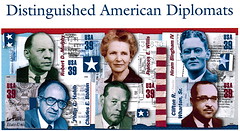
Distinguished American DiplomatsImage by misterbisson via Flickr
"Stereotyping diplomacy is very easy to do. We suffer from it enormously and we haven’t found any very effective response. There was a case the other day, about travel advice, in the light of recent sad events in the Yemen and Uganda, where a spokesman for the Travel Agents Association or something says - the Foreign Office travel people are bow-tied ex-Oxford types - if anything could be further from the truth I can’t imagine but that is the stereotype she wanted to portray because she feels that strikes a chord particularly in the tabloids and perhaps more generally across British public opinion."

Sir David Gore-Booth
Former British Ambassador to India
British Diplomatic Oral History Project | 1999
David Alwyn Gore-Booth, diplomat and banker (1943- 2004)


Thursday, March 18, 2010

The First Civilian Surge and a Lesson from History

James Traub writing in Foreign Policy on America’s nation-building efforts says “let’s face it, America isn’t very good at nation-building,” (see Surge Incapacity | FP | March 8, 2010):  Excerpt: 

The United States' first "civilian surge" took place in August 1901, when 500 teachers disembarked from the USS Thomas, a converted cattle ship, in Manila Bay -- "the men wearing straw boaters and blazers," according to journalist and historian Stanley Karnow, "the women in long skirts and large flowery hats. Like vacationers, they carried baseball bats, tennis rackets, musical instruments, cameras and binoculars." America's colonial enterprise was new: Only a few months had passed since the Army had subdued a fierce insurgency and commenced governing the Philippines. The Thomasites, as this proto-Peace Corps came to be known, had responded to an advertisement placed in newspapers across the United States.

The State Department and U.S. Agency for International Development (USAID) no longer have to put ads in the papers to assemble a civilian force for the state-building effort now under way in Afghanistan, but it's remarkable how haphazard, and almost frantic, the system remains. "It's a numbers game," a USAID official told me, "a body game." Only a few of the 400-odd civilians USAID has hired so far have either language or technical skills; most are either eager youngsters or post-career officials from the military, State, or USAID. Jack Lew, the deputy secretary of state who is overseeing the process, says that "it's proved incredibly difficult to take on such an urgent challenge when you don't have a deep enough bench."
[…]
The fiasco in Iraq demonstrated even to the ideologues that you couldn't win the war unless you won the postwar as well; and the postwar required civilian capacity. In April 2004, the National Security Council established the Office of the Coordinator for Reconstruction and Stabilization to orchestrate postwar operations. Carlos Pascual, the first director (and now ambassador to Mexico) drew up a plan to field a rapid deployment force of civilian specialists backed by a pool of 3,000 reservists. The cost of building the quick force and deploying it for three months would be a paltry $350 million a year. The money was put in the State Department's budget, and then cut by the White House. As Pascual explained to me several years later, the Pentagon believed in the new force, but the civilian agencies, ironically, did not. The civilian force died yet another death.

Read the whole thing here.

What Mr. Traub did not include in his piece is that although the first “civilian surge” occurred in August 1901, the United States did not recognize the independence of the Philippines and relinquish American sovereignty over the Philippine Islands until July 4, 1946.  A good 45 years after the initial civilian surge. 

Clark Air Base was in operation from 1903 to 1991. Subic Naval Base was in operation from 1899-1992. The Philippine Senate in 1991 finally rejected the extension of the Military Bases Agreement of 1947 during the post-Marcos era. According to its Wikipedia entry, “on November 24, 1992, the American Flag was lowered in Subic for the last time and the last 1,416 Sailors and Marines at Subic Bay Naval Base left by plane from NAS Cubi Point and by the USS Belleau Wood. This withdrawal marked the first time since the 16th Century that no foreign military forces were present in the Philippines.”

Something else here from the pages of history:

One of the US bases negotiators during the Marcos regime was the youngest Assistant Secretary of State for East Asian Affairs.  That man is no other than the current S/SRAP Richard Holbrooke who was A/S for the EAP Bureau under president Carter from 1977-1981.  See  Waltzing with a Dictator -Marcos (must-read chapters #9 on Bases and #10 on Visitors to Manila): 
"I made Philippine policy," says Richard Charles Albert Holbrooke. It is a boast, but it is not an exaggeration.[...] In the Philippines Holbrooke joined Landsdale and Byroade in the exclusive club of individuals who had a singular impact on the policy and the country (p.172).
“In Washington […] December 1978 was a time for rejoicing for Holbrooke and his staff. “We are euphoric,” Holbrooke recalled. “We’d had a hell of a December.” The bases negotiations were completed, and something else Holbrooke cared about, and had played a role in achieving, had come to fruition: Carter announced on December 16 that US-China relations would be normalized.” (p.254, Waltzing with a Dictator, Raymond Bonner).  
 
I don't know the answer to this -- I'm just thinking out loud..  If we take these pages from history on the Philippines, might the United States still be in Iraq and Afghanistan in 2050 if it’s deemed to be in the national interest? It was communism then, it is terrorism now ....


Wednesday, March 3, 2010

Books on Life in the Diplomatic Fold

Lest you think that State’s internal culture is a new subject -- you can read  A Theory of Public Bureaucracy: Politics, Personality, and Organization in the State Department by David Warwick from Harvard Press (1975).  There is also Managing Diplomacy (1984) where career diplomat, Harrison M. Holland writes about it at length (see pages 172-187). The surprising thing is how the organization has both changed and remained the same in so many ways. The most recent book about the service is Career Diplomacy: Life and Work in the U.S. Foreign Service by former Foreign Service officer, Harry Kopp and the late Ambassador Charles Gillespie (former ambassador to Grenada, Colombia and Chile). The last one is a good read, although it does not go deep enough on the internal life of the organization:


Saturday, February 20, 2010

Alexander Haig, 59th SecState Dies at 85

Alexander Haig who was Secretary of State from January 22, 1981 to July 5, 1982 under Ronald Reagan passed away today at the age of 85. He was White House Chief of Staff under Presidents Richard Nixon and Gerald Ford. He was also as the 7th Supreme Allied Commander Europe, commanding all U.S. and NATO forces in Europe from December 15, 1974 to July 1, 1979

From the State Department’s Office of the Historian:

Alexander Meigs Haig, Jr. was appointed Secretary of State by President Ronald Reagan and assumed the
office on January 22, 1981. He served a relatively short time in office, facing many challenging situations before stepping down on July 5, 1982.

As Secretary of State, Haig had hoped to restore the Department of State to the dominant position in foreign policy-making that it had lost during previous administrations. However, the United States faced many challenges during the time that Haig served as Secretary of State, including the Soviet presence in Afghanistan, the Solidarity movement in Poland, disputes with the People’s Republic of China over trade and Taiwan, escalating tensions between the United Kingdom and Argentina, and a new round of conflict between Israel, Lebanon, and Syria. He also had to deal with the intra-government turmoil that followed in the wake of the attempted assassination of President Reagan.

Haig did have some diplomatic successes, particularly in regards to relations with China, where he forged a balance that both stabilized relations with the PRC and allowed for the continuation of arms sales to the government on Taiwan.

He also strengthened the NATO alliance and helped to re-orient the focus of U.S. foreign policy back toward the Soviet Union, both of which reflected the overall foreign policy priorities of the Reagan Administration.

Nevertheless, his efforts to broker diplomatic resolutions to the disputes over the Falkland Islands and in the Middle East did not succeed. Throughout his tenure as Secretary, Haig was overshadowed in foreign policy matters by other members of the Administration and was thus unable to fully control the Administration’s diplomatic process. He resigned from office after only 18 months.


Tuesday, January 12, 2010

The ‘Palmer Effect’ on the US Foreign Service

Caption: "The old state department buildi...Image via Wikipedia


FSO Alison Palmer once worked as social secretary to a US ambassador’s wife 

Cape Cod Times has an article on Alison Palmer’s battle against the U.S. State Department which began in the 1970s when she couldn’t land Foreign Service officer jobs because of her gender (Wellfleet resident's lawsuit broke ground for women | January 11, 2010). Excerpt below:

In 1976, when she was in her mid-40s, Alison Palmer brought a class-action discrimination suit against the U.S. Department of State because she was tired of being passed over for jobs as a Foreign Service officer.

Palmer is now 78. Last month, more than 20 years after winning her case, Palmer decided with her attorneys to agree to terminate the lawsuit, said one of Palmer's attorneys, Elisabeth Lyons, who was practicing with a Washington, D.C., firm at the time. On Dec. 18, the U.S. District Court for the District of Columbia, upon an agreement by the parties, dismissed what has come to be known as "the Palmer Case."

The parties agreed to dismiss the class action because the State Department had finally demonstrated compliance with court orders, made reparations to affected women and modified hiring and personnel systems.
[…]
She was hired as a Foreign Service officer in 1959 and specialized in African affairs. She served in what was then the Congo in central Africa and then-British Guiana on South America's northern coast. The State Department then paid for her to attend Boston University for a master's degree in African studies, which she completed in 1970.

But after the federal government had invested in her future, and despite her graduate degree, Palmer was turned down for two assignments in Africa after ambassadors wrote that they didn't want her because she was a woman. A third ambassador in Ethiopia also said he didn't want her because she was female. She ended up as a social secretary to his wife.
[…]
In 1975, 9 percent of Foreign Service officers were women, according to Leader. As of 2007, it was 37 percent, according to the State Department.

"Why not 51 percent, the same as the general population?" Palmer said.

Read the whole thing here.

According to this, a Court Order dated January 19, 1989, found that the Department of State (“State”) had discriminated against women in the administration of a written examination that applicants for positions in the Foreign Service were obliged to take. As part of the relief awarded, it enjoined State from administering any written examination that had an adverse impact upon women.

In 2002, plaintiffs and State entered into a Consent Decree. Pursuant to the decree, the court certified as a class all female applicants who took, but did not pass, the 1991, 1992, 1993, or 1994 Foreign Service Written Examinations. The decree also permitted 390 members of the plaintiff class to participate in the Oral Assessment phase of the Foreign Service application process. These women, referred to as the invitees, had the highest non-passing scores on the 1991-1994 examinations.

I could not  find the 1989 or the 2002 court documents, but have included links to some of the Palmer case documents available online below.


Related Items:
Palmer Case Documents:

Mar 24, 1987 DC

May 11, 1990 DC

May 11, 1990 | United States Court of Appeals, District of Columbia Circuit.

Palmer v. Rice

Palmer Documents