Showing posts with label Elections. Show all posts

Friday, January 13, 2012

The Newtster's Pick for Secretary of State Endorses the Mittster

Secretary Rice announces the nomination of Joh...Image via WikipediaRemember last December when I blogged about Newt Gingrich's pick for Secretary of State? He told some crowd that he would appoint former United Nations Representative John Bolton as his Secretary of State.

But Ambassador Bolton had somebody else in mind. On January 11, Ambassador Bolton announced his endorsement of Mitt Romney on Fox News’ “On the Record” with Greta van Susteren. He called the Mittster “the person who can best lead the party, best articulate our conservative principles, and is most likely to beat Barack Obama.”

What took you so long, John B.? Iowa by eight votes? Check.  NH by 39.3%? Check. A 32% projected vote range in the Palmetto state? 

WaPo's Jennifer Rubin may have the answer:

"I spoke to former U.N. ambassador John Bolton this morning about his endorsement last night of Mitt Romney. He said he has been contemplating for some time whether to endorse a GOP candidate. “I just thought you oughta decide at some point,” he said. He said it was critical that he back someone who could beat President Obama. “I do think Governor Romney is the best candidate to defeat Obama. Jim Baker [former secretary of Treasury and state] gave me some great advice: ‘Keep your eye on the prize.’ ”
By Friday the 13th, the former U.N. ambassador has showed that can be one of the Mittster's fiercest attack dogs of President Obama's foreign policy. Via CBS:
"He's not only the most radical president in history domestically; he is the first president, Republican or Democrat, at least since Franklin Roosevelt, who didn't get up every morning thinking first about what threats the United States faces. [...] He just doesn't care about national security the way other presidents did,"  Bolton said of President Obama to an audience (in Hilton Head, South Carolina).
Keeping his eye on the prize, no doubt. Maybe he'll be able to parachute to Foggy Bottom from a Romney plane ...   


Sunday, January 8, 2012

Ambassador Huntsman's Country First, Gov Romney's Country First Only If ...

"He criticized me while he was out raising money for serving my country in China, yes, under a Democrat, like my two sons are doing in the United States Navy. They're not asking who -- what political affiliation the president is. I want to be very clear with the people here in New Hampshire and this country: I will always put my country first. And I think that's important to them."

Ambassador Jon Huntsman
Former U.S. ambassador to China (2009-April 2011)


The Mittster's response: “I think we serve our country first by standing for people who believe in conservative principles and doing everything in our power to promote an agenda that does not include President Obama's agenda.”

So if the Mittster had served under G.W.Bush in whatever capacity during the Iraq War, that would have been considered "serving the country first" but had the Romney sons served in the mountains of Afghanistan instead of campaigning for their dad in this election year, that would not be "serving the country first?" 

Service to our country is a worthy undertaking only if ... ohhh man ... what a character! Hookay, I think I get it now.

OTB points out that Ambassador Huntsman is not the first Republican to serve under a Democrat in the White House: "Wendell Wilkie spent two years in a Europe at war as President Roosevelt’s personal ambassador. The fact that Wilkie was a Republican and Roosevelt a Democrat didn’t matter, Wilkie was serving his country. Similarly, Henry Cabot Lodge Jr., who had been Richard Nixon’s running mate in the 1960 Presidential election, served as Ambassador to Vietnam for Presidents Kennedy and Johnson from 1963 to 1967, and then Ambassador to West Germany under LBJ for the last year of his Presidency."


Thursday, December 15, 2011

Quickie: The State Department Nightmare on C. Street, and It's Not Friday the 13th

Just saw a piece by Ben Adler, an editor at The Nation about the State Department's worst nightmare. Iran? Iraq? Pakistan? Sorry, none of the above. If you want to get a decent sleep in the next 11 months, you might want to skip this one.  Excerpts:

One of Newt Gingrich’s many peculiar fixations stands out as especially troublesome: his hatred of the State Department. Gingrich has recently been attacking career civil servants there in hostile terms, complaining that they are “Arabists” who advocate “appeasement” of America’s enemies.
[...]
The ideological roots of Gingrich’s views go back quite a bit farther than 2003. “It’s a critique we’ve heard periodically from the right since the McCarthy witch hunts,” says Jeffrey Laurenti an expert on international affairs at the Century Foundation. “They want to ensure that only people loyal to supposed ‘Americanist’ values work in the State Department and that it should not be contaminated by understanding the way others think.”

When implemented, these ideological purges have damaged the effectiveness of the State Department and American foreign policy. “It blinded American policymakers to what was happening in China [in the late 1940s and early 1950s],” says Laurenti. According to Laurenti, John Foster Dulles chased out the analysts who best understood the civil war that was going on China because their correct analysis, that the communists would win, was not what politicians wanted to hear. Some would argue that the resulting chilling effect on the way civil servants approached their job had terrible reverberations in years to come, possibly causing Washington to misunderstand the situation in Vietnam in the 1960s by believing that Hanoi was a puppet of Beijing. “This is a formula for blinding America’s leadership to what is happening on the outside,” says Laurenti. “When the State Department has been cowed by the political class in Washington to not report what it sees, we’ve had catastrophic failures: not just China in ‘49, but Iran in ’78–’79.”
[...]
“Career people in the State Department who have served under [Bolton] just felt very strongly his involvement in trying to promote the most conservative and ideologically rigid Foreign Service officers and to ignore anyone providing information inconsistent with what he already believed,” says Laurenti.

So what would happen if Bolton were appointed Secretary and charged with carrying out Gingrich’s transformation of the State Department? Revolt, dysfunction, and ultimately probably an exodus of the best analysts and Foreign Service officers. “The notion that whatever you report in the field is going to be vetted by some ideological litmus test would be extremely demoralizing,” warns Laurenti. But Gingrich’s dream of an addendum to the Pentagon instead of a department of diplomacy would be fulfilled.

Quotable quotes:
 “[Gingrich] wants to take the country back on foreign policy that even George W. Bush had some sense to reject towards the end of his second term in office,” says Brian Katulis, an expert on national security at the Center for American Progress. “Trumpeting John Bolton as a diplomatic brand worth selling is kind of like the Ford Motor Company trying to revive the Pinto.”
“Putting John Bolton in charge of the State Department would be like making Aman al-Zawahiri commandant of the Marine Corps,” says Lawrence Wilkerson, retired United States Army Colonel and former chief of staff to United States Secretary of State Colin Powell. 

This is not the first time, the Newtster has gone after the State Department, of course. Back in 2003, he too, was hysterical over the department's Arabists and Foggy Bottom's failure in his view to "communicate" after our troops went into Baghdad. Below is an excerpt from a 2003 article from time.com:
"Gingrich says the State Department is broken, and must be fixed. But for the kind of "diplomacy" he's talking about, the fiscally disciplined thing to do would simply be to abolish it altogether, and replace it with megaphone mounted atop a Bradley Fighting Vehicle."

This is not like Rick Perry's airhead moment. The Newtster has been thinking about C. Street improvement needs, repairs and fixin' and decorating  and reconstruction for ahhh long time now .... speaking of transformation, a bureau of diplomacy inside the Pentagon is the next horror film on option.


Wednesday, December 7, 2011

US Embassy Kinshasa Restricts Personnel and Family Members to Residences Until Further Notice

Ambassador Entwistle served
as an international election
observer in Kinshasa.
Photo from US Embassy Kinshasa/FB
The US Embassy in Kinshasa released an emergency message for U.S. citizens in the Democratic Republic of the Congo, announcing the embassy personnel restrictions and potential roadblocks in the aftermath of the country's presidential election.
12/6/2011 | The U.S. Embassy has restricted U.S. Embassy personnel and their family members in Kinshasa to their residences effective at 6 p.m. on December 6, 2011, until further notice.

At any time, there is the potential for roadblocks to occur spontaneously throughout the city, manned by police or military personnel.  In these situations, you are strongly advised to obey all commands by armed security personnel.

The U.S. Embassy in Kinshasa will have minimal staffing on December 6-7, 2011, and the Consular Section will be open only for emergency American Citizen Services.
The American School of Kinshasa (TASOK) will be closed from December 5-7, with further updates on Wednesday evening December 7.

A number of international airlines have cancelled flights in and out of Kinshasa on the 6th and 7th of December.

Further updates are planned daily at 6 p.m.  Additional messages may be sent on a more frequent basis as the security situation evolves.  As SMS capabilities have been limited and are likely to remain irregular and unreliable, it is important to frequently check your email messages and review Embassy Kinshasa’s website for the latest Emergency Messages to U.S. Citizens.

On November 28, U.S. Embassy personnel in Lubumbashi and Kananga were instructed to remain in place until further notice.

On December 2, the embassy informed U.S. Citizens in the DRC that U.S Embassy personnel are returning from Lubumbashi to Kinshasa due to general election related security concerns.

On December 4, the embassy issued a message reminding U.S citizens that Embassy personnel and their family members in Kinshasa are not permitted to travel outside the Gombe neighborhood, and are urged to exercise caution and remain vigilant at all times. This restriction includes travel to the N’djili airport.

Kinshasa is a consumable post, which means our embassy folks have edible foodstuffs and personal maintenance items at their residences and will not go hungry while they are restricted to their residences. However, there is no telling how long the restriction would last. 

DRC is also a critical crime post. The 2011 Crime and Security Report on Kinshasa indicates that the overall crime and safety situation in the DRC can best be described as tenuous and volatile.  The report which is put together annually by the embassy's security office also says that "the breakdown of civil order could occur at any moment in Kinshasa and is our most important security concern."

A 2009 report put the number of American citizens who live in the Democratic Republic of the Congo (mainly around Kinshasa) at approximately 1500.  A few American tourists visit the country annually and residents primarily include missionaries and business representatives.


Thursday, June 16, 2011

2011 AFSA Election Results, a Disappointing Turn Out

The AFSA Committee on Elections announced the results of the 2011-2013 AFSA Governing Board Election without much fanfare. I actually had to write to AFSA to inquire about the public release of the results since I could not locate them in the AFSA website. I was told that the results were released to the membership; and can be found here (see in archives dated June 10). I am told it will also be printed in the September issue of the Foreign Service Journal.

According to AFSA, a total of 2,523 ballot envelopes were received of which 2,510 were valid ballots (13 were voided due to ballot irregularities). For comparison, there were 3,326 ballots cast in the 2009 elections. So some 800 AFSA members who voted in 2009, did not vote in the 2011 elections.

AFSA represents over 28,000 active and retired Foreign Service employees of the Department of State and Agency for International Development (AID), as well as smaller groups in the Foreign Agricultural Service (FAS), U.S. & Foreign Commercial Service (FCS), and International Broadcasting Bureau (IBB). The AFSA website indicates that its has over 15,000 dues-paying members. This means that approximately 17% of the members voted in this election, down by 7% from the number of voters in the 2009 election. A disappointing turn out but not totally unexpected.

Via AFSA:
The following AFSA members have been elected:

Officer Positions on the Board

President:
Susan Johnson (elected), 1,479 votes
Tex Harris, 986 votes
Treasurer: Andrew Winter, 2,066 votes
Secretary: Susan Shultz, 2,001 votes
Retiree Vice President: Robert Houdek, 1,139 votes
State Vice President: Daniel Hirsch, 622 votes.
USAID Vice President: Francisco Zamora, 113 votes
FCS Vice President: Keith Curtis, 34 votes.
FAS Vice President: David Mergen, 27 votes.

Constituency Representatives of the Board


Retiree Representatives (4 vacancies):
Molly Williamson (elected), 855 votes
Edward Marks (elected), 798 votes
Hugh Neighbour (elected), 752 votes
Mary Ellen Gilroy (elected), 749 votes
State Representatives (10 vacancies):
Matthew Asada, 688 votes
Kenneth Kero-Mentz, 675 votes
Kimberly Krhounek, 667 votes
David Zwach, 663 votes
Elise Mellinger, 661 votes
Les Hickman, 657 votes
Mary Glantz, 18 write-ins
Joyce Namde, 13 write-ins
William Bent, 6 write-ins
Grace Choi, 3 write-ins
USAID Representatives(2 vacancies):
Michael Henning, 117 votes
Dennis M. Fuentes, 1 write-in
FCS Representative: Steve Morrison, 34 votes
FAS Representative:
Andrew Burst, 1 write-in (determined by coin-toss)
IBB Representative: Zero votes.

See the full list here.


State VP Daniel Hirsh who was reelected for his second term and who has pledged not to run again in 2013 writes: " I am committed to advancing the reforms to AFSA's elections process which were stymied by our opponents during the past two years.  This includes, first and foremost, a bylaws amendment regarding term limits. [...] Somewhere along the way, AFSA has lost your trust. We will do better - I will do more - to make AFSA relevant to you."


Tuesday, April 26, 2011

Don't be a passhole, go vote in the AFSA Elections

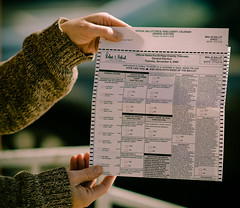
Ballot bokehImage by iceman9294 via FlickrA passhole is "someone who opts out of participating in a decision, but then complains bitterly about the outcome."

Don't be one. Elections have consequences. Go vote in the AFSA elections. 

The ballots were mailed to all constituencies on April 1, 2011. Some important dates to remember.

# June 2, 2011 Ballots counted
# June 6, 2011 Elections Committee declares results
# July 15, 2011 New board takes office
I have written many times previously about the contentious AFSA elections in 2009. I have not always agreed with AFSA, and the previous election had left a sour taste in the mouth of many. That said, I also think that Foreign Service folks would be in a real bad shape without an active, forceful and effective advocate.  

In the aftermath of the 2009 elections, I blogged about the details behind the numbers and found the following:
Active-duty State employees are the largest voting bloc in AFSA at 63.3% of the total membership. In this election, State employees account for 1,459 of the total votes or 43% of the votes counted. However, 1,459 votes out of approximately 8,801 due-paying members amount to only 16.57% of this constituency. In short – only slightly more than 15% of active-duty State AFSA members sent in their votes.

Retirees are the second largest constituents of AFSA at 26.4% of the total membership. In this election, AFSA retirees account for 1,568 of the total votes or 47% of the votes counted. However, 1,568 retiree votes out of approximately 3,670 dues-paying retiree members amount to 42% of this constituency. In short – almost half the total AFSA retiree members sent in their votes.
This is not to say that the retirees should not have a voice in the direction of the organization.  But the active members of the Foreign Service, as the largest voting bloc and as the folks who have been repeatedly deployed to warzones, hardship/unaccompanied and dangerous assignments in the last decade, and who will continue to deploy to increasingly challenging assignments in the years ahead -- they need to have their voices heard, in shall we say, more appropriate collective tone of voice.

And-- they won't have their voices heard unless you, the active members, participate in greater number in the process of picking your own representatives.

The Foreign Service has changed in so many ways in the last decade alone. I think candidates who are on active duty, who have served in warzones or hardship assignments, who have specialized skills in management, human resources, and other functional skills, those who have professional spouses navigating unemployment overseas -- those with compelling and recent experiences from the trenches can only add to better representation of the rank and file of the service.

And, of course, being a self identified political junkie often disgusted with the darker side of politics, I've always thought that term limits are good for the soul. There ought to be term limits for the officers of AFSA; whether that's two terms or three terms, the membership should decide on that. US presidents have it, why not members of the Governing Board?  Besides, with all the talented members of the Foreign Service, identifying good candidates shouldn't be too hard, should it? 

Finally, growing the next crop of leaders from the relatively newer members of the organization ought to be one of its priorities. AFSA needs to grow the next generation of leaders needed to negotiate with management on issues affecting the changing Foreign Service.   

So don't be a passhole. Go vote in the AFSA elections.  


Related links:

21st Century AFSA | http://www.21stcenturyafsa.com/facts.htm
AFSA Strong | http://www.afsastrong.com/
Candidate Statements | http://www.afsa.org/Portals/0/candstatements11.pdf


Related posts:

AFSA Election 2011: This Looks Like A Slam Dunk | Diplopundit | Mar 21, 2011

AFSA: Why Some Game Changers Are Needed Sooner Not Later |Tuesday, October 12, 2010


Drilling Down the 2009 AFSA Election Results | Jun 17, 2009


Friday, April 1, 2011

US Embassy Côte d'Ivoire: Staff Shelters in Place as Bloody Battle Reaches Abidjan

Map of Abidjan with Cocody highlighted.Image via WikipediaThe following is from a Warden Message posted on March 31, 2011 from the US Embassy in Abidjan, Côte d'Ivoire.  Note that the embassy went on ordered mandatory departure for non-emergency personnel and family members last December (see US Embassy Abidjan goes on Ordered Departure | Diplopundit | Dec 20, 2010).

Prior to the evacuation, the U.S. Embassy Abidjan was reported to have 58 direct-hire Americans and 310 LE staff.  Since the embassy remains open, a smaller staff of emergency core-personnel continue to work at the embassy; the notice below to US citizens confirms that embassy employees have been instructed to shelter in place and to restrict their movements:  

As armed conflict continues to escalate, particularly in and around Abidjan, Embassy Abidjan urges U.S. citizens in Cote d’Ivoire to carefully review their personal security and make appropriate any immediate plans for their safety.

Since December 2010, the State Department has warned U.S. citizens of the danger of traveling to Cote d’Ivoire and has urged those who remain in Cote d’Ivoire to depart the country while commercial means of transport are available.  If you have chosen to remain in Cote d’Ivoire despite these warnings, you should shelter in place in the event of armed conflict.  If you have plans to depart the country in the next few days, review your plans carefully to ensure that you are able to leave safely.

Embassy personnel have been instructed to shelter in place during coming days and to restrict their movements, especially after dusk.   U.S. citizens who believe they cannot depart safely should do the same. While the Embassy remains open with a limited number of U.S. employees many consular services have been curtailed, including visitor visas processing.  Our ability to provide the full range of consular services, including visas and requests for non-emergency citizenship services, is greatly diminished.  U.S. Embassies outside of Cote d’Ivoire are generally able to assist people who ordinarily live in Cote d'Ivoire.

The Embassy currently has no plans to evacuate U.S. citizens and advises citizens not to wait until it is too late to make plans.  If there is a decision to provide evacuation assistance, the destination is generally to a safe haven in the region, and not the United States.  Once an evacuee arrives at a safe haven country, U.S. citizens are expected to take care of themselves.   Please watch for further updates from the U.S. Embassy in Abidjan.  Such information updates will be made available as circumstances change.  

Read the full notice here.

VOA, earlier today reported that it was a full day of fighting in Abidjan as forces loyal to the internationally recognized President Alassane Ouattara battled troops still loyal to incumbent President Laurent Gbagbo:
They fought near Gbagbo's home in the Cocody neighborhood and around the presidential palace downtown.

Gbagbo's whereabouts are not known. He has not been seen in public since the fighting began. There was brief TV footage of him on state-run television late Thursday joking with a dozen supporters.

The spokesman for the United Nations mission in Ivory Coast, Hamdoun Toure, said the U.N. is willing to facilitate Gbagbo's departure, but he has not yet responded to that offer.

While pro-Ouattara troops moved quickly to capture the capital Yamoussoukro and the port of San Pedro, Gbagbo appears to have far-more-determined defenders in Abidjan, despite the defection of army chief of staff, Philippe Mangou, who has sought refuge with his wife and children in the home of the South African ambassador.
Read in full here.

The blog, Texas in Africa has posted quite a grim account from somebody hiding out in Abidjan in a "barricaded room in our house in darkness." 

The US embassy is located in the Cocody district of Abidjan, also considered the diplomatic district.  The presidential palace is located in the same district.  


Monday, March 21, 2011

AFSA Election 2011: This Looks Like A Slam Dunk

I am struck by the thin list of candidates released by AFSA for its 2011 election.  First, you see the familiar names, no real surprise there. Two, there's one slate running,  the 21st Century AFSA slate, and that's it.  Three, there are independents running not listed as members of any slate; that's not a bad thing, by the way.

Whatever happened to last election's Team AFSA and CLEAN slates?

Four, the numbers are glaringly thin -- they hurt the eyes. For the AFSA officers' line-up, there is exactly one candidate running for each position except for president, where Tex Harris is challenging the incumbent, Susan Johnson.

For constituency representatives, there is exactly one candidate for USAID (allocated two elected reps), one candidate for FCS and no/no candidates at all for FAS and IBB. For State Department reps, 6 candidates are running for 10 elected positions (four of the 6 are with the slate). For retiree reps, 7 candidates are running for 4 elected positions (2 of the 7 are with the slate).     

It looks like last election's food fight not only attracted the attention of the Department of Labor, it also appears to turn off a lot of members from putting their feet into AFSA politics.

We'll have to see what the election turn out will be like in a few months.
    
Below is the announcement from afsa.org:

The AFSA Committee on Elections has approved the following candidates for positions on the ballot for the AFSA Governing Board for the 2011-2013 term.  If you are a regular voting member of AFSA as of March 1, a ballot and the special election edition of AFSA News will be mailed to you on or about March 28, 2011.   Please read the instructions with and on the ballot carefully.  Any position for which there is no candidate will be filled by the eligible AFSA member who receives the most write-in votes.  If no one is elected on this basis, the new Governing Board will fill the vacancies.

Completed ballots must be received in the PO Box by 9:00am June 2, 2011.  Ballots will be counted on June 2, 2011.  The new AFSA Governing Board will take office on July 15, 2011.

AFSA members are encouraged to visit the AFSA website to participate in a discussion forum with candidates.  Candidates may post statements to this forum and respond to members' questions. All members must register to participate by clicking on the “Register” link below the user log in boxes.

The candidates' statements will also be posted on the AFSA website at the time of the ballot mailing.

If you have not already done so, please ensure AFSA has your current address on record.  To update your address information, send an email to member@afsa.org.

IMPORTANT:
If you do not receive your ballot by April 18, 2011, please contact AFSAelectionsupervisor@dol.gov and provide your full name, work location, current address, telephone number and the last four digits of your social security number.

2011 Candidates
~~~~~~~~~~~~~~~~~~~
Officers:
~~~~~~~~~~~~~~~~~~~
President:
Tex Harris
Susan Johnson *

Secretary:
Susan M. Shultz *

Treasurer:
Andrew Winter *

USAID VP:
Francisco Zamora
          
FCS VP:
Keith Curtis

FAS VP:
David Mergen

State VP:
Daniel Hirsch *

Retiree VP:
Robert Houdek
 
~~~~~~~~~~~~~~~~~~~
Constituency Representatives:
~~~~~~~~~~~~~~~~~~~
USAID Rep (2):
Michael Henning

FCS Rep (1):
Steve Morrison

FAS Rep (1):No candidate

IBB Rep (1):  No candidate

State Reps (10)
Matthew Asada *
Les Hickman *
Kenneth Kero-Mentz*
Kimberly C. Krhounek *
Elise Mellinger
David Zwach

Retiree Reps (4)
Janice Bay
Harry Blaney
Mary Ellen Gilroy *
David T. Jones
Edward Marks
Hugh Neighbour *
Molly Williamson

(*  = member of the 21st Century AFSA slate)


Tuesday, November 9, 2010

AFSA Election 2011: This is what happens after a food fight

The Food Fight Bowl Trophy (left) and the Ulti...Image via WikipediaThe instructions for the AFSA 2011 election has now been posted online here. It says in part:

"Pursuant to an agreement between AFSA and the U.S. Department of Labor, Office of Labor-Management Standards (OLMS), AFSA is conducting a new election for officers and members of its Governing Board under the supervision of the Secretary of Labor. The U.S. Department of Labor-OLMS is responsible for assuring that the election is conducted in accordance with Title IV of the Labor-Management Reporting and Disclosure Act of 1959 (LMRDA). [...] Additional discussion and possible modifications will occur in a pre-election conference to be held in January of 2011. Additional details regarding the pre-election conference will be provided in the future. There will also be a meeting with candidates on February 11, 2011 (see section 7 below) where the Instructions will be further discussed. After all comments and suggestions have been considered, the Final Instructions will be posted.

The AFSA 2011 Governing Board Election page is here with the important dates and contact info.

We have excerpted below the sections that we found most interesting from the instructions:
"It should be clearly understood that all phases of the AFSA election of 2011 are subject to U.S.  Department of Labor, OLMS, supervision. No aspect may be conducted without prior consultation with and approval by the OLMS Election Supervisor or her designated representatives."

Who is that?

See item #2
2. Election Supervisor

OLMS Investigator Alison Dunn has been appointed Election Supervisor and has authority and responsibility for implementing all aspects of the election. All questions, correspondence or protests should be directed to her at the following address:
Election Supervisor Alison Dunn
U.S. Department of Labor, OLMS
Washington District Office
800 North Capitol Street, NW, Suite 120
Washington, DC 20002-4244
Phone: (202) 513-7314
Fax: (202) 513-7301
E-mail: AFSAelectionsupervisor@dol.gov
The authority of the Election Supervisor was set forth in Brennan v. Local 551 United Auto Workers (486 F.2d 6, 7th Circuit 1973) in which the Court stated:

If the Union, or its incumbent leadership, or any other interested party wishes to object to any action taken by the Secretary in his supervisory capacity, that party assumes a heavy burden of persuasion and proof. If there is procedural irregularity (such as complete lack of any opportunity to object or explain), evidence of bias, or if the Secretary's action is manifestly arbitrary, such an interested party may be able to demonstrate that judicial intervention in advance of the election is necessary. Otherwise, generally speaking, the Secretary's decision taken in his supervisory capacity must be heeded . . .

12. Emails


AFSA's election constitutes internal union business. Federal and agency policy prohibits the use of official time or agency or union resources, such as photocopying machines, email, or facsimiles, for internal union business. However, the Department of State and the other foreign affairs agencies have agreed to permit the transmission of three (3) “blast” email messages to those AFSA members who have given AFSA email addresses ending in .gov.

A. Any candidates and/or slates that wish to participate in the three (3) authorized email transmissions to the Department of State and the other foreign affairs agencies may include statements or appeals to voters in these messages and should submit them to the Elections Committee and the Election Supervisor (by e-mail to elections@afsa.org and AFSAelectionsupervisor@dol.gov) no later than the following dates:

Message 1 – March 3, 2011

Message 2 – March 24, 2011
Message 3 – April 14, 2011

Candidates whose material does not reach the Committee by 5 p.m. EST on these dates will not be included in the email. Campaign material sent in these three (3) authorized email transmissions to US Government email addresses must be in good taste and not contain scurrilous language. The Elections Committee and the Election Supervisor reserve the right to remove any material deemed inappropriate. Material submitted by individual candidates must not exceed 150 words per message; material submitted by a slate must not exceed 300 words.

In addition, AFSA will send an identical email to its members who have given AFSA their personal email addresses, i.e., non-governmental addresses. Candidates should be aware that not all AFSA members have given a private, non-employer-supplied email address to AFSA, and therefore an AFSA email will not reach all members.

Candidates, their supporters, and all other persons must refrain from sending or forwarding campaign-related e-mail from or to e-mail addresses provided by any employer, except through AFSA as described above. This use of e-mail would violate Federal law governing union officer elections. Campaign-related e-mail may be sent from private, non-employer-supplied e-mail addresses to private, non-employer-supplied e-mail addresses.

B. Candidates may also have AFSA (via an AFSA-selected private vendor) send out campaign emails to all private, non-union or employer supplied e-mail addresses of AFSA members, or to particular constituencies within AFSA, for a fee. Candidates should be aware that not all AFSA members have given a private non-union or nonemployer supplied email address to AFSA, and therefore these e-mails will not reach all members.

The cost of conducting one of these private, non-union or employer supplied e-mailings to AFSA members will be provided at a later date. Any requests for this e-mailing should be directed to Janet Hedrick, Director of Member Services, 703-203-9002; elections@afsa.org; or the Election Supervisor.


13. Campaign Restrictions


LMRDA Section 401(g) prohibits the use of any union or employer funds or resources to promote the candidacy of any person in a union officer election. This prohibition applies to cash, facilities, equipment (including copiers, computers, printers, and e-mail), vehicles, office supplies, newsletters and other publications, and any other financial or in-kind resources of AFSA and any other union, and of any employers, whether or not they employ AFSA members. Union officers and employees may not campaign on time paid for by the union or by any employer.

As stated in (12) above, candidates, their supporters, and all other persons must refrain from sending campaign-related e-mail from or to e-mail addresses provided by any union or employer. This use of e-mail violates Federal law governing union officer elections. Campaign-related email may be sent from private, non-employer supplied e-mail addresses to private, non-employer supplied e-mail addresses. The same applies to the use of employer or union telephones topromote a candidacy. Campaign-related phone calls may be made from private, non-employersupplied phone/phone numbers to private, non-employer-supplied phone/phone numbers.

The AFSA on-line membership directory and the AFSA Retiree Directory are the property of AFSA and as such the use of these resources for campaign purposes is strictly prohibited.

Federal law provides that candidates must be treated equally regarding the opportunity to campaign.

Candidates and their supporters are required to observe all applicable employer regulations when posting campaign notices or placing campaign literature in public locations and to respect materials placed in public locations in support of opposing candidacies.

Candidates can make campaign calls, provided that they use a personal list to make those calls from a personal cell phone or home phone.

You must campaign on your own time. If you are within working hours with your employer or the union, you should not be campaigning.

If you campaign to members, they should be on their own time. They should not be within working hours with the employer or the union.

Candidates must keep all receipts for campaign purchases (including copies of campaign literature) to demonstrate that they paid full market price for all products and services.

Candidates must keep track of all campaign donations to prove that all funds contributed to their campaigns were from private individuals – as opposed to unions or employers.

Section 401(e) provides that members may not be subjected to penalty, discipline, or improper interference or reprisal of any kind in the exercise of their right to support the candidate of their choice.

If you witness any candidate, potential candidate, member, or anyone else engaging in this type of activity IMMEDIATELY contact the Election Supervisor and the AFSA Elections Committee and provide a detailed description of what occurred. See Sections (1) and (2) for contact information.


14. Campaign Meetings and Online Forums


The Elections Committee is willing to organize campaign meetings, if sufficient interest is shown, in each constituency (one for active duty employees in each agency, plus one for retirees).

Candidates can express their views on this at the February 11, 2011, meeting. Candidates or slates may also organize their own meetings. A section of the AFSA web site will be made available for online discussion forums. Each slate and candidate will be given a forum area to post statements and respond to questions from members. Slates will be asked to assign one member of the slate as the point of contact for management of the forum. Candidates and forum participants will be required to follow the forum guidelines as posted on the AFSA web forum page. AFSA reserves the right to remove any posted material deemed inappropriate.


15. Use of AFSA Resources


A. During the election period, from now through June 10, 2011, AFSA staff and resources, including its website, publications and communications, are not to be used to support or oppose any candidate or slate (other than the 3 AFSA-distributed “blast” emails described in Section 12, above).

B. To implement this policy, the U.S. Department of Labor will screen all written and electronic communications between AFSA and any significant portion of its membership, including, but not limited to, the September 2010 – May 2011 issues of the Foreign Service Journal, AFSA News, and the AFSA Letter (for retired members) prior to publication.

C. AFSA representatives at posts abroad, when acting in their capacity as AFSA representatives, must scrupulously avoid actions tending to favor one candidate over another. Specifically, they have been instructed in that capacity to reject any requests to distribute or post campaign literature for candidates and must return such material to the requester. There are no restrictions on activities of AFSA representatives when they are clearly acting in their personal capacities as individual AFSA members on their own time.

D. AFSA staff have been directed to avoid any action that gives advantage to one candidate over another, and to deal with candidates only as instructed by the Elections Committee.

E. Any concern regarding use of AFSA publications and communications, or of AFSA staff and resources, should be brought to the attention of the Election Supervisor and the Elections Committee See Sections (1) and (2) for contact information.

Active links added above.  This is not quite as embarrassing as an election re-do but it is pretty close. Read the full set of instructions here.


Related post:


Wednesday, November 3, 2010

The morning after: the new "boss" of you at HFAC and SFRC's loss and boss wait-listing

Ileana Ros-LehtinenImage via WikipediaThe House Foreign Affairs Committee (HFAC) has jurisdiction over bills and investigations related to the foreign affairs of the United States. With the switch in power flipped by voters who showed up and voters who went MIA in yesterday's midterm elections, the HFAC leadership will also switch from Howard Berman (D-CA) to -- it looks like, Ileana Ros-Lehtinen (R-FL).  See Josh Rogin's introduction to the new chairwoman:

Now that the Republicans are projected to take control of the House, we here at The Cable would like to introduce you to the next head of the House Foreign Affairs Committee, Florida Congresswoman Ileana Ros-Lehtinen.

Ros-Lehtinen has been a force on the committee for years as the vocal, passionate, sometimes combative ranking Republican. A Cuban-American lawmaker from a heavily Jewish district, Ros-Lehtinen has staked out firm positions on several issues that stand in contrast to now outgoing chairman Howard Berman (D-CA).

Her ascendancy as chairwoman will change the tone and agenda of the committee and will pose new challenges for the Obama administration's efforts to advance its foreign-policy agenda.


Over the mid to long term, Ros-Lehtinen is poised to thwart Obama's efforts to move toward repealing sanctions on Fidel Castro and resist any White House attempts to pressure Israeli Prime Minister Benjamin Netanyahu. She isn't likely to move Berman's foreign-aid reform bill through the committee and she is likely to seek cuts in the foreign-aid budget in her authorization bill.

Read the whole thing here.


Over at the Senate Foreign Relations Committee, one of the few Dems who did not run away from his record and pretended he was somebody else just to win re-election, also got kicked out.  Via The Cable:
Russ Feingold, United States Senator from Wisc...Image via Wikipedia
Wisconsin's Russ Feingold was no ordinary Democratic senator. He staunchly staked out unabashedly liberal positions on all things foreign policy and national security related, right up until his defeat Tuesday night.
[...]
He was the only senator to vote against the Patriot Act in 2001 when it first came up for a vote. He voted against giving Bush authorization to wage war in Iraq and pushed for withdrawal timelines throughout the war, often ignoring the wishes of Senate Democratic leadership. He introduced a resolution to censure Bush for violating Americans' civil rights through what he said was illegal domestic wiretapping.
[...]
With Feingold gone, the Senate Foreign Relations Committee's Democratic roster is more centrist, just as the Republican side of the bench is set to become more conservative. With Dodd also leaving the Senate this year, that's a lot of institutional knowledge to lose in one night.

And if Kerry ever does become secretary of state, Feingold is no longer in the running to replace him. Kerry's departure would leave the job of chairman of the Senate Foreign Relations Committee up for grabs, with Robert Menendez (D-NJ) and Barbara Boxer (D-CA) as the early favorites.

Continue reading, Senate loses its left-wing leader on foreign policy.

Tuesday, November 2, 2010

Quickie: Forget Karzai's House, Go Small and Stay Home

Via FP, Aaron David Miller, public policy scholar at the Woodrow Wilson International Center for Scholars and a former State Department adviser writes Go Small and Stay Home for Foreign Policy.  "With an opposition Congress coming soon, Obama would be wise to resist the temptation of becoming a foreign-policy president." Excerpt

"It matters far less whether Nancy Pelosi or John Boehner wields the speaker's gavel than how Karzai deals with the Taliban and whether Nouri al-Maliki and Ayad Allawi can get along. In the new world of the small tribe and the great power, the United States' leverage is limited. We really have become a modern day Gulliver -- tied up by small, determined powers whose interests aren't our own. And these aren't Wilson's or FDR's wars. Victory is determined not by whether we can win, but by when we can leave, and what -- if anything -- of value we leave behind."

Read the whole thing here.


Monday, October 25, 2010

Eight days till election day - do you know your Hatch Act Rules?

The Hatch Act of 1939 is a United States federal law whose main provision is to prohibit federal employees from engaging in partisan political activity.

The 2010 midterm election is predicted to be one of the most expensive and heated elections in recent years. The Office of Special Counsel (OSC), an independent investigative and prosecutorial agency with jurisdiction to enforce the Hatch Act recently cited two Merit Systems Protection Board (MSPB) decisions to remind all federal employees of the importance of understanding and observing the Hatch Act’s restrictions on political activity. As seen from these decisions, the penalties for violating the Hatch Act are significant. The federal employee in the first case was ordered removed; and the second employee was ordered suspended without pay for 120 days. According to OSC:

The first employee was a Program Analyst/Contracting Officer Technical Representative with the Bureau of Engraving and Printing (BEP). This employee, while on duty and in the federal workplace, forwarded several partisan political e‐mails, including two that solicited political contributions, to BEP employees and BEP contractor employees over whom she had authority and influence. In finding that the BEP employee violated the Hatch Act’s restrictions on using official authority or influence to affect the result of an election, soliciting, accepting or receiving political contributions, and engaging in political activity while on duty or in a room or building occupied in the discharge of official duties, the MSPB found that the employee’s conduct was “little different than distributing campaign literature prepared by others, a clear violation of the Hatch Act.” Special Counsel v. Ware, 114 M.S.P.R. 128, 138 (2010). The MSPB also ruled that “soliciting contributions from persons doing business with an agency is a serious violation of the Hatch Act because of the threat of coercion and the appearance that government contracts are awarded based on political patronage rather than competitive bidding.” Id. at 137.

The second case involved an employee of the Internal Revenue Service (IRS). The employee, while on duty and in the federal workplace, disseminated a fundraising e-mail to approximately 44 recipients. The e‐mail requested contributions for then‐Presidential candidate Barack Obama, and provided three links for recipients to make contributions online. In affirming the Initial Decision finding that the IRS employee violated the Hatch Act’s restrictions on soliciting, accepting or receiving political contributions, and engaging in political activity while on duty or in a room or building occupied in the discharge of official duties, the MSPB stated that “any Hatch Act violation by a federal employee, on duty and in government offices, [is] a serious matter.” Special Counsel v. Mark, 114 M.S.P.R. 516, 520 (2010). Also, the MSPB determined that the employee’s violation warranted a “significant penalty” of a 120‐day suspension. Id. at 525.

Read the whole thing here.

In the September issue of AFSANet, the organization issued a Hatch reminder and cited the "most recent cable on this issue" (the text unfortunately, appears to be extracted from the original cable and does not contain any daytimegroup indicator, so we can't tell how recent this is). Here is a summary: 
For Foreign Service employees: Hatch Act requirements and Department policy place broad restrictions on what political activities Presidential appointees may undertake. All employees are prohibited from engaging in partisan political activities while "on duty." For Chiefs of Mission serving overseas, this restriction has a large footprint; you are considered to be "on duty" twenty-four hours per day while at your post of assignment. Accordingly, you may not engage in any partisan political activities while at post, including host ing events at the Embassy or official residence on behalf of a partisan political candidate or group (after consultation with L/Ethics, however, the Embassy may be able to meet with such candidates or meet with members of these groups under other limited circumstances). You also may not leave post for the primary purpose of participating in partisan political activities in the United States.

In addition, your partisan activities are considerably restricted even when not at post. You may not endorse or oppose a candidate for partisan political office in a political advertisement, broadcast, campaign literature, or similar medium. You may not attend a political party convention or an election night celebration, unless authorized to attend due to special circumstances by the Department's Designated Agency Ethics Official, Deputy Legal Adviser Jim Thessin. You may not run for a partisan political office or work for a partisan political campaign. You also may not speak, attend or host a fundraising event for a partisan political candidate or party, or conduct any fundraising activity in this regard, even if the candidate is a spouse or family member.

Like other employees, Chiefs of Mission may register and vote; express personal opinions on partisan political subjects; and be a member of a partisan political party or group. You also may make contributions to political parties or candidates, subject to state and federal limitations. Additionally, when authorized by the Executive Secretary of the Department, you may provide foreign policy briefings in your official capacity to candidates and political groups on a nonpartisan basis.
For your ready reference, we have reprinted below the Department's more detailed guidance on political activity restrictions applicable to PAS employees. This is also available on the ethics webpage at http://ethics.state.gov If you have further questions, please contact the attorneys at L/Ethics, preferably by e-mail on the SBU at L-EMP-Ethics-Attorney-Mailbox, or, by phone at 202-647-4646.  We also urge that all employees familiarize themselves with 5 FAM 790, Social Media Use and Policy, which may also affect political activity.
Read the whole Hatch Act Rules and detailed guidance for FS personnel here.


OSC has put together a Federal Q&A on the Hatch Act here.

If you are a Federal employee and is active on Facebook Twitter, blogs, etc., the OSC's FAQ regarding social media and the Hatch Act may also be worth a read. Reposted below via USNavy in Slideshare:


Tuesday, October 12, 2010

AFSA: Why Some Game Changers Are Needed Sooner Not Later

We posted multiple times about the contentious 2009 AFSA election in this blog last year (see links at the bottom). In July, after reading an AFSA announcement, we asked, Whatever happened to that challenged AFSA election results?  A blog friend in the know answered us with four word: "Swept. Under. The. Rug."


Now, David T. Jones has written about the 2009 AFSA election -- from its preparation stage in early 2009 to the compromised solution of a Dept of Labor supervised election next year (not something you want to brag about). Mr. Jones initially nominated himself for one of the retiree slots as an independent and later joined the CLEAN slate. We appreciate his putting all this down for all to read.  He asked some very relevant questions for AFSA members  -- for example -- were they better served by officers who were not only older than President Obama, but also older than the Secretary, several of whom had not been assigned overseas in the 21st century?  

For our part, we have often wondered if the composition of officers from the senior ranks has an impact on which issues are pursued. For instance, AFSA has made repeated splash in the news about its opposition to political ambassadorships. Understandable but also curious since total ambassadorship positions is no more than a couple hundred.  Why harp on something repeatedly that is an old entrenched political reality when there are other issues affecting majority of the membership of the Foreign Service -- unaccompanied assignments, linked onward assignments, PTSD, spousal employment, staffing gaps, and on and on.

In late September, The Cable had an item about the State Dept doubling its mental health counselors, from two to four in Iraq and Afghanistan.  That's right - from two to four.  Apparently, a total of six mental health providers are now tasked with covering over 800 State Department employees currently deployed in hazardous areas.  Josh Rogin writes that "Pakistan will have to make do with the one it has." Steve Robinson, a retired Army Ranger who works as a veteran's advocate, has met with several State Department employees and was quoted in the piece. No comment from AFSA was included in that article (don't know if comment was solicited) nor was there a subsequent statement as far as we know, after the article went online. 

That's one mental health provider for every 133 personnel. Roughly about as many as career ambassadorship positions. Times four.
 
We also happen to think that FS officers repeatedly deployed to unaccompanied assignments in war zones and danger posts, unavoidably will have an impact on the organizational culture of the Foreign Service. We haven't heard anyone talk about the coming in-culture conflict hovering in the horizon. What would work be like if you have done three danger posts assignment and upon return work for a boss who has never deployed?

In any case, we are not a dues paying member of AFSA, but we agree totally with Mr. Jones conclusions.

The piece below was originally published in American Diplomacy on October 4, 2010 and republished here with the author's permission. (Source: http://www.unc.edu/depts/diplomat/item/2010/0912/oped/op_jones.html). 


AFSA Election 2009

by David T. Jones
(SFSO-Retired)


Some Background

AFSA acts in a dual capacity as the Foreign Service’s professional association and as its exclusive bargaining agent—most importantly with the Department of State.  In its role as bargaining agent, AFSA addresses many essential concerns subject to bargaining, e.g., EER instructions; promotion precepts; time in class/time in service rules; and assignment procedures.

Unfortunately, AFSA is frequently deemed as failing in its dual role:  perhaps satisfactory as a professional organization (although what constitutes “professional” credentials for an FSO is vague when there is no “continuing diplomatic education” akin to “continuing medical education” or “continuing legal education”) but ineffective in promoting Foreign Service interests with State/FA agencies management.  As a result, significant percentages (approximately 25%) of over 12,000 active FS personnel are not AFSA members and even fewer retirees (24% of 15,700) hold/retain AFSA membership.  Very few AFSA members vote in Governing Board elections (20% in 2007; 23% in 2009).  The essential conclusion must be AFSA members regard the effect on their lives as so ancillary and/or the consequences from AFSA efforts so ineffectual that voting was not worth the few minutes to review candidates/platforms (or the cost of postage to return the ballot).  The result of this indifference was predictable:  those few who cared gained and held control of AFSA abetted by de facto abdication/ indifference of the Foreign Service majority.


The 2009 Election

Although it was well known that there would be a Governing Board (GB) election, preparations in early 2009 appeared desultory.  Indeed, in mid-January there were no fleshed out slates of candidates, despite a 2 February deadline for nominations.  One might have concluded from this lackadaisical approach that the 2009 election would be a “promotion from within” nonevent as David Firestein, a State Department GB representative, had been quietly assembling a team.  He announced for AFSA president on 16 December, and there appeared to be no organized competition.

This slow-motion nomination/self-nomination process contrasted with AFSA's Election Committee (EC) which issued its basic alert message on 14 November.  On 23 January, in the absence of significant response, AFSA issued another notice inviting, indeed urging, candidates for positions since, ostensibly, the deadline for nominations was nearing.   It was not quite a “Help, will somebody please run!” epistle; however, it was an unusual appeal.  And it prompted me to respond.  Although I had not run for any office since (losing) an election for 9th grade homeroom representative, I inquired about the status of nominations for Retiree Representative.  AFSA responded that there were no nominations; so, sensing competition might be modest, I nominated myself as an “independent” and awaited developments.

Indeed, the next several months were the proverbial “education.”

First, in what can be regarded as, if not a violation of the AFSA election rules, at least a vigorous variation from the norm, the EC extended nominations until 25 February, significantly beyond the original 2 February closing date.  This recalibrating the clock gave Firestein's opponents time to assemble a Slate designated “Team AFSA 2009” headed by senior FSO Susan Johnson.

During this “overtime,” both AFSA 2009 and the somewhat pretentiously titled “CLEAN (COURAGEOUS LEADERSHIP, EFFECTIVE ACTION--NOW) Slate” raced to fill every slot in foreign affairs agencies and active and retired candidates.  Additionally, Johnson and Firestein examined self-nominated, independent candidates to see if they fit their slates.

In my personal case, it meant that Firestein telephoned me on 1 February, discussed the evolution of the nomination process and the creation of CLEAN Slate, and suggested I join him as one of his four candidates for Retiree Representative.  Since AFSA campaign circumstances had changed from when I volunteered (no formal slates; few nominees), I accepted his offer, appreciating that independent candidates usually failed when confronted with slates.  So, I figured, “in for a dime; in for a dollar,” and working with a slate would be more interesting than campaigning blindly as an independent.


The Slates

Nevertheless, with organizational flailing complete, an abstract observer could conclude that it was a contest between “ins” (Team AFSA 2009) with four retired ambassadors and a medley of senior officers against “insurgents,” who were considerably younger and, except for one ambassador, holding lower ranks.

But confirmation is not deification, and while experience has its utility, sometimes it only serves to inform that you have now made the same mistake twice.  More importantly, with seven members of the AFSA 2009 campaign team eligible for social security retirement, the 2009 foreign service was not their foreign service.  Their (and my) foreign service is book-ended by the Vietnam War and the collapse of the USSR; it is not the post-9/11 foreign service where the scenario holds over 900 unaccompanied positions and two dozen unaccompanied hardship posts.  While AFSA 2009 candidates could understand the challenges of this scenario intellectually, they had not lived day-to-day with terrorism; had not evacuated posts; left families in Washington; manned PRTs in Iraq or Afghanistan.  Several had not been assigned overseas in the 21st century.  Thus, the question for AFSA members was whether they were better served by officers who were not only older than President Obama, but also older than the Secretary.  CLEAN Slate, while attempting not to alienate Retirees by dwelling on this point (and prompting backlash against “snotty young whippersnappers”), tried to galvanize active duty FS personnel within and outside State.


Substance and Style—Opening Rounds of the Campaign

In many respects, both slates shared the same objectives:  for active duty officers "comparability pay" and rights and benefits for FS households overseas; and for Retirees maintaining current annuity and health insurance benefits.  But if the substantive issues coincided, the style of the contending campaigns differed considerably.  Essentially, CLEAN Slate projected a much more transparent regime:  advance publication of GB meeting agendas; full meeting minutes; recorded roll-call votes; a more diverse group of appointments to AFSA committees; and term limits for officers in AFSA service.  Coincidentally, there was commitment to election reform as CLEAN Slate felt disadvantaged by perceived tilts in the AFSA EC favoring the incumbents, a position perhaps implicit in the slate name that their opponents were not “clean.”

Moreover, there was CLEAN Slate's intimation that AFSA needed more vigor with senior State officials and other FA agencies regarding members' rights and needs.  Its implicit point was that AFSA 2009 wanted credit for experience while avoiding the onus for having failed to secure key AFSA objectives.  In response, AFSA 2009 members charged CLEAN Slate was “angry” and confrontational—and such an approach would be counterproductive—essentially “undiplomatic.”


The Campaign

An AFSA campaign is a slow motion affair.  Implicitly launched with the November notice of the election and specifically begun on 25 February when nominations closed, ballots, including the campaign material, were mailed to all AFSA members on 10 April.  But to permit the furthest flung consulate to return ballots by pouch, ballots were not counted until 12 June with official results announced on 15 June, and the new GB installed on 15 July.  This protracted process left considerable time for maneuvering and increasingly ad hominem invective.

The “Air Game” and the “Ground Game”

In virtually every election, incumbents have the advantage.  AFSA 2009 had incumbency in spades; if CLEAN Slate didn’t find new ways to reach AFSA members, engage the indifferent, and get their support, AFSA 2009 would win on the complacency of AFSA voters—80% of whom had not bothered to vote in the 2007 election.

Thus CLEAN Slate focused e-mail to AFSA's electorate, active duty and retired, bringing its message to them immediately and personally.  CLEAN Slate directed its candidates to send out notifications to “Fifty Best Friends” (or all friends/colleagues that would respond positively to the candidate) seeking their votes.  With 18 candidates, they hoped individualized messages of the “Support me, I’m running for ‘xyz’ on CLEAN Slate” could reach upwards of 1,000 AFSA-ites.

Initially, CLEAN Slate anticipated access to the AFSA membership list to send messages; such was the practice in the 2007 election; however, the AFSA EC reversed its 2007 precedent, denying access to the membership list.  The EC also contended it was impermissible to send messages to AFSA members at work e-mail (.gov) addresses.  This was a debatable reading of regulations that government resources could not be used for election activity.  As the normal interpretation of that restriction was that one could not use government-paid work time, equipment, and/or office supplies to campaign, the interpretation that receiving an e-mail from an outside-the-government source would be a campaign violation raised eyebrows.  In the end, senior State Department management never delivered written interpretation of this point.

CLEAN Slate combined its tactics with a sophisticated Web site that out-paced AFSA 2009’s initial efforts; a decision to take out a well-placed campaign advertisement in the May Foreign Service Journal; and some nicely designed handouts and banners providing early tactical advantages normally unavailable to a challenger.
Indeed, this 21st century approach appeared to disconcert AFSA 2009.  Unable to match the IT challenge initially, AFSA 2009 fulminated that CLEAN Slate was running an “expensive” and “slick” campaign—perhaps seeking the sympathy vote of those who believe that being cheap and clumsy is the AFSA standard.  In fact, CLEAN Slate simply used the volunteered skills of its candidates, family members, and friends with 21st century IT knowledge.  The reality remained that so far as financial assets were concerned, AFSA 2009, replete with well-cushioned senior retirees and senior active duty officers, far surpassed financing available to CLEAN Slate.

Of separate interest was neglect of the official AFSA forum for dialogue with candidates.  The 55 candidates each had a site for posting questions/responses; however, only 16 had more than two entries and only five reached double-digits.  Moreover, there were fraudulent (but never traced) "attack" messages.  Lesson learned?  Future campaigns must employ security measures to limit access to the site.  Essential conclusion? 
The site simply didn’t interest Foreign Service personnel.


Role of Retirees

For most of the FS, retirees are “gone and forgotten.”  Not so, however, for an AFSA election.  Retirees select not only four retiree representatives and a retiree VP, but also vote for the three AFSA-wide offices:  president; treasurer; and secretary—and vote they do at levels significantly higher than the active Foreign Service (46% to 16% in 2009).  Moreover, incumbency and seniority particularly engage retirees, and the AFSA 2009 slate was rich with such credentialed individuals.  CLEAN Slate appreciated this conundrum and knew that it needed mechanisms to engage them.

For example, in the last month of the campaign, CLEAN Slate struck an innovative note.

A significant number of Retirees do not have e-mail addresses.  They had received only the turgid, basic campaign literature cum ballot mailed by AFSA's EC.  Consequently, CLEAN Slate believed many Retirees had not voted, either setting aside the literature in a “get around to it” stack or consigned to the circular file.  To reach this group, which might still be open to CLEAN Slate's message, it purchased the AFSA address labels for the Retiree cohort—eliminating the tedium of addressing the equivalent of a huge Christmas mailing—and constructed a message specifically for them.


Security Clearances and Their Relevance for AFSA Work

Perhaps the most disappointing element of my campaign “education” was AFSA 2009's exploitation of personal security clearance issues for CLEAN Slate candidates.  Several AFSA 2009 candidates repeatedly charged that these CLEAN Slate candidates could not perform official AFSA functions without security clearances—although such accusations never appeared on the AFSA 2009 Web site.

The security clearance topic was not of blithe indifference to me.  For 46 years, I’ve held a security clearance and been proud of the trust that the USG confides in me.  An FSO without a clearance is akin to a de-feathered eagle with clipped wings.  Had I made a gruesome error in supporting CLEAN Slate?  I reached two conclusions:

    — if a serious security problem existed, the Department would have fired and, as appropriate, prosecuted individuals involved; and

    — if a security clearance was required, AFSA's EC would not have permitted their Governing Board candidacy.

Having made these judgments, I deliberately avoided information on individual circumstances.  I regarded them as “personal” and not a matter for prurient interest; perhaps I lack the voyeur instinct.  My concern was whether they could serve AFSA effectively, and I concluded they would.

Nevertheless, AFSA 2009 sensed it had an issue with the security question and persisted like a Rotweiller with a grip on your groin.  Harris contended that “sensitive legal classified case work” pointed out “at times” problems for AFSA to address.  However, Louise Crane, AFSA’s State VP 2001-05 and CLEAN Slate’s candidate for Secretary, rebutted the argument as the only candidate having post-9/11 negotiating experience with State.  In a 13 May circular e-mail, she said that as AFSA VP

    “…not once did a classified document cross my desk…NEVER did I receive a classified document.  The highest classification of any document I saw or held …came in an envelope on which someone had scrawled “CLOSE HOLD.”  What was in that envelope?  That year’s promotion numbers…by definition, AFSA issues are all unclassified.”

Tex Harris (AFSA candidate) did not respond.


The Legal Battle

Again, it was illustrative of the campaign's basic bitterness that both slates “lawyered up” and, charging each other with improprieties throughout the election period, attempted to lay the groundwork for a Department of Labor (DOL) appeal if defeated.

Essentially, each slate adopted a separate approach:  AFSA 2009 charged CLEAN Slate had obtained and illegally exploited AFSA's online membership directory to send campaign literature.  Ostensibly, EC-revised rules prohibited either Slate from using the lists; however, since senior AFSA 2009 members had gathered massive “personal” e-mail lists from years in AFSA, the ruling was the equivalent of forbidding bankers and bankrupt from sleeping on park benches.

On 15 May and again on 28 May, the EC demanded specifics from Firestein regarding his use of e-mails.  Firestein rebutted EC accusations; however, on 10 June the Committee rejected his explanations and declared CLEAN Slate had violated AFSA election rules.

For its part, CLEAN Slate believed the existing AFSA establishment was exploiting AFSA resources to support AFSA 2009's campaign.  CLEAN Slate documented these alleged violations, submitted their essence to the EC on 26 April and, following EC rejection, delivered a 77-page complaint to the Department of Labor on 6 May.  The most prominent complaint element was that AFSA's State VP used internal, official AFSA membership databases and AFSA time and equipment to campaign for AFSA 2009; and that he also had sent explicit campaign messages from his .gov account.

Separately, during the 12 June vote counting, an AFSA staffer told a CLEAN Slate candidate that AFSA 2009 "hacked" into AFSA's internal database and mined the database for e-mail addresses Team AFSA then used for campaign mailings; this alleged Team AFSA action was also reported to DOL.


Ballot Counting and Aftermath

On 12 June, the AFSA electorate delivered a split decision.  At day’s end, informal totals showed Firestein lost to Johnson (winning the active duty vote but losing the retiree vote), incumbent Treasurer (Winter) and Secretary (Harris) were re-elected, and all five AFSA 2009 retiree candidates were elected.  However, CLEAN Slate largely swept contested active duty positions, winning State VP, 7 of 9 State rep positions, and the FCS rep.  Moreover, all five CLEAN-Slate-endorsed independent candidates won seats, and even one write-in candidate won with CLEAN Slate’s behind-the-scenes support.

Fight after the Fight:  Appeals to Election Committee and Department of Labor

As the election ended, prospective claims by AFSA 2009/Independents (presumably contending all CLEAN Slate victories should be voided due to campaigning irregularities) remained pending.  Team AFSA 2009/Independents' combined appeal was filed by 22 June; Harris entered a separate appeal.

At the 5 August GB meeting, the EC reviewed complaints filed during and after the campaign.  The EC confirmed its decisions but noted it could not determine whether campaign violations affected the election outcome.


The DOL Review Ground Exceeding Slow

Its final judgment in early February determined both slates—and AFSA—had violated campaign rules.  A re-run election appeared in the offing.  But vigorous pushback by virtually all GB members, emphasizing the cost/delay of a new election, persuaded DOL to compromise.  Thus the 2011 election (as was the case a generation ago in 1973 following similar dispute) will be run under close DOL supervision.  AFSA has never made the DOL judgment letter available to its membership.


Conclusions

AFSA remains a bifurcated organization.  It is hardly a harbinger for effective action as an exclusive bargaining agent when Retirees vote more heavily than active duty personnel.  That some of our “best and brightest” are so indifferent says more about AFSA than about the FS community.

As its foremost objective, AFSA must convince active FS personnel it is useful and relevant.  Delivering on commitments will galvanize AFSA members and attract nonmembers.

More generally, AFSA must rebrand.  New, younger GB leaders can engage active duty officers through innovative IT and greater institutional openness.  Committee members should regularly change.  Term limits for AFSA officers promise generational renewal; retirees should not dominate AFSA.

At the same time, AFSA should recognize that up-or-out rules have created a tranche of “young retirees."  AFSA should engage these veritable youngsters both for operational insights and to promote FS interests in government, on the Hill, and elsewhere in the U.S energetically.

Moreover, the election is agonizingly long.  Months of extended voting need shortening.  AFSA should implement electronic delivery of election material and design secure electronic voting for outside U.S. mail.  Providing return envelopes with a standard "No Postage Necessary if mailed in the United States" (not a 44 cent stamp) might also encourage participation.  Additionally, for future elections, AFSA e-mail membership lists need be open to all contenders.  If recipients don't wish further e-mail, "Unsubscribe" is the solution.

Even more basically, AFSA's elections must return to diplomatic civility rather than channeling canines contending over hunks of meat.  The Foreign Service faces wide challenges as the second decade of the 21st century begins.  Key to attacking these challenges will be vigorously engaging the Foreign Service community with creative imagination


David T. Jones
is a retired State Department Senior Foreign Service Officer. During a career that spanned over 30 years, he concentrated on politico-military issues, serving inter alia as a POLAD for the Army Chief of Staff.  He is coauthor of Uneasy Neighbo(u)rs, a study of American-Canadian bilateral concerns and has published several hundred articles, columns, and reviews on U.S.-Canadian bilateral issues and general foreign policy.


Related posts: