Showing posts with label UN. Show all posts

Friday, November 25, 2011

US Embassy Kinshasa Diplomat Reportedly Assaulted by Uruguayan Major in the DRC

The Laboratoire Médical de Stanleyville was si...Image via WikipediaA Nov 23 AP report carried by WaPo says that an unidentified female U.S. embassy official in the Democratic Republic of the Congo has accused an Uruguayan army major stationed in the country with assault.

The report which quotes an Uruguayan official was filed from Montevideo and there does not appear to be any other source on this at this time.  Note that approximately 1300 U.N. peacekeeping troops from Uruguay are posted in the DRC. Although the news report did not indicate where the alleged assault took place, US presence in the country includes the embassy in Kinshasa and a small office in Goma, the center of the UN presence in the east.

The most recent OIG report we could find for the US Embassy in the DRC is dated 2009.  At that time, U.S. Embassy Kinshasa has 63 American direct-hire employees plus 11 personal services contract positions. The official presence in the country includes the Department of State, U.S. Agency for International Development (USAID), Department of Defense, and the Centers for Disease Control (CDC) located on three compounds. It is entirely possible that the staffing number is no longer accurate due to mission expansion in the last couple of years.

The OIG report also note that "Steady mission growth since 2007 has resulted in a lack of office space, and more growth is projected. Recent plans to begin construction of a NEC have now been pushed back to 2014 because of the inability to find a suitable site."

More excerpts:

Through the U.S. presence in the city of Goma in the conflictive eastern Congo, Embassy Kinshasa is successfully advancing U.S. foreign policy interests through political and humanitarian representation, reporting, and delivery of humanitarian assistance.

The Embassy has carried out an impressive effort to establish and provide administrative and security support for the U.S. presence in Goma, a presence that is likely to be necessary for the next three to five years.


There is an important need to regularize the status of the Goma location as a small, medium-term presence in order to assure the security and proper functioning of the U.S. personnel there.


As U.S. engagement with the Democratic Republic of the Congo has grown, and U.S. development assistance has resumed, the size of the U.S. embassy in Kinshasa has increased greatly and is scheduled for further growth in the next several years. Future growth of embassy program staff needs to be adjusted to the embassy’s ability to provide security and administrative services.


SECURITY

The Ambassador and the DCM recognize the importance of security in Embassy Kinshasa, and support the strong security program of the regional security officer. Because of the poor maintenance record of local airlines, the Ambassador has prohibited Embassy employees from using local carriers with resultant difficulties in getting around this large country.

U.S. PRESENCE IN GOMA

The city of Goma in eastern Congo is located a 2.5 hour flight by UN aircraft and is unreachable by any other safe transport from Kinshasa. Goma is on the border with Rwanda and close to military clashes and consequent population flights in that region. The United States has been present in Goma with temporary duty (TDY) political and humanitarian representation since October 2007 in response to the request of Democratic Republic of the Congo President Kabila to the U.S. Government. USAID humanitarian officers, a political officer, and rotating diplomatic security officers have been based full-time in Goma since November 2008. In order to diminish costs and provide a safer location, the Embassy leased, furnished, and helped secure, with Department support, a residence and small compound for these permanent officers and frequent TDY visitors.

THE STAKES AND THE TIMEFRAME

Although Goma would not be the U.S. Government's first choice for a consulate in the Democratic Republic of the Congo, the situation in the Goma area encompasses the most significant U.S. interests and objectives in the Congo: regional and domestic stability and conflict, humanitarian assistance to the war-affected population, human rights and movements of refugees and internally displaced people. In addition to being the city closest to ongoing Rwanda/Congo military operations, Goma is the center of the UN presence in the east, and provides access through the United Nations to areas and populations affected by Ugandan operations against the Lord’s Resistance Army in the remote northeast Democratic Republic of the Congo. Goma is also a frequent stop for visiting congressional and congressional staff delegations. The Embassy estimates, and the OIG team agrees, that the United States will need a political and humanitarian presence in Goma for the next three to five years.

INSPECTION

The OIG team that visited Goma confirmed the excellent work being done by personnel there in representing U.S. interests with the UN peacekeeping mission, other diplomatic missions, local authorities and the many humanitarian nongovernmental organizations and the voluminous reporting that keeps an avid Washington and regional readership informed. The OIG team also confirmed the outstanding management and security support provided by Embassy Kinshasa in leasing, equipping, and securing a compound of two houses for the political officer and TDY personnel. The position of political officer in Goma is currently filled on a permanent basis by an officer officially assigned to Kinshasa, who receives full meals and incidental expenses in Goma. The regional security office in Kinshasa and the Bureau of Diplomatic Security in Washington support Goma with TDY security officers and the FY 2011 MSP proposes a new assistant regional security officer position for Goma.
GOMA OPERATIONS
During the inspection, OIG personnel traveled to Goma, met with the Goma political officer and accompanied him to a number of meetings. The officer, experienced in Africa, is Embassy Kinshasa’s senior representative vis-à-vis Congolese and international authorities in Goma. He serves as the primary reporting officer on the regional conflicts in the eastern Congo. As the eyes and ears of the U.S. Government in a conflict-torn region, he sends in daily reports to the political section in Kinshasa, which then adds its own input, puts the reports into cable format, and transmits them to Washington, thus providing hungry Washington consumers with conflict-related reporting from this extremely isolated part of the Congo. He also reports by telephone to offices in the Departments of State and Defense, as well as to other embassies in the region.
The Goma officer has forged strong bonds with UN officials, European governments, nongovernmental and religious organizations, international media, and civil authorities. He attends the UN forces daily military briefing to remain current on UN operations and has accompanied UN officials to visit conflict zones throughout eastern and northern Congo. He has provided invaluable assistance to visiting Members of Congress and Congressional staff with interest in issues related to the conflict, humanitarian assistance, refugee affairs, sexual and gender-based violence, child soldiers, and trafficking in persons. The U.S Government presence in Goma is successfully advancing U.S. foreign policy interests in the region.


OIG Report No. ISP-I-09-36A, Inspection of Embassy Kinshasa Democratic Republic of the Congo - May 2009(pdf)


Wednesday, November 2, 2011

USA vs. Most of the World: Now Deadbeat at UNESCO and Very Concerned About It

Flag of the United Nations Educational, Scient...Image via WikipediaWaPo reports that UNESCO voted Monday to admit Palestine into the organization as its newest member, and the United States promptly responded by cutting off funding for the agency.

Acting under a legal requirement to cut U.S. funds to any U.N. agency that recognizes a Palestinian state, the State Department on Monday announced that the United States has stopped funding the U.N. Educational, Scientific and Cultural Organization because of the vote. Department spokesman Victoria Nuland told reporters that the Obama administration would not make a planned $60 million payment to the agency due this month.
[...]
The UNESCO membership bid, which required approval by two-thirds of the agency’s General Conference, passed by a vote of 107 to 14, with 52 abstentions.

Huge cheers erupted in the Paris meeting hall when the Palestinian membership was approved, news agencies reported. France cast a surprise yes vote, drawing applause from the delegates. The United States, Israel, Sweden, the Netherlands and Germany were among those voting no.
The State Department Spokesperson ran around, around and around the room with this one and not just on UNESCO, but also WIPO. Excerpts below:
QUESTION: Quite apart from the congressional lot, you’re opposed to the Palestinians having membership in the World Intellectual Property Organization?
MS. NULAND: We are.
QUESTION: You are?
MS. NULAND: Yeah.
QUESTION: Because the Palestinians don’t have any intellectual property, or because their intellectual property, because they’re not a state, is somehow less protectable or less worthy of protection?
MS. NULAND: Because this is a cascade effect of the decision in the UNESCO which we consider --
QUESTION: What does protecting intellectual property have to do – anything to do with statehood?
MS. NULAND: It has to do with the declaration of state status in UNESCO, which cascades into WIPO, that we are opposed to.
QUESTION: I used to think that this government, my government, had some intellect itself, but this just seems ridiculous. You are going to oppose them in some kind of international weather organization as well? The Civil Aviation Organization?
MS. NULAND: Our position on this with regard to all the UN agencies is the same.
QUESTION: You can – you think that there is somewhere – somewhere in this building that someone can draw a intellectually responsible and acceptable argument that membership in the World Intellectual Property Organization should not be granted to the Palestinians because they are not a state, because their intellectual property, because they’re not a state, is somehow less deserving of protection than anyone else’s, including the Syrians, including whoever else?
MS. NULAND: Matt, the move here is not with regard to the aspiration that we all have for the Palestinians to have access to and full rights of all of these UN organizations. The concern here is trying to shortcut the process of statehood, trying to establish statehood through the back door --
QUESTION: But see, that’s the --
MS. NULAND: Can I finish my point, please?
QUESTION: Yeah.
MS. NULAND: Thank you. Rather than establishing true statehood the way it has to be done, which is in direct negotiations with their neighbor. And from that can flow all of the benefits of these organizations.
QUESTION: But not even the Palestinians themselves say that this is a way to statehood. They --
MS. NULAND: Well, but what has been granted here --
QUESTION: They know that this is not – this does not mean statehood.
MS. NULAND: What has been granted here in UNESCO is Palestinian membership and statehood status. That’s what’s of concern.
QUESTION: I’m sorry, and the Palestinian vote on that?
MS. NULAND: Excuse me?
QUESTION: The Palestinians didn’t vote for this. A hundred and seven other countries, including some of your best friends, voted for this. The Palestinians didn’t vote for it; they just simply put it up for – they put it up for a vote. They didn’t have a vote on this.
MS. NULAND: This began --
QUESTION: You lost.
MS. NULAND: Matt --
QUESTION: Why --
MS. NULAND: Are you asking me a question that you’d like me to answer, or are you just going to have an argument with me today?
QUESTION: No, no. I’m – I want to know why you think, and everyone else – which is a position that everyone else disagrees with, that this is somehow – that this hurts the peace process or hurts the ability of the Palestinians to get a state, short of just upsetting the Israelis?
MS. NULAND: Start with the premise this process in UNESCO began with a Palestinian petition for membership, which we thought was ill-advised and ill-considered, and which we so said to the Palestinians at the time. So the Palestinians made a move here that we didn’t think was conducive to the environment for the talks or conducive to getting us back to the table. That is our concern. We want to get the Palestinians their state. It’s only going to happen if we can get these parties back to the table. We have to create an environment that gets them back to the table, and this is not helpful.
QUESTION: Okay. But you accept that 107 countries disagreed with you.
MS. NULAND: A hundred and seven countries made their own decision. We disagree with them.
QUESTION: Right. Exactly. So, I mean, isn’t it maybe – doesn’t that tell you anything, that if you add in the abstentions, which included the Brits, your special ally, who abstained, then 159 countries disagreed with you?
This is not the end of the story.  The Cable reported that the Obama administration is required by existing U.S. law to cut off funding for any international organization that grants the Palestinians full membership.
Membership in UNESCO also grants the Palestinians membership in the World Intellectual Property Organization (WIPO) and the United Nations Industrial Development Organization (UNIDO). The United States is not a member of UNIDO, but will be forced to stop contributing to WIPO.
But that's only the tip of the iceberg. The Palestinians could seek membership in more prominent international organizations, which could result in the United States defunding or even withdrawing from institutions such as the World Health Organization and the International Atomic Energy Agency. The AP reported today that the Palestinian Authority was examining seeking membership in 16 more U.N. organizations.
Read more here.

So, it is possible to see the US defund 16 U.N. organizations in the foreseeable future. And that is going to enhance U.S. positions from A-Z, how?


Tuesday, November 1, 2011

Confirmations: USTR, ACPD, UN

On October 21, 2011, the U.S. Senate confirmed the following nominations:

PN106 *       EXECUTIVE OFFICE OF THE PRESIDENT
Michael W. Punke, of Montana, to be a Deputy United States Trade Representative,with the Rank of Ambassador.

PN107 *       EXECUTIVE OFFICE OF THE PRESIDENT
Islam A. Siddiqui, of Virginia, to be Chief Agricultural Negotiator, Office of the United States Trade Representative, with the rank of Ambassador.

PN274 *       UNITED STATES ADVISORY COMMISSION ON PUBLIC DIPLOMACY
Anne Terman Wedner, of Illinois, to be a Member of the United States Advisory Commission on Public Diplomacy for a term expiring July 1, 2013.

PN982 *       UNITED NATIONS
Ann Marie Buerkle, of New York, to be a Representative of the United States of America to the Sixty-sixth Session of the General Assembly of the United Nations.

PN983 *       UNITED NATIONS
Russ Carnahan, of Missouri, to be a Representative of the United States of America
to the Sixty-sixth Session of the General Assembly of the United Nations.


Wednesday, August 17, 2011

US Mission at the UN: Disparity is a fact of USUN life

The OIG recently reviewed the US Mission at the United Nations. Below is a quick snapshot of work there:

The nature of the work at USUN and its multiple employment categories mean that there will never be parity in pay, work hours, or benefits among all the members of staff in any of these sections. That disparity is a fact of USUN life. The rewards for these staff members come with the work itself and the recognition that they get from the executive office or their supervisors for jobs well done. During the 4-week inspection, the OIG team witnessed several occasions where UN negotiations dragged on until 3:30 or even 5:30 in the morning. USUN staff members were not only involved in discussions until the very end, but they were back at work an hour before the official work day started to report on overnight developments and prepare for the next round. One officer followed this routine 3 days in a row but never flagged. Like professionals on Wall Street, some of the USUN staff members will burn out and move on to jobs with more rational work hours after a few years, but many will stay, testing their stamina year after year. Those whose business it is to monitor the use of U.S. Government resources may not realize the benefits they derive from the unremunerated labor of the USUN policy and negotiating staff. However, the mission would not have registered the recent successes it has achieved in the multilateral arena or advanced American interests so well without it.
Read in full here (pdf),


Thursday, May 19, 2011

Officially In: Jeffrey DeLaurentis to the UN (Alternate Rep)

The UN headquarters in New York              Image via WikipediaOn May 5, 2011, President Obama announced his intent to nominate Jeffrey DeLaurentis to be Alternate Representative of the United States for Special Political Affairs in the United Nations, with the rank of Ambassador. The WH released the following brief bio:

Jeffrey DeLaurentis, a career member of the Senior Foreign Service, currently serves as Deputy Assistant Secretary of State for the Bureau of Western Hemisphere Affairs.  Prior to this assignment, Mr. DeLaurentis served as Minister Counselor for Political Affairs and Security Council Coordinator at the U.S. Mission to the United Nations in New York.   Since beginning his State Department career in 1991, Mr. DeLaurentis has served in a number of overseas posts including Political/Economic Section Chief at the U.S. Interests Section in Havana, Political Counselor at the U.S. Mission to the United Nations in Geneva, and Political Counselor at the U.S. Embassy in Bogota.  In Washington, Mr. DeLaurentis served as Executive Assistant to the Under Secretary of State for Democracy and Global Affairs, Special Assistant to the Assistant Secretary of State for Western Hemisphere Affairs, Director of Inter-American Affairs at the National Security Council, and as an International Relations Officer in the Bureau of International Organizations.  Prior to entering the Foreign Service, Mr. DeLaurentis held a senior staff position at the Council on Foreign Relations.  

Mr. DeLaurentis is a graduate of the Georgetown University School of Foreign Service and Columbia University Graduate School of International and Public Affairs.


Related item:
President Obama Announces More Key Administration Posts


Friday, March 18, 2011

Four Weeks After 'Day of Revolt' Started, UN Votes for a No-Fly Zone Over Libya, Five Abstentions

The Libyan protests began on 17 February on its Day of Revolt. It escalated into a widespread uprising unfolding on television screens around the world, and by March, the country was at the brink of a civil war. UPI.com reported that Muammar Gadhafi's second-oldest son, Saif al-Islam Moammar Gadhafi, said Wednesday that "Within 48 hours everything will be finished. Our forces are almost in Benghazi," Libya's second-largest city and the provisional capital of the rebel's interim Libyan government."

On March 17, four weeks after the protests started, and kinda half-way through Saif Gaddafi's 48-hour threat, the 15-member UN Security Council finally voted on a no-fly zone over Libya.


Leslie H. Gelb in The Daily Beast asks why is a U.N. approved no-fly zone over Libya necessary when Gaddafi's neighbors have ample airpower and the responsibility to do the job themselves?
The 22-nation Arab League has called for a no-fly zone over Libya. So have Britain and France. They say Libya will become a humanitarian calamity if Col. Muammar Gaddafi isn't stopped now. They say his victory will mean the strategic collapse of all that could be good in the Mideast. But these strategic moralists fail to note one insidious and self-damning fact: They would have no trouble doing the job all by themselves. They possess hundreds upon hundreds of frontline jet fighters and the necessary air bases—in sum, full air superiority over Libya. And now, with the 10-0 vote in the U.N. Security Council, they have full authority to launch that no-fly zone, plus the blessing to take "all necessary action" to protect Libyan rebels.

But if they believed things were so terrible in Libya weeks ago, they could have imposed a no-fly zone then. They have more than enough authority to act now.
Alarabiya reported late last year that the combined defense budget of the GCC states and Jordan is on the increase, with an expected $68 billion rise in defense spending in 2011.
"This is expected to grow to about $80 billion by 2015. It is expected that the overall defense spending in the Middle East will cross $100 billion by 2015... led by Saudi Arabia," John Siddharth, Industry Analyst, Aerospace and Defense Practice, South Asia and Middle East, Frost and Sullivan told Gulf News.
Gulf Cooperation Council (GCC) states  include Bahrain, Kuwait, Oman, Qatar, Saudi Arabia and the United Arab Emirates. All GCC member states as well as Jordan are also members of the 22-nation Arab League, which called for a NFZ on March 12.  Latest news seem to indicate that only the UAE and Qatar have so far indicated a willingness to take part in the NFZ operation.  


Below is the UNSC announcement:

Security Council Approves ‘No-Fly Zone’ over Libya, Authorizing ‘All Necessary

Measures’ to Protect Civilians, by Vote of 10 in Favour with 5 Abstentions

Demanding an immediate ceasefire in Libya, including an end to the current attacks against civilians, which it said might constitute “crimes against humanity”, the Security Council this evening imposed a ban on all flights in the country’s airspace — a no-fly zone — and tightened sanctions on the Qadhafi regime and its supporters.

Adopting resolution 1973 (2011) by a vote of 10 in favour to none against, with 5 abstentions (Brazil, China, Germany, India, Russian Federation), the Council authorized Member States, acting nationally or through regional organizations or arrangements, to take all necessary measures to protect civilians under threat of attack in the country, including Benghazi, while excluding a foreign occupation force of any form on any part of Libyan territory — requesting them to immediately inform the Secretary-General of such measures.

Recognizing the important role of the League of Arab States in the maintenance of international peace and security in the region, and bearing in mind the United Nations Charter’s Chapter VIII, the Council asked the League’s member States to cooperate with other Member States in implementing the no-fly zone.

The Council stressed the need to intensify efforts to find a solution to the crisis that responded to the legitimate demands of the Libyan people, noting actions being taken on the diplomatic front in that regard.  It further demanded that Libyan authorities comply with their obligations under international law and take all measures to protect civilians and meet their basic needs and to ensure the rapid and unimpeded passage of humanitarian assistance.

In that connection, the Council specified that the flight ban would not apply to flights that had as their sole purpose humanitarian aid, the evacuation of foreign nationals, enforcing the ban or other purposes “deemed necessary for the benefit of the Libyan people”.

It further decided that all States should deny permission to any Libyan commercial aircraft to land in or take off from their territory unless a particular flight had been approved in advance by the committee that was established to monitor sanctions imposed by resolution 1970 (2011).

In tightening the asset freeze and arms embargo established by that resolution, the Council this evening further detailed conditions for inspections of transport suspected to be violating the embargo, requesting States enforcing the embargo to coordinate closely with each other and the Secretary-General on the measures they were taking towards implementation.

It requested the Secretary-Secretary to create an eight-member panel of experts to assist the Security Council committee in monitoring the sanctions.

Introducing the resolution, the Foreign Minister of France, Alain Juppé, said “the situation on the ground is more alarming than ever, marked by the violent re-conquest of cities that have been released”.  The Security Council could not stand by and “let the warmongers flout international legality”.  The world was experiencing “a wave of great revolutions that would change the course of history”, but the will of the Libyan people had been “trampled under the feet of the Qadhafi regime”.  Earlier Council measures had been ignored and violence against Libyan civilians had redoubled.

He said that the urgent need to protect the civilian population had led to the elaboration of the current resolution, which authorized the Arab League and those Member States wishing to do so to take all measures to protect areas that were being threatened by the Qadhafi regime.  “We have very little time left — perhaps only a matter of hours,” he said, adding that each hour and day that passed “increased the weight” on the international community’s shoulders.

Speaking after the vote, representatives who had supported the text agreed that the strong action was made necessary because the Qadhafi regime had not heeded the first actions of the Council and was on the verge of even greater violence against civilians as it closed in on areas previously dominated by opposition in the east of the country.  They stressed that the objective was solely to protect civilians from further harm.

Lebanon’s speaker stressed that the text would not result in the occupation of “one inch” of Libyan territory by foreign forces.  The representative of the United Kingdom pledged that partners in the North Atlantic Treaty Organization (NATO) and the Arab League were now ready to act to support the text.

The representative of the United States said that today, the Council had responded to the Libyan peoples’ cry for help.  The Council’s purpose was clear: to protect Libyan civilians.  The Security Council had authorized the use of force, including enforcement of a no-fly zone, to protect civilians and civilian areas targeted by Colonel Muammar Al-Qadhafi, his allied forces and mercenaries.

The representatives of China and the Russian Federation, explaining their abstentions, prioritized peaceful means of resolving the conflict and said that many questions had not been answered in regard to provisions of the resolution, including, as the Russian representative put it, how and by whom the measures would be enforced and what the limits of the engagement would be.  He said the resolution included a sorely needed ceasefire, which he had called for earlier.  China had not blocked the action with a negative vote in consideration of the wishes of the Arab League and the African Union, its representative said.

The delegations of India, Germany and Brazil, having also abstained, equally stressed the need for peaceful resolution of the conflict and warned against unintended consequences of armed intervention.

Statements were also made made by the representatives of Bosnia and Herzegovina, Colombia, Portugal, Nigeria and South Africa.

The meeting was opened at 6:25 p.m. and closed at 7:20 p.m.
The whys of the five abstentions}

Tuesday, September 28, 2010

Officially In: Fulp, Nickels, Shaheen and Wicker to UNGA-65th Session

The United Nations General Assembly building.Image via WikipediaPresident Barack Obama announced his intent to nominate the following individuals to key administration posts:

  • Carol Fulp, Representative of the United States of America to the Sixty-fifth Session of the General Assembly of the United Nations
  • Greg Nickels, Alternate Representative of the United States of America to the Sixty-fifth Session of the General Assembly of the United Nations
  • Senator Jeanne Shaheen, Representative of the United States of America to the Sixty-fifth Session of the General Assembly of the United Nations (U.S. Senator from the State of New Hampshire)
  • Senator Roger Wicker, Representative of the United States of America to the Sixty-fifth Session of the General Assembly of the United Nations (U.S. Senator from the State of Mississippi)

Related item:

President Obama Announces More Key Administration Posts


Wednesday, September 15, 2010

Diplomacy and great knockabout entertainment

We have written previously about the dangerous mix of drinks and microphones, especially for diplomats.  Tim Collard, a retired British diplomat who spent most of his career in China and Germany heard about the rant that ricochet around the world from China's John Bolton and recalled from memory a prior diplomatic encounter with the drink/microphone mix up, then blogged about it in the Telegraph. Excerpt below:  

When I worked in Beijing in the late 1990s Mr Sha was head of the Arms Control department of the Foreign Ministry, and an entertainingly robust opponent. The best performance I ever witnessed was in 1998, when he was guest of honour at a lunch given by Commonwealth diplomats.

Rather naughtily, we seated him directly opposite the Indian Ambassador, this being directly after India had declared itself a nuclear weapon state, to China’s fury. As expected, China’s fury erupted across the table in an impassioned rant, which the urbane Indian envoy took on the chin, responding with a few rapier thrusts of his own. It was great knockabout entertainment.
[...]
The spokesman who was wheeled out afterwards to give the official smoothing-over statement even went so far as to suggest Sha may have had a few drinks. Surely not, among senior diplomats on a “retreat”?

Actually, I’m not sure. The great thing about Sha Zukang, for those of us used to hearing Chinese officials droning predictably on, with all the real content having to be dug out with spades from between the lines, was that he was always capable of this kind of performance stone cold sober.

A more total refutation of the stereotype of Oriental inscrutability is hard to imagine. And far from being superannuated, he is only 62. Even Ban Ki-moon will surely come to appreciate a genuine original. Long may he continue to rage against the dying of the light. And the Americans – they can take it.

Stone cold sober, huh?  Diplomacy is 95% theatrical aplomb, too? Perhaps we should think twice about that dangerous mix ....

Read the whole thing here.


Thursday, September 9, 2010

If you give a diplomat a few drinks, do not/not give him a microphone ...

#048: JunImage by GogDog via FlickrWe've always suspected that drinks and microphones are a dangerous mix. Now we have the proof we need -- you can drink or have a microphone but you should never, ever have both. 

Of course, if you are the host, you should never serve both either, unless you want sparks fly as live entertainment.  Colum Lynch in Foreign Policy wrote about China's John Bolton, who forgot the danger in the mix and had both.   Excerpt:

Sha Zukang, the U.N. undersecretary general for Economic and Social Affairs and the organization's most senior Chinese official, offered U.N. Secretary-General Ban Ki-moon a toast last week at a retreat in the Alpine resort town Alpbach that degenerated into an intoxicated rant against the United Nations, the United States, and his boss, Turtle Bay has learned.

"I know you never liked me Mr. Secretary-General -- well, I never liked you, either," Sha told Ban at a dinner attended by the U.N.'s top brass, according to a senior U.N. official who attended the event. "I didn't want to come to New York. It was the last thing I wanted to do. But I've come to love the U.N. and I'm coming to admire some things about you."

The blunt dinner remarks -- which came after Sha had a few drinks  -- prompted U.N. officials to approach Sha and try to coax him into putting down the microphone, according to a U.N. spokesman and several U.N. sources who were there. It didn't work. Sha continued a lengthy speech, in which he also expressed his antipathy toward the United States.
[...]
Sha's colleagues, including Catherine Bragg, a humanitarian relief official, tried to approach Sha to persuade him to calm down. But Shaw continued. At one stage, Sha singled out a senior U.N. official, Bob Orr of the United States, and said "I really don't like him: he's an American and I really don't like Americans," according to the senior official.
[...]
Sha has long had a reputation as a pugnacious diplomat, a Chinese nationalist with a high-pitched voice and a short temper. A diplomatic colleague, Wang Guangya, China's former U.N. ambassador, described Sha to me as the "John Bolton of the Chinese foreign ministry." In a 2006 interview with the BBC, Sha told the United States to "shut up" about China's military buildup.
Active links added above. Read the whole thing here.


Sunday, August 15, 2010

Why Are the Richest Muslim Countries "Missing in Action" in Pakistan's Flooding Disaster?

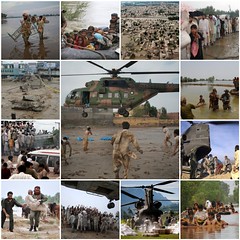
Pakistan Floods 2010 - Helpless and HelpersImage by Edge of Space via FlickrThe Islamic Republic of Pakistan is the world's sixth most-populous country. It is the second largest Muslim country in the world, after Indonesia.  The Human Development Indices of 2008 indicates that about 20% of the country's population live below the international poverty line of US$1.25.

According to the Guardian, the recent floods have decimated Pakistan: the number of people suffering could exceed 13 million - more than the combined total of the 2004 Indian Ocean tsunami, the 2005 Kashmir earthquake and the 2010 Haiti earthquake. Let's pause and let that sink for a minute.The

Guardian has also broken down the contributions and pledges, country by country here, including the funding gaps.
Radio Free Europe on Sunday reported an update on the flooding:  "Pakistani Prime Minister Yousuf Raza Gilani has said authorities now believe some 20 million people, or more than 10 percent of the country's population, have been affected by the floods, in what has become the worst humanitarian crisis in Pakistan's history."

UN officials have confirmed at least one case of the deadly water-borne disease cholera, in Mingora in the northwestern Swat Valley, while officials say other cases of the disease are suspected in flood-hit regions.  Cholera can lead to severe dehydration and death  (25-50% of typical cases are fatal) without prompt treatment.

UN Secretary-General Ban Ki-moon is reported to visit the flood-devastated areas of Pakistan to review efforts to deliver food and shelter to millions of people. The United Nations has also appealed to international donors to provide at least $460 million to provide immediate relief to victims of the flooding.

Relief We
b has posted the following list of contributions to the Pakistan flooding. The original document is
located here.


If you scroll through the list above, you will note the following striking items:
  • Kuwait has made $5,000,000 in contribution to the Pakistan relief efforts.   
  • Turkey has contributed 105 tonnes of humanitarian aid (food parcels, Kitchen Sets, Blankets, Sleeping-bag,Sponge Beds,Sleeping-bag Mat, medicine, food,clothing ) and $1,133,380. 
  • United Arab Emirates has made separate contributions through three different channels in the amount of $20,027, $137,057 and $1,362,398 respectively.
Also, the country of Azerbaijan, number #19 in the list of Organization of Islamic Conference Member States with GDP  per capita (PPP) of $5,400 has made a pledge of $1,000,000.

But only three of the top ten richest OIC member states have forked out some help. Here is the list of the Top 10 Organization of Islamic Conference Member States by GDP  at purchasing power parity (PPP) per capita:


1
 United Arab Emirates
  $45,200
2
 Qatar   
   28,300
3
 Brunei    
  23,600
4
 Bahrain   
 23,100
5
 Kuwait    
 20,300
6
 Oman 
  13,500
7
Turkey
            13,138
8
Saudi Arabia
  13,100
9
Malaysia  
 12,000
10
Libya    
 $11,800
                           
What do you make of that?

Meanwhile, the United States flood assistance to Pakistan that started in July 29 has continued to-date to an approximate commitment of $71 million (updates available in English and Urdu here).  To combat possible disease outbreaks in flooded areas, the United States has also provided $3 million to WHO for the expansion of Pakistan's Disease Early Warning System (DEWS) nationwide and to establish the first 15 treatment centers for water-borne illness, located in high risk flood-affected areas.

In Lahore, the US Consulate General held a blood drive in collaboration with the Pakistan Red Crescent society participated by staff of the Consulate General and the Lahore American school. The Red Crescent Society said they are getting many requests for blood for women who have given birth in flood affected areas.

US ConGen Karachi met the USS Peleliu, currently positioned in international waters in the Arabian Sea (a ship we're slightly acquainted with) where 19 helicopters are assisting in delivering flood aid and assistance to the victims of the flooding disaster. Photos here.


Things are tough for a lot of folks but below are some quick ways to send help if you can:

Text the word "SWAT" to telephone number 50555 using your cell phone in the US.  The text will result in a donation of $10 to the U.N. High Commission for Refugees (UNHCR) Pakistan Flood Relief Effort. Every $10 helps provide tents and emergency aid to displaced families.

Text AID to 27722 to give $10 the the World Food Programme USA, which transports food to flood victims in isolated communities

Text ZAKATUS to 50555 to donate $10 to the Zakat Foundation of America, which is providing food and clothing for flood survivors

More ways to help here through MGive.

In Pakistan, you can contribute to the Prime Minister's Fund for Flood Relief by texting the amount of your donation to 1234.


Saturday, May 1, 2010

Most Disturbing Video: Who Killed Louis Maxwell?

Louis Maxwell graduated from Miami Central High School in 2000.  He was reportedly popular among his UN colleagues. During the most recent attack at the UN compound in Afghanistan, he fought heroically to defend it.

This report says that "One of the main questions investigators are examining is how Maxwell, who defended the compound from a rooftop, ended up being killed at street level when the attack was over. Afghan interior ministry spokesman Basharay said at least one of the attackers was wearing an Afghan uniform. “We have accepted that there was a bomber wearing a police uniform and he was shooting everyone that was coming in front of him. Perhaps he has shot the UN security guard. But before saying that, we need to investigate this,” Basharay said. But the former UN officials said senior Afghan officials were uncooperative in providing information after the attack. “We were completely stonewalled,” one former UN official told NBC News."

A disappointing response from a ministry spokesman (did we train him, too?). The least they could have done, is be more cooperative in the investigation no matter where it leads instead of saying "Perhaps he has shot the UN security guard." Perhaps?

I'm trying to get this straight in my head - if this is not a case of "perhaps," as Mr. Basharay has indicated  and if Mr. Maxwell was indeed shot by "friendlies," was he shot by one of those guys paid and trained with USG money in Afghanistan?   

Watch the video below and see if this does not disturb you.  I really am appalled and upset by this. This young man and his family needs more than a "Perhaps."  Three days ago, Afghanistan has also officially denied the role of its police force in the death of the other four UN employees in the October attack. It seems to me that this one as well as the "abducted" election process were all perpetrated by foreigners. Anything else that happens in the future can also be blamed on the foreigners.  Will they ever own up to anything there?   I am terribly sick of this war.


Wednesday, March 24, 2010

Tony Lake Goes to UNICEF

Lake (left) meets with Bill Clinton and Leon P...Image via Wikipedia
A statement from the UN:  16 March 2010 – Secretary-General Ban Ki-moon today appointed the United States foreign policy adviser, diplomat and academic Anthony Lake as the next Executive Director of the United Nations Children’s Fund (UNICEF).

“He brings with him a wealth of experience after a long and distinguished career with the United States Government,” the Secretary-General said today in New York at his monthly press briefing to journalists.

Mr. Lake, 70, joined the US Foreign Service in 1962 and served as National Security Adviser to former President Bill Clinton. He spent nine years on the board of the US Fund for UNICEF, including a stint as chair from 2004-2007. Most recently he has served as a professor at Georgetown University’s School of Foreign Service, in Washington D.C.

Mr. Lake replaces Ann Veneman, a former US Secretary of Agriculture, whose term as chief of UNICEF expires on 30 April.

Mr. Ban today thanked Ms. Veneman for her “immense dedication, energy and determination to improve the lives of children around the world. She leaves behind an organization well-equipped for the enormous challenges ahead.”

The Secretary-General appoints the UNICEF chief in consultations with the board of the UN agency.


Friday, March 12, 2010

Nominations Confirmed: DeLisi, Welters, Kelly, Anderson, DiCarlo, Booth

The United States Senate confirmed the following State Department nominations on March 10:  


PN1183 *      Federal Democratic Republic of Nepal
Scott H. DeLisi, of Minnesota, a Career Member of the Senior Foreign Service,
Class of Minister-Counselor, to be Ambassador Extraordinary and Plenipotentiary of
the United States of America to the Federal Democratic Republic of Nepal.

PN1184 *      Republic of Trinidad and Tobago
Beatrice Wilkinson Welters, of Virginia, to be Ambassador Extraordinary and
Plenipotentiary of the United States of America to the Republic of Trinidad and
Tobago.

PN1219 *      STATE/OSCE
Ian C. Kelly, of Maryland, a Career Member of the Senior Foreign Service, Class of
Minister-Counselor, to be U. S. Representative to the Organization for Security
and Cooperation in Europe, with the rank of Ambassador.

PN1242 *      STATE/UN
Brooke D. Anderson, of California, to be Alternate Representative of the United
States of America for Special Political Affairs in the United Nations, with the
rank of Ambassador.

PN1243 *      STATE/UNGA
Brooke D. Anderson, of California, to be an Alternate Representative of the United
States of America to the Sessions of the General Assembly of the United Nations
during her tenure of service as Alternate Representative of the United States of
America for Special Political Affairs in the United Nations.

PN1244 *      STATE/UN
Rosemary Anne DiCarlo, of the District of Columbia, a Career Member of the Senior
Foreign Service, Class of Minister-Counselor, to be the Deputy Representative of
the United States of America to the United Nations, with the rank and status of
Ambassador Extraordinary and Plenipotentiary, and the Deputy Representative of the
United States of America in the Security Council of the United Nations.

PN1245 *      STATE/UNGA
Rosemary Anne DiCarlo, of the District of Columbia, a Career Member of the Senior
Foreign Service, Class of Minister-Counselor, to be Representative of the United
States of America to the Sessions of the General Assembly of the United Nations,
during her tenure of service as Deputy Representative of the United States of
America to the United Nations.

N1261 *      Federal Democratic Republic of Ethiopia
Donald E. Booth, of Virginia, a Career Member of the Senior Foreign Service, Class
of Minister-Counselor, to be Ambassador Extraordinary and Plenipotentiary of the
United States of America to the Federal Democratic Republic of Ethiopia.


CONFIRMATIONS -- (Senate - March 10, 2010)
[Page: S1413]  GPO's PDF


Friday, February 12, 2010

Nomination Confirmed: Betty King


One of the 27 nominees confirmed by the Senate on February 11 was Betty King for the US Mission in Geneva:


PN1111 *      DEPARTMENT OF STATE
Betty E. King, of New York, to be Representative of the United States of America
to the Office of the United Nations and Other International Organizations in
Geneva, with the rank of Ambassador.


Related Posts: 


Wednesday, December 30, 2009

Officially Out: Jide Zeitlin Withdraws Nomination for “Personal Reasons”

Josh Rogin of The Cable had an exclusive yesterday on Jide Zeitlin, President Obama’s nominee as US Representative to the United Nations for U.N. Management and Reform with the rank of Ambassador (Controversial Obama U.N. nominee withdraws for "personal reasons," official says | The Cable | December 29, 2009).


The report cites Zeitlin’s trouble in India (the case was settled between IMIL and Shatakshi Contractors, according to settlement documents obtained by The Cable) and his earlier legal problem with American Tower. Also this:
"But concerns about his nomination grew as rumors swirled around Washington and New York that Zeitlin was engaged in other activities that called into question his overall character and also may have included elements of identity fraud.

Specifically, one woman contacted several government offices and multiple news outlets, including The Cable, with allegations that Zeitlin had used deception to lure her into what eventually she claims was a romantic relationship. Those allegations could not be independently confirmed by The Cable. The administration official declined to comment as to whether they had been investigated as part of Zeitlin's vetting process or afterwards. In his letter, Zeitlin said his withdrawal was due to "personal reasons," the administration official said.


We have not seen the official statement of withdrawal sent to the Senate yet, but folks are on a holiday break.  And -- Josh’s report includes a blurb from White House spokesman Tommy Vietor when contacted about the story -- "We appreciate his willingness to serve and wish him the best of luck in the future."


Related Posts:
Related Item:

January 21, 2010 - Withdrawals Sent to the Senate


Tuesday, December 22, 2009

UN Undiplomatic Mess Refuses to Go Away

http://en.wikipedia.org/wiki/File:Emblem_of_th...Image via Wikipedia
Where the saga of former Ambassador Peter Galbraith, Kai Eide, and the United Nations continue ...
December 10 | According to Peter Galbraith, he initiated a wrongful dismissal action against the United Nations.
December 11 | The Guardian reported that Kai Eide, the top United Nations official in Afghanistan who was criticised for his handling of allegations of fraud in the country's presidential election, will not be renewing his contract.
December 11 | Inner City Press had this piece: Galbraith Claims Disclosed Oil Interest to UN, Eide Leaked Before Leaving? | “Inner City Press has asked the UN if Galbraith disclosed the oil interest. UN Ethics Officer Robert Benson responded that Galbraith filed a form, but that its contents will not be disclosed, even to the UN's executive 38th floor, apparently. The financial disclosure forms are filed with PriceWaterhouseCoopers. It is unclear who in the UN system vets them for conflicts of interest. […]Still, UN officials have bad mouthed Galbraith both on and off the record. At a press conference at UN headquarters, the number two official of UN Peacekeeping Edmond Mulet said that Galbraith had an ulterior motive which would later be revealed. And a senior UN official from the 38th floor called UN correspondents to make them aware of the Norwegian stories.”
December 14 | Josh Rogin of The Cable interviewed Galbraith | Galbraith: Eide was fired | “Kai Eide, the top U.N. official in Afghanistan, was forcibly removed and did not resign voluntarily as he claims, according to his former deputy and "frenemy," Peter Galbraith. "This was involuntary and inevitable, ever since the end of September," said Galbraith in an interview with The Cable. Relaying information from his discussions with U.N. staff on the ground in Kabul, Galbraith said that U.N. Secretary General Ban Ki-Moon has made it clear that he wants to announce Eide's successor during January's London conference on Afghanistan.”
December 16 | NYT | U.N. Officials Say American Offered Plan to Replace Karzai | “As widespread fraud in the Afghanistan presidential election was becoming clear three months ago, the No. 2 United Nations official in the country, the American Peter W. Galbraith, proposed enlisting the White House in a plan to replace the Afghan president, Hamid Karzai, according to two senior United Nations officials.”
The two senior UN officials were Kai Eide, Norwegian diplomat and the topdog at UNAMA in Kabul who is feuding with Galbraith and Vijay Nambiar, chief of staff to the United Nations secretary general, Ban Ki-moon. According to the report, Nambiar was aware of Mr. Galbraith’s proposal to go to Vice President Joseph R. Biden Jr. and later learned of Mr. Karzai’s anger over the episode. Mr. Nambiar said it played a role in Mr. Galbraith’s firing.
December 17 | NYT | Diplomat to Challenge Dismissal by U.N. After Afghan Vote | “Peter W. Galbraith, the American diplomat who was dismissed by the United Nations after exposing voter fraud this fall after the Afghan presidential election, has decided to challenge his dismissal.”
December 18 | From the UN Spokesperson | Spokesperson: “This was circulated quite widely, I believe. The reason Peter Galbraith’s appointment as Deputy Special Representative of the Secretary-General for the United Nations Assistance Mission in Afghanistan (UNAMA) was terminated was because the Secretary-General determined that such action would be in the interests of the Organization. And then we added, further elaboration would not be appropriate at this time since Mr. Galbraith has chosen to challenge the termination of his appointment. That’s what we said.” December 19: Inner City Press: As UN Dodges Questions on Galbraith, Stonewalling or Whistleblowing? | "I'm sick of Peter Galbraith," a senior UN official told Inner City Press on December 18. "It's over. I don't think we should be commenting on it anymore." Compared to the bloodshed in Afghanistan, the firing of one UN official does seem small. But at times it appears that the "it" being avoided is the indisputably fraudulent election of Hamid Karzai, and the UN's role in it.”
December 21 | Peter Galbraith | Special to Sphere: 'I Never Proposed to Oust Karzai’ | Readers deserve context in order to understand a complex story. In this case, the Times deliberately excluded information that would have presented the accusations in a much different light. The truth is that I never proposed to oust Karzai, but instead tried to resolve a looming constitutional crisis caused by Karzai's maneuvering to stay in office a year beyond the end of his legal term -- without submitting himself to the inconvenience of an election. […] It strains credulity to believe that I proposed a plot to oust Karzai to a lesser embassy official (as the Times reports) and he never informed his ambassador or Holbrooke. To be clear, I never proposed to oust Karzai to anyone in the U.S. government, and any discussion would have been about the constitutional issues involved in holding a runoff in May 2010. (Note: NYT reported that Galbraith discussed his plan with Frank Ricciardone, the deputy American ambassador in Kabul). […] Mr. Eide is quoted in the Times as saying President Karzai was "deeply upset" about my supposed plan but fails to disclose how Mr. Karzai would have learned of this very private conversation between Mr. Eide and myself.
December 21: Gerard Russell Former British and United Nations Diplomat | Afghanistan's Elections: How Dr. House Can help: “UN internal division between Kai Eide and Peter Galbraith being still in the news, though, it's impossible for me to forget it. (I am also reminded of it every time I look at my bank balance, since my unhappiness with that process and its aftermath led me to resign from the UN before I started to receive a stipend from Harvard. And as the poet Juvenal said, integrity is all very well, but it doesn't pay your bills.) I am happy to pass over the Eide-Galbraith story, which was an unpleasant enough experience at the time without my re-living it here. But the fact that Galbraith has been the only person to have lost his job as a result of the fraud in those elections -- this is not about past history. It's about over $200 million in donor funds that were, in part, misused. This was an Afghan election, an exercise which was rightly led by Afghans (even if the Electoral Commission's head was appointed by one of the candidates, which was always an obvious flaw in the process). But it was also a donor-funded project, and donors have the right -- even the duty -- to verify that taxpayers' money was well spent." (Um, ‘xcuse me, side quiz -- where was SIGAR on this?).
Mr. Galbraith reportedly said that he has begun UN legal proceedings not to get his job back - but to get justice.
Well, this is bound to be a painful experience for the United Nations going into the new year. Who's running this show from the 38th floor, anyways? They may not realize this yet, but every time their officials disses Peter Galbraith, readers and viewers are also reminded of that inglorious Afghanistan election conducted under UNAMA’s watch. I wonder if there's anyone out there who'll get out of this meze fight with a clean shirt?