

Via USAspending.gov


According to the Prime Award spending data from USAspending.gov, the following organizations are the State Department's Top 10 Assistance Recipients in FY2010.
 | |
| screen capture from usaspending.gov |
According to the Prime Award spending data from USAspending.gov, the State Department had 81,323 transactions in the amount of $10,949,985,424 in FY2010 (October 1, 2009-September 30, 2010). Below are the Top 10 Contractors at State.
 |
| Screen capture from usaspending.gov |
The State Department's actual and projected numbers of Foreign Service and civil service personnel for fiscal years 2006 through 2014.
 | ||
| Extracted from GAO-11-241, Jan 25, 2011 |
 |
| Source:State Department/EUR |
In the FY2011 request, Afghanistan tops the list at nearly $4 billion, followed by Pakistan at $3 billion. This is in addition to significant supplemental funds—$2 billion and $370 million, respectively—requested for these countries for FY2010. Israel and Egypt would continue to receive significant funds, primarily for Foreign Military Financing, at $3 billion and $1.56 billion, respectively. Jordan would also continue to rank high on the list, with $682.7 million requested. Iraq, which dropped out of the top 10 list in FY2010 (though a request for more than $2 billion in FY2010 supplemental funds is pending), would be the fifth largest recipient of aid in FY2011, under the Administration request. Assistance to the other top recipients—Kenya, Nigeria, Ethiopia, and South Africa—is targeted primarily at HIV/AIDS and other health programs.

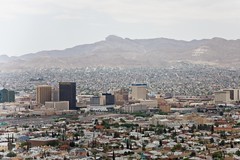 Image by charlie llewellin via Flickr
The consular section in Ciudad Juarez is the largest in the world with 50 consular officers, six EFMs, and 116 LE staff, yet its staffing is still too small for the workload (see the section of this report on IVs for a complete discussion). Despite workload pressures, the consular section is doing a remarkable job under excellent leadership. The consular section chief and IV unit chief work effectively as a team to manage the massive challenges facing the IV unit. However, the other parts of the consular section are also under stress. NIV work increased 31.4 percent to 121,010 cases in FY 2008.
The NIV unit copes with this increase with the help of a steady stream of TDY ELOs from other posts in Mexico.This NIV workload increase was not surprising because Ciudad Juarez was the first post in Mexico to start issuing an improved version of the BCC on April 1, 1998, and therefore the first post to experience a surge from the 10-year replacement program. The workload rose dramatically in 1999 (to 308,370 cases) and peaked in 2001 (at 411,743 cases). This means Ciudad Juarez is likely to be hit by a huge increase in NIV work in the next three years. In addition, analysis shows that much of the Ciudad Juarez FY 2008 NIV workload increase is, in fact, coming from first time applicants, and this means that NIV levels after the BCC renewal surge ends are likely to remain higher than previously thought, requiring additional permanent resources.[…]Immediately following the visit by the OIG team to Ciudad Juarez, the consulate staff moved into a new OBO-built facility. This vast facility -- with 87 visa interview windows -- gives the staff the capability to handle the huge numbers of consular visitors and provides for future growth.
The consulate general in Ciudad Juarez processes all IVs for Mission Mexico, and in FY 2008 it handled 149,014 applications, 19 percent of all IVs worldwide. The workload was greater than that of the next three largest IV operations in Santo Domingo, Manila, and Ho Chi Minh City combined. IV workload has fluctuated greatly in the last 10 years in Ciudad Juarez, but recently increased dramatically. The Department will need to increase significantly officer and LE staffing in Ciudad Juarez to rightsize the operations.
Here is a nugget from the report that you may or may not know:
US Mission Mexico, consisting of an embassy, seven consulates general, two consulates, and 14 consular agencies, is one of the largest U.S. missions in the world. The magnitude of the consular operation is staggering: 20 percent of all arrests of Americans abroad occur in a single consular district in Tijuana. Consulate General Ciudad Juarez processes more IVs than any other post in the world. Embassy Mexico City processes more NIVs than any other post in the world except Embassy Seoul.
Because of the consular workload, 10 percent of all entry-level officers (ELO) in the U.S. Foreign Service are assigned to Mexican posts. With such numbers, Mexican experience will have an important influence on the next generation of Foreign Service officers.

2,730 missions | 0 casualties | 0 incidents with deadly force
The Department’s OIG office has recently released its inspection report of Embassy Abuja and Consulate General Lagos, Nigeria (ISP-I-08-25A) from July 2008 Living conditions in the country are difficult and the work is not easy. By one estimate I've heard, post there receives about 150 complaints per day on Nigerian scams alone. Both Lagos and Abuja are 25% hardship differential posts. Excerpt from the report below:

 Image via Wikipedia
from Remarks by Michael J. Jacobsen Chief, Consular Section, U.S. Consulate General Guangzhou at U.S.-China Visa Conference | December 1, 2009
What type of jobs are there?
 (Click on image for larger view)
 (click on image to see larger view)
Extracted from CRS: State, Foreign Operations, and Related Programs: FY2009 Appropriations | PDF

This list of the State Department’s Top 10 Contractors is from USAspending.gov. You can also view the Contractor Profiles in the website. The Federal Funding Accountability and Transparency Act of 2006 (Transparency Act) requires a single searchable website, accessible by the public for free that includes for each Federal award: 1. the name of the entity receiving the award; 2. the amount of the award; 3. information on the award including transaction type, funding agency, etc; 4. the location of the entity receiving the award; 5. a unique identifier of the entity receiving the award. USAspending.gov, a re-launch of www.fedspending.org, provides this information to the public, as collected from federal agencies, in an easy to use website. The data is largely from sources: the Federal Procurement Data System, which contains information about federal contracts; and the Federal Assistance Award Data System, which contains information about federal financial assistance such as grants, loans, insurance, and direct subsidies like Social Security.
The website is searchable by contractor, place of performance, by agency; also by competition process, type of contract or product/service purchased.
Click here for an explanation of the data included in the website.

From the CRS Report: State Department and USAID disbursements represent only about 30% of total U.S. foreign assistance in 2007 and 64% of economic (non-military) aid. The increasing portion of assistance disbursed by U.S. military entities since FY2002 can be largely attributed to dramatic increases in military and reconstruction assistance associated with the wars in Iraq and Afghanistan, and appears to be on the decline. The impact of these wars on foreign assistance levels is demonstrated by Figure 2, which compares the same FY2001 agency disbursement chart in Figure 1 with a chart showing FY2007 disbursements without aid to Iraq and Afghanistan. Excluding funding to these two countries more than doubles the share of aid disbursed by State, from 11% to 25%, and gives DOD the third largest share, after USAID and State. Furthermore, it is important to note that much of the funding disbursed by DOD is military assistance, for which State plays a key role in allocation.

CRS: Foreign Aid Reform: Agency Coordination | August 7, 2009 PDF
 US Embassy Abuja via Facebook
Despite a robust package of incentives, staffing Lagos and Abuja was hard, with many officers in stretch assignments, working out-of-cone, on excursion tours, or on directed first assignments. These staffing woes, an operating budget that was lagging behind program funding, and aging facilities in Lagos reduced the efficiency of diplomatic operations. Both the consulate office building and many U.S. Government-owned residences in Lagos had suffered physical neglect, based partly on the view that operations in Lagos would get smaller when the Embassy moved to Abuja in 2000. This shrinkage is unlikely to happen. Inspection of Embassy Abuja and Consulate General Lagos, Nigeria (ISP-I-08-25A) Excerpted from Office of Inspector General Semiannual Report to the Congress, April 1, 2008 to September 30, 2008 | PDF
#1. South Central Asian Affairs - 44% (see SCA countries here)
#2. African Affairs - 39% (see AF countries here)
#3. Near Eastern Affairs – 27% (see NEA countries here)
#4. Western Hemisphere Affairs – 25% (see WHA countries here)
#5. East Asian Pacific Affairs – 24% (see EAP countries here)
#6. European and Eurasian Affairs – 18% (see EUR countries here)
 June 2009
State department/Family Liaison Office
June 2009
State department/Family Liaison Office
Below is the overall ranking by geographic bureau with the percentage of family members working inside US missions as well as those working in the local economy and the self-employed. You will note that except for the switch between EAP (#4) and WHA (#5), the ranking below is identical to the working inside the mission ranking above.
Family Members Working at Post (overall by geographic bureau)
#1. South Central Asian Affairs - 64% (see SCA countries here)
#2. African Affairs - 56% (see AF countries here)
#3. Near Eastern Affairs – 44% (see NEA countries here)
#4. East Asian Pacific Affairs – 37% (see EAP countries here)
#5. Western Hemisphere Affairs – 36% (see WHA countries here)
#6. European and Eurasian Affairs – 32% (see EUR countries here)
The interesting thing is that the South Central Asian (SCA) bureau (covering Afghanistan*, Bangladesh, Bhutan, India, Kyrgyzstan, Kazakhstan, Maldives, Nepal, Pakistan*, Sri Lanka, Tajikistan, Turkmenistan, and Uzbekistan) has the lowest number of family members present at posts (430 individuals) but has the highest rate of employment. (As an aside here -- I should note that Afghanistan and Pakistan are fully unaccompanied assignments as of February 2009 and adult EFMS are only authorized on a case by case basis by “M;” apparently EFMs must secure employment at missions (I’m presuming prior to authorization). In Afghanistan, both the Ambassador’s wife and the Deputy Ambassador’s wife are reportedly working inside the US mission in Kabul.)
On SCA, although not all family members get to accompany their employee-spouses to posts, almost half of those that get to go, are able to work within the mission (44%) or in the local economy (20%).
The most numbers of family members (3,249) according to current data are located in European and Eurasian posts -- at some 30 countries from Albania to the Ukraine. But the EUR bureau has the lowest percentage of employment both inside US missions (18%) and outside (local economy employment is at 14%). Part of this may have to do with language barriers, preference for hiring EU nationals in EU countries, bilateral work agreement restrictions, etc. I can't say for sure. What is clear is if you are heading to a European post, you can expect two things: 1) high standard of living in a good number of posts (also often expensive); and 2) over 2/3 of overall family members will be unemployed during the tour.
I guess in real terms that means -- family members will have time to hang around and have coffee, except that having coffee will be too expensive a past time for many.
 Image via Wikipedia
 2007
(217 Posts reporting October 2007)
2007
(217 Posts reporting October 2007)


